1. Okwu mmalite
This user manual provides comprehensive instructions for the safe and efficient operation of your FOVAL 12V to 48V DC to DC Charger. This 800W ultra-fast battery charger is designed to replenish various 48V battery types, including LiFePO4, Lead-Acid, AGM, Gel, and Lithium batteries, making it ideal for RVs, CVs, trailers, boats, and trucks.

Image: FOVAL 12V to 48V DC to DC Charger, showcasing ya kọmpat na nke siri ike imewe.
2. Atụmatụ igodo
- Ultra Fast-Speed Charging: The 800W alternator charger replenishes house batteries by 1kWh during a 75-minute drive. This efficiently utilizes excess alternator energy, minimizing waste and enhancing energy utilization for an eco-friendly and efficient journey.
- Compatible Multiple Battery Types: The DC-DC battery charger is compatible with various 48V battery types, including AGM, Gel, SLA, CA, and Lithium-ion batteries. It tailors the most suitable charging scheme for different battery types, ensuring a safer and more efficient charging process.
- Ọtụtụ Nchekwa Nchekwa: Built-in safety features such as overheating, short circuit, overvoltage, na undervoltage ensure the DC charger maintains an efficient and stable working state during driving, contributing to a safer experience.
- Protect and Extend Battery Life: The charger identifies when the generator is started, preventing the start battery from over-discharge and protecting the generator. Its advanced 3-stage charging technology intelligently adjusts the charging process to prevent overcharging, over-discharging, and overheating, thereby extending battery service life.
- Ọ dị mfe ịwụnye na iji: The 12V DC to 48V DC charger is lightweight, compact, sturdy, and durable, designed to adapt to various extreme environments. It can be easily installed and put into use in recreational vehicles, ships, or commercial vehicles.

Image: Diagram illustrating the charger's high-speed charging capability, replenishing 1kWh of electricity.
3. Ozi nchekwa
The FOVAL DC to DC Charger incorporates a 7-point safety system to ensure reliable and secure operation. Always adhere to safety guidelines during installation and use.

Image: Visual representation of the charger's 7-Point Safety System.
The integrated safety system includes:
- Nchekwa okirikiri dị mkpụmkpụ
- N'elu-Voltage Nchedo
- Nchekwa oke ibu
- N'okpuru-Voltage Nchedo
- Nchekwa gafere ugbu a
- Nchekwa oke okpomọkụ
- Metal Case Protection
4. Ngwaahịa gafereview na akụrụngwa
Familiarize yourself with the various components and connection points of your FOVAL DC to DC Charger.
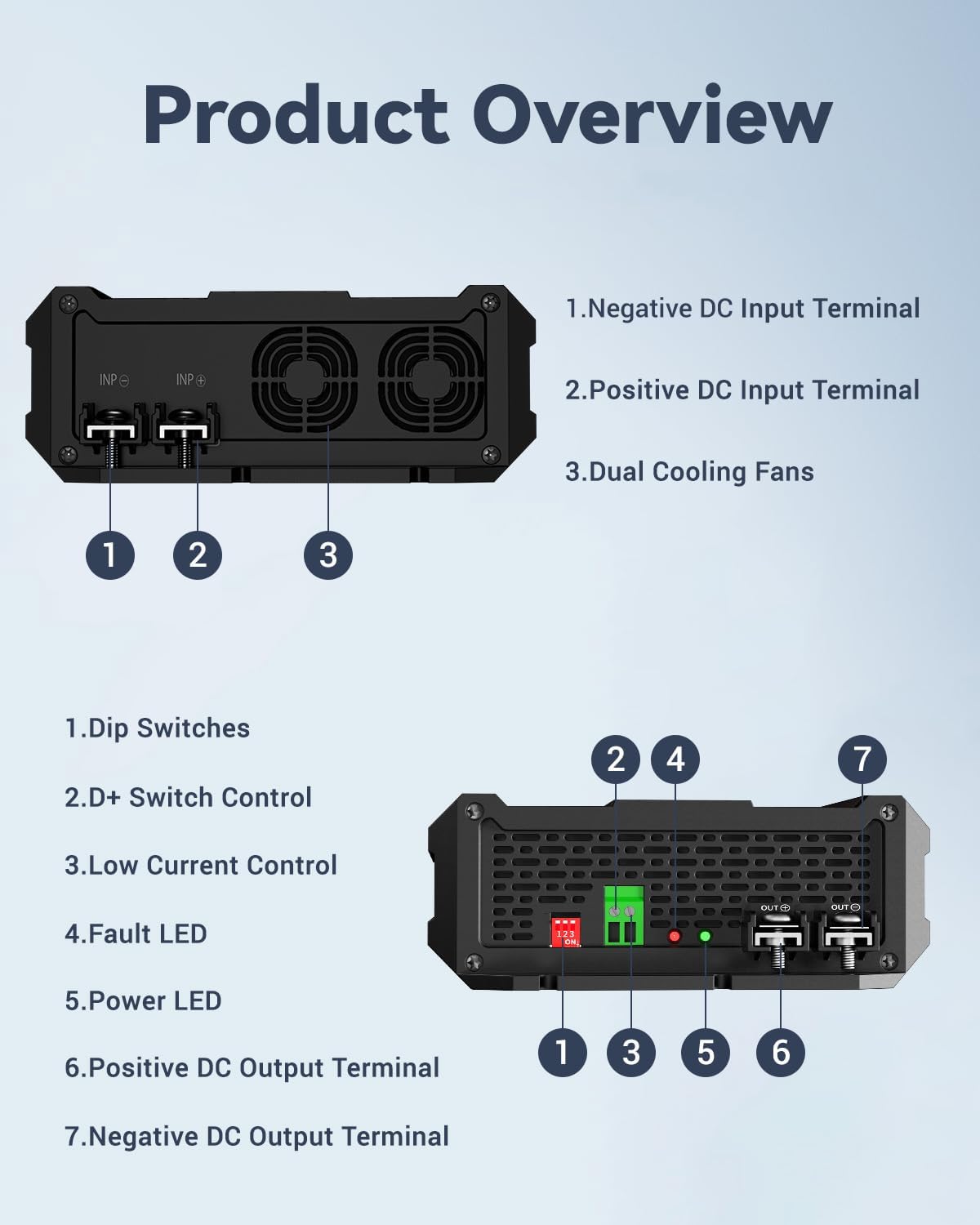
Foto: Zuru ezu view of the charger's input/output terminals, cooling fans, and control switches.
Njikwa panel ihu na ihe ngosi:
- Mgbanwe mgbanwe: Used for configuring battery type and charging parameters.
- D+ Switch Control: For alternator detection and control.
- Low Current Control: Adjusts charging current.
- Ikanam mmejọ: Indicates operational errors or warnings.
- Igwe ọkụ ọkụ: Na-egosi ọkwa ike.
- Positive DC Output Terminal: Connects to the positive terminal of the house battery.
- Negative DC Output Terminal: Connects to the negative terminal of the house battery.
Akụkụ azụ azụ:
- Negative DC Input Terminal: Connects to the negative terminal of the starter battery/alternator.
- Positive DC Input Terminal: Connects to the positive terminal of the starter battery/alternator.
- Ndị Fans jụrụ oyi abụọ: Provide active cooling for optimal performance.
5. Ntọala na nwụnye
Proper installation is crucial for the performance and safety of your charger. Refer to the diagram below for a typical installation setup.

Image: Diagram showing the installation of the FOVAL DC-DC Charger connecting a starter battery to a house battery in an RV.
Nzọụkwụ nwụnye:
- Ịkwanye: Choose a dry, well-ventilated location for mounting the charger, away from direct heat sources or flammable materials. Ensure adequate space around the unit for airflow to the cooling fans.
- Input Connection (12V DC): Connect the positive input terminal (INP+) of the charger to the positive terminal of your starter battery or alternator. Connect the negative input terminal (INP-) to the negative terminal of your starter battery or vehicle chassis ground. Use appropriately sized cables to minimize voltage dobe.
- Output Connection (48V DC): Connect the positive output terminal (OUT+) of the charger to the positive terminal of your 48V house battery bank. Connect the negative output terminal (OUT-) to the negative terminal of your 48V house battery bank.
- D+ Control (Optional): If your vehicle's alternator provides a D+ signal, connect it to the D+ switch control terminal on the charger. This allows the charger to detect when the engine is running and optimize charging.
- Nhazi Mgbanwe Dip: Before powering on, configure the dip switches according to your specific 48V battery type (AGM, Gel, SLA, CA, Lithium-ion) to ensure correct charging parameters. Refer to the charger's label or a separate configuration table for specific settings.
- Ike izizi: Once all connections are secure and dip switches are set, power on your vehicle. The charger's Power LED should illuminate, indicating proper operation.
Warning: Incorrect wiring can cause damage to the charger, batteries, or vehicle. If unsure, consult a qualified technician.
6. Ntuziaka ọrụ
The FOVAL DC to DC Charger operates automatically once properly installed and configured. It employs a 3-stage charging technology to optimize battery health and longevity.
6.1. Ọrụ akpaaka
The charger automatically detects the presence of an input voltage from the starter battery/alternator and begins charging the house battery bank. It intelligently adjusts the charging process based on the battery's state of charge and type.
6.2. Multi-Battery Compatibility
This charger is designed to work with a wide range of 48V battery chemistries. Ensure the dip switches are correctly set for your battery type.

Image: Visual representation of the charger's compatibility with various battery types.
Ụdị batrị akwadoro:
- Lithium Battery (LiFePO4, Lithium-ion)
- Lead-Acid Battery (SLA, CA)
- Gel batrị
- Batrị AGM
6.3. Ịchaji Stages
The charger utilizes an advanced 3-stagusoro ịchaji:
- Nnukwu ego: Delivers maximum current to rapidly bring the battery to approximately 80% of its capacity.
- Ụgwọ mmịpụta: A na-akwụ ụgwọ n'otu mbelataasing current to bring the battery to 100% capacity, preventing overcharging.
- N'elu mmiri n'Aka: Maintains the battery at full charge with a low, constant voltage, na-akwụghachi ụgwọ maka mwepụ onwe onye.
7. Nlekọta
The FOVAL DC to DC Charger requires minimal maintenance. Regular checks can help ensure its longevity and optimal performance.
- Ịdị ọcha: Keep the charger clean and free from dust and debris. Use a dry cloth to wipe the exterior. Do not use liquid cleaners.
- Njikọ: Periodically inspect all cable connections to ensure they are tight and free from corrosion. Loose connections can lead to overheating and inefficient charging.
- Igwe ikuku: Ensure that the cooling fans and ventilation openings are not obstructed. Blocked airflow can lead to overheating and reduced performance.
- Ọnọdụ gburugburu: Avoid exposing the charger to extreme temperatures, direct sunlight, or excessive moisture.
8. Nchọpụta nsogbu
If you encounter issues with your FOVAL DC to DC Charger, refer to the following common problems and solutions. If the problem persists, contact customer support.
| Nsogbu | Ihe nwere ike ime | Ngwọta |
|---|---|---|
| Charger not powering on (Power LED off) | Enweghị ntinye voltage; Loose connections; Blown fuse (external); Internal fault. | Lelee ntinye voltage from starter battery/alternator. Verify all connections are secure. Check any inline fuses on the input line. If problem persists, contact support. |
| Fault LED illuminated | Overheating; Over-voltage/N'okpuru voltage; Short circuit; Overload. | Check for obstructions around cooling fans. Verify input/output voltages are within specified range. Disconnect output to check for short circuit. Reduce load if possible. Allow unit to cool down. |
| Nchaji nwayọ ma ọ bụ enweghị chajị | Incorrect dip switch settings; Undersized cables; Battery fault; Alternator issue. | Verify dip switch settings match battery type. Ensure cables are of adequate gauge. Have battery tested. Check alternator output. |
| Excessive heat from unit | Poor ventilation; Overload; Internal fan failure. | Ensure adequate airflow around the unit. Check if the load exceeds the charger's capacity. Listen for fan operation; if not spinning, contact support. |
9. Nkọwapụta
Technical specifications for the FOVAL 12V to 48V DC to DC Charger.
| Njirimara | Uru |
|---|---|
| Ụdị | FOVAL |
| Agba | Uhie |
| Akụkụ ngwaahịa | 11.65"D x 6.5"W x 2.48"H |
| Mmepụta Voltage | 48 volts (DC) |
| Nkọwapụta Met | CE, FCC, RoHS |
| Ntinye Voltage | 12 volts (DC) |
| Mpụta ike | 800W |
10. Ngwa
The FOVAL 12V to 48V DC to DC Charger is versatile and suitable for a variety of mobile and off-grid applications.

Foto: Examples of vehicles and setups where the charger can be used.
- Commercial Vehicles (CV)
- SUVs
- Ụgbọ mmiri
- Ihe nkiri
- RVs (Recreational Vehicles)
- Ụgbọ ala
11. Akwụkwọ ikike na nkwado ndị ahịa
FOVAL provides a Akwụkwọ ikike nke ọnwa 24 for this 800W DC to DC charger, ensuring peace of mind regarding product quality and performance.
For any inquiries, technical assistance, or warranty claims, please contact FOVAL customer service. We are committed to providing 100% satisfaction.
Ozi mkpọtụrụ:
Please refer to the product packaging or the official FOVAL websaịtị maka nkọwa kọntaktị kachasị ọhụrụ maka nkwado ndị ahịa.


