Okwu mmalite
Thank you for choosing the YESWELDER MIG-205DS PRO Multi-Process Welder. This machine is designed for versatility, offering 5-in-1 welding capabilities including Gas MIG, Flux Core MIG, Spool Gun MIG, Lift TIG, and Stick welding. This manual provides essential information for the safe and efficient operation, setup, maintenance, and troubleshooting of your welding machine. Please read this manual thoroughly before operation to ensure proper use and to prevent injury or damage.
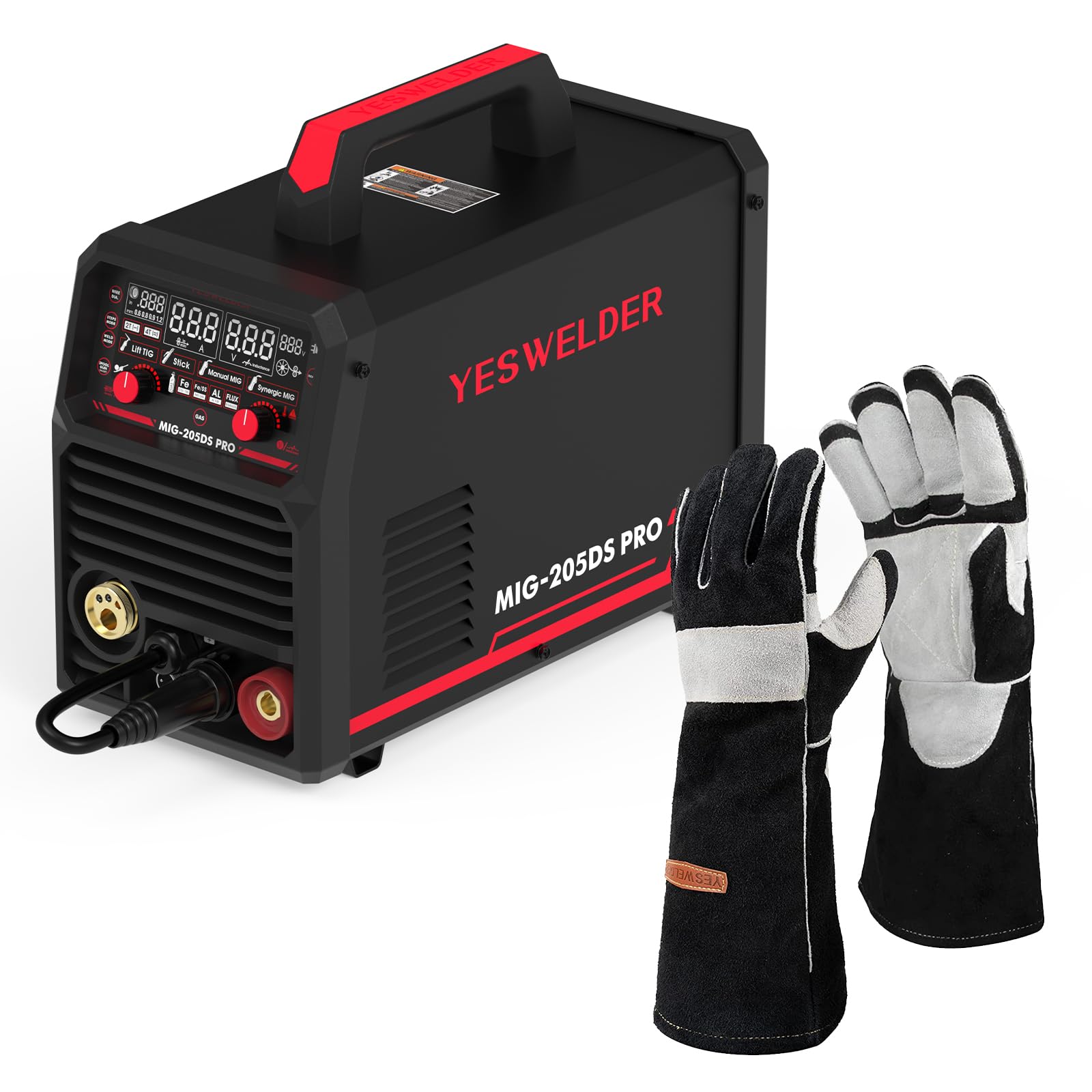
Image: The YESWELDER MIG-205DS PRO Multi-Process Welder, showcasing its compact design and various connection points for different welding processes, along with included accessories like the MIG torch, ground clamp, and electrode holder.
Ozi nchekwa
Welding can be dangerous. It is crucial to follow all safety precautions to prevent serious injury or death. Always wear appropriate personal protective equipment (PPE) including a welding helmet with proper shade, welding gloves, protective clothing, and safety shoes. Ensure adequate ventilation to avoid inhaling welding fumes. Keep a fire extinguisher nearby. Disconnect power before performing any maintenance or service.
- Ọkụ eletrik: Can kill. Do not touch live electrical parts. Wear dry insulating gloves and clothing.
- Uzuoku na gas: Can be hazardous to your health. Keep your head out of the fumes. Use enough ventilation or exhaust at the arc to keep fumes and gases away from the breathing zone.
- Arc Rays: Can burn eyes and skin. Wear a welding helmet with a proper shade filter. Wear protective clothing to protect your skin.
- Ọkụ na mgbawa: Ọkụ ọkụ nwere ike ibute ọkụ ma ọ bụ mgbawa. Debe ihe ndị nwere ike ire ọkụ n'ebe dị anya n'ebe a na-agbado ọkụ. Nwee ihe mgbanyụ ọkụ dị mfe.
- Akụkụ na-ekpo ọkụ: Can cause severe burns. Do not touch hot parts with bare hands.

Image: A pair of black and gray YESWELDER MIG welding gloves, designed for hand protection during welding operations. These gloves feature a durable leather construction with reinforced palms and fingers.

Image: A diagram illustrating the dimensions of the YESWELDER MIG welding gloves, showing a total length of 16 inches, a palm width of 6.7 inches, and a finger length of 7.5 inches, indicating their extended coverage and fit.
Ngwaahịa gafereview
The MIG-205DS PRO is a versatile welding machine featuring advanced IGBT inverter technology for stable performance. It includes a large digital display for clear parameter adjustments and monitoring. The machine supports multiple welding processes, making it suitable for various applications.
Akụkụ ndị bụ isi:
- 5-in-1 Multi-Process: Gas MIG, Flux Core MIG, Spool Gun MIG, Lift TIG, Stick.
- Abụọ Voltage Input: 110V/220V automatic detection.
- Advanced Digital Display: Enhanced clarity for settings.
- IGBT Inverter Technology: For reliable and stable arc performance.
- Synergic Control: Simplifies parameter setup for MIG welding.

Foto: A nso nso view of the YESWELDER MIG-205DS PRO's upgraded large LED digital display, showing various welding parameters and mode selections such as Lift TIG, Stick, Manual MIG, and Synergic MIG, along with material and gas settings.

Image: A visual representation of the five welding processes supported by the YESWELDER MIG-205DS PRO: Spool Gun Welding, Gas MIG Welding, Flux Core Welding, Stick Welding, and Lift TIG Welding, each depicted with an example of the welding process.
Melite
1. Mwepu na nyocha
- Carefully remove the welder and all accessories from the packaging.
- Inspect for any shipping damage. Contact your supplier immediately if damage is found.
- Nyochaa akụrụngwa niile edepụtara na ndepụta nkwakọ ngwaahịa dị.
2. Njikọ ike
- The MIG-205DS PRO automatically detects input voltage (110V ma ọ bụ 220V).
- Connect the power cord to a suitable grounded power outlet. Ensure the circuit breaker rating is appropriate for welding current.
- For 220V operation, ensure the correct plug adapter is used if necessary.
3. Ground Clamp Njikọ
- Jikọọ ala clamp cable to the appropriate terminal on the front panel (usually the negative (-) terminal for MIG/Stick, or positive (+) for Lift TIG).
- Securely attach the ground clamp gaa na ọrụ ahụ, na-eme ka ọ dị mma ịnweta kọntaktị eletriki.
4. Gas Connection (for Gas MIG)
- Connect the gas hose from your shielding gas cylinder (e.g., Argon/CO2 mix for MIG, 100% Argon for TIG) to the gas inlet on the rear of the machine.
- Hụ na njikọ niile siri ike iji gbochie mmiri gas.
- Set the gas regulator to the recommended flow rate (typically 15-25 CFH for MIG).
5. Wire Installation (MIG/Flux Core)
- Open the wire feeder compartment.
- Install the wire spool onto the spindle, ensuring it rotates freely.
- Thread the welding wire through the guide tube and into the drive rollers.
- Adjust the drive roller tension to prevent slipping or crushing the wire.
- Select the correct drive roller groove size for your wire diameter.
- Feed the wire through the MIG torch liner until it exits the contact tip.
6. Spool Gun Connection (Optional)
- Connect the spool gun cable to the dedicated spool gun port on the front panel.
- Ensure the spool gun is loaded with the appropriate wire (e.g., aluminum wire for aluminum welding).
7. Lift TIG Torch Connection (Optional, not included)
- Connect the Lift TIG torch to the appropriate terminal (usually the negative (-) terminal for DC TIG).
- Connect the gas hose from the TIG torch to the gas outlet on the machine or directly to the gas cylinder with a separate regulator.
- Ensure a tungsten electrode is properly installed in the torch.
8. Stick Electrode Holder Connection
- Connect the electrode holder cable to the positive (+) terminal on the front panel.
- Insert the desired stick electrode into the holder.
Ụdị arụ ọrụ
The MIG-205DS PRO offers multiple welding processes. Select the desired mode using the control panel.
1. Digital Display and Control Panel
The large digital display shows welding parameters such as current (Amps), voltage (Volts), and wire feed speed. Use the control knobs to adjust these parameters. The display also indicates the selected welding mode and material type.
Foto: nkọwa zuru ezu view of the YESWELDER MIG-205DS PRO's control panel and digital display, highlighting the clear readouts for current, voltage, and wire feed speed, along with indicators for selected welding modes and material types (Fe, Fe/Ss, AL, Flux).
2. Gas MIG Welding
- Melite: Ensure gas cylinder is connected and flowing, correct wire is installed, and ground clamp dị nchebe.
- Nhọrọ ụdị: Select "Gas MIG" on the control panel.
- Ndozi oke: Use the synergic function for automatic parameter setting based on wire diameter and material, or adjust manually.
- Ọrụ: Position the torch, press the trigger to start the arc and wire feed. Maintain a consistent travel speed and arc length.
3. Flux Core MIG Welding
- Melite: Install flux core wire. No shielding gas is required. Ensure polarity is set correctly (usually DCEN - electrode negative).
- Nhọrọ ụdị: Select "Flux Core MIG" on the control panel.
- Ndozi oke: Adjust current and wire feed speed according to wire manufacturer recommendations.
- Ọrụ: Similar to Gas MIG, but the flux in the wire provides shielding.
4. Spool Gun MIG Welding
- Melite: Connect the spool gun with appropriate wire (e.g., aluminum). Ensure shielding gas (100% Argon for aluminum) is connected.
- Nhọrọ ụdị: Select "Spool Gun MIG" on the control panel.
- Ndozi oke: Adjust settings for aluminum welding, typically higher wire feed speed and AC balance if available (this machine is DC only for TIG, so MIG will be DC).
- Ọrụ: The spool gun feeds wire directly, ideal for softer wires like aluminum.
5. Lift TIG Welding
- Melite: Connect Lift TIG torch, gas, and ground clamp. Ensure tungsten electrode is sharpened.
- Nhọrọ ụdị: Select "Lift TIG" on the control panel.
- Ndozi oke: Tọọ chọrọ ampoge.
- Ọrụ: Touch the tungsten to the workpiece, then lift slightly to initiate the arc. This method minimizes tungsten contamination.
6. Stick Welding (SMAW)
- Melite: Connect electrode holder to positive (+) and ground clamp to negative (-) for DCEP (most common), or vice-versa for DCEN. Insert appropriate electrode.
- Nhọrọ ụdị: Select "Stick" on the control panel.
- Ndozi oke: Tọọ amperage based on electrode type and diameter.
- Ọrụ: Strike the arc by lightly scratching the electrode on the workpiece. Maintain a consistent arc length and travel speed.

Image: A welder wearing a helmet and protective gear, operating the YESWELDER MIG-205DS PRO machine. The image emphasizes the smooth operation and quality results achievable with the welder, showing sparks during a welding process.
Nlekọta
Regular maintenance ensures the longevity and optimal performance of your welding machine. Always disconnect power before performing any maintenance.
1. Nchacha izugbe
- Periodically clean the exterior of the machine with a dry, soft cloth.
- Use compressed air to blow out dust and debris from the cooling vents. Ensure the air is dry and oil-free.
- Keep the control panel clean and free from grease or dirt.
2. Consumable Replacement
- Ọkụ MIG: Regularly inspect and replace worn contact tips, nozzles, and diffusers. Ensure the liner is clean and free of kinks.
- TIG Torch: Inspect and replace tungsten electrodes as needed. Ensure the collet and collet body are clean.
- Stick Electrode Holder: Check for wear on the jaws and cable connections.
3. Wire Feeder Maintenance
- Clean the drive rollers and wire guide tubes to prevent wire feeding issues.
- Check drive roller tension and adjust as necessary.
- Inspect the wire spool spindle for smooth rotation.
4. Cable and Connection Inspection
- Regularly inspect all welding cables (MIG torch, ground clamp, electrode holder) for cuts, abrasions, or loose connections.
- Ensure power cord and plug are in good condition.
Nchọpụta nsogbu
Nkebi a na-enye azịza maka nsogbu ndị ị na-enwekarị. Maka nsogbu ndị a na-edeghị ebe a, kpọtụrụ ndị na-ahụ maka ndị ahịa.
| Nsogbu | Ihe nwere ike ime | Ngwọta |
|---|---|---|
| Enweghị ike | Power switch off, circuit breaker tripped, loose power cord. | Turn on power switch. Reset circuit breaker. Check power cord connection. |
| Enweghị Arc | Poor ground connection, incorrect welding mode, wrong parameters, faulty torch/electrode holder. | Hụ na ala clamp is secure. Select correct mode. Adjust parameters. Inspect and replace torch/holder if damaged. |
| Poor Wire Feed (MIG) | Incorrect drive roller tension, wrong drive roller size, clogged liner, wire tangled. | Adjust drive roller tension. Use correct roller groove. Clean or replace liner. Untangle wire spool. |
| Porosity in Weld (MIG) | Insufficient shielding gas, gas leak, contaminated workpiece, incorrect gas type. | Check gas cylinder level and flow rate. Inspect gas hose for leaks. Clean workpiece thoroughly. Use correct shielding gas. |
| Nchekwa ekpo oke ọkụ | Exceeded duty cycle, blocked cooling vents. | Allow machine to cool down. Ensure cooling vents are clear. Reduce welding time or current. |
Nkọwapụta
| Njirimara | Nkọwa |
|---|---|
| Nlereanya | MIG-205DS PRO |
| Usoro ịgbado ọkụ | Gas MIG, Flux Core MIG, Spool Gun MIG, Lift TIG, Stick |
| Ntinye Voltage | 110V/220V Abụọ Voltage (Automatic Detection) |
| Nsonaazụ dị ugbu a | 30-205 Amps (max) |
| Nkà na ụzụ | IGBT Inverter |
| Ngosipụta | Advanced Digital Display |
| Ngwa gụnyere | MIG Torch, Ground Clamp, Electrode Holder, Welding Gloves |
Akwụkwọ ikike na nkwado
For warranty information, technical support, or service inquiries, please refer to the warranty card included with your product or visit the official YESWELDER websaịtị. Debe nnata nzụta gị ka ihe akaebe nke ịzụrụ.
Akụrụngwa dị n'ịntanetị: For additional support, FAQs, and product registration, please visit www.yeswelder.com.


