1. Ngwaahịa gafereview
The WTW-TC33 is a compact, high-performance trail camera designed for security and monitoring. It features a 24-megapixel still image resolution and 2-megapixel video recording capability, ensuring clear and detailed captures. Its battery-powered operation allows for versatile placement without the need for external power sources, making it ideal for remote locations.

The WTW-TC33 Trail Camera, shown with its included solar panel and an open view of the battery compartment and internal monitor.
Akụkụ ndị bụ isi:
- Onyonyo dị elu: Captures 24 million pixel still images and 2 million pixel videos.
- Ịrụ ọrụ batrị: Runs on 4 AA dry cell batteries, offering up to 6 months of standby time.
- Ọhụụ abalị infrared: Equipped with infrared LEDs for clear black-and-white recording in low-light conditions.
- Nchọpụta ngagharị: Features a wide-range human sensor that detects motion and temperature differences to trigger automatic recording.
- Built-in Monitor: Allows for immediate review of captured images and videos directly on the camera.
- Nkwado kaadị SD: Compatible with SD cards up to 128GB for extensive recording capacity.
- Nhazi mgbochi mmiri: Suitable for both indoor and outdoor security applications.

A palm-sized compact trail camera, WTW-TC33, highlighting its 24MP still image, 2MP video, 6-month standby, IR night vision, and motion detection capabilities.
Solar Panel Options:
The WTW-TC33 can be paired with two types of solar panels to extend battery life and provide continuous power:
- Household Solar Panel: Lightweight and portable, with a 1,500mAh capacity.
- Business Solar Panel: Large capacity options (12,000mAh, 18,000mAh, 21,000mAh) for extended long-term use.

Illustration showing the two types of solar panels available: a compact household panel and a larger business-grade panel with higher capacities.
2. Nhazi
2.1 Ntinye batrị
The WTW-TC33 operates on 4 AA dry cell batteries. Ensure the batteries are inserted with the correct polarity as indicated inside the battery compartment.

The camera's battery compartment, illustrating the insertion of four AA dry cell batteries for operation without external power.
Ntinye kaadị SD 2.2
Insert a compatible SD card (up to 128GB) into the designated slot. Ensure the card is inserted correctly until it clicks into place. Mara: SD cards requiring a size conversion adapter are not compatible.
The camera connected to a laptop, demonstrating how to connect for data transfer, with an SD card visible next to the camera.
2.3 Waterproofing for Outdoor Installation
When installing the camera outdoors, especially if using a power adapter, it is crucial to waterproof all cable connections to prevent malfunction due to water ingress. Use self-adhesive tape or a waterproof junction box for all exposed connections.

A detailed diagram illustrating the importance and method of waterproofing cable connections for outdoor camera installations, showing both successful and failed examples.
3. Ọrụ
3.1 Gbanyụọ/ gbanyụọ
Locate the power switch on the camera. Slide it to the 'ON' position to power on the device. To power off, slide the switch to the 'OFF' position.
3.2 Using the Built-in Monitor
The camera features an internal monitor for immediate viewfoo weghaaratage and for adjusting settings. Open the camera's casing to access the monitor and control buttons.

The camera's internal monitor displaying a live view, allowing users to check the camera's field of view and captured images directly.
3.3 Nchọpụta na Ndekọ Mmegharị
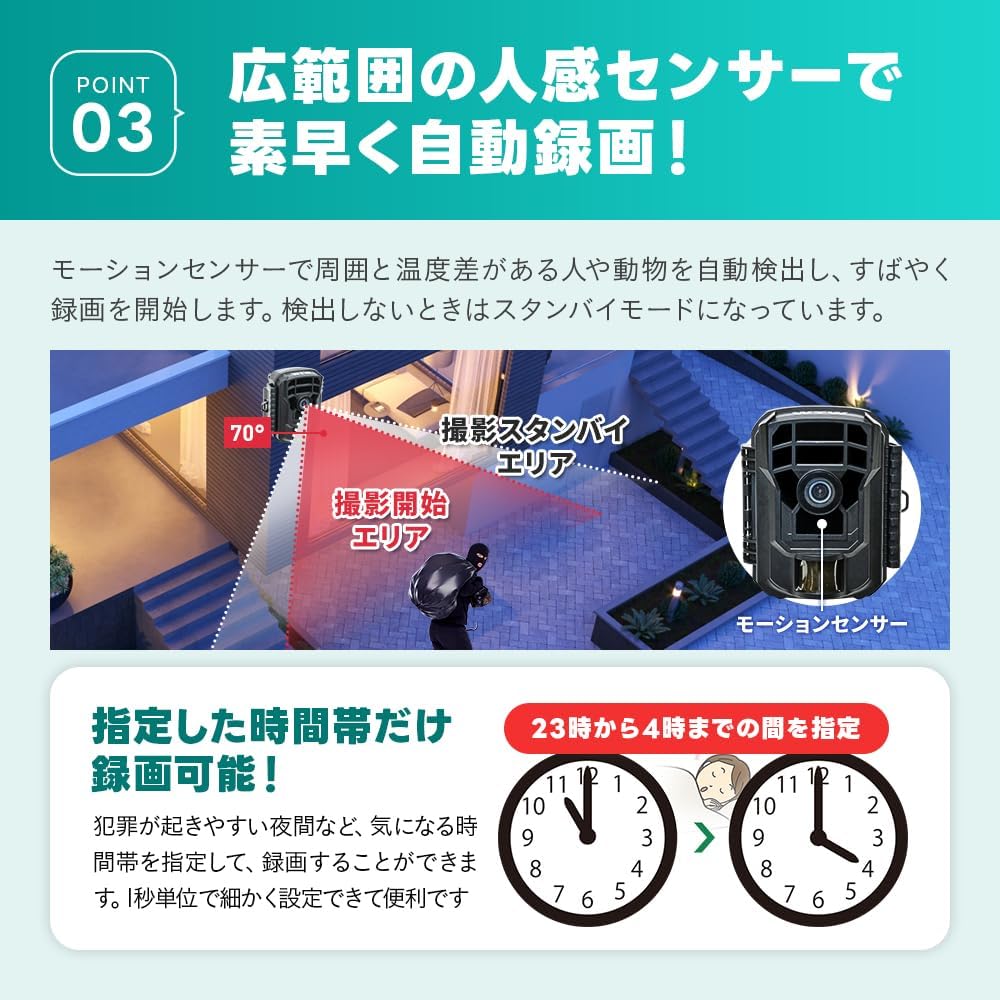
The camera utilizes a motion sensor to detect movement and temperature changes, automatically initiating recording. You can also set specific time periods for recording, such as during nighttime hours, for targeted surveillance.

A diagram illustrating the camera's motion detection area and how it triggers recording when movement is detected within the specified zone.
3.4 Ọhụụ abalị
The integrated infrared LEDs enable clear recording in complete darkness. Night vision footage will be captured in black and white. Avoid placing the camera to shoot through glass at night, as infrared light may reflect and obscure the image.

A side-by-side comparison showing a daytime color image and a nighttime black-and-white image captured by the camera, demonstrating its night vision capability.
3.5 Jikọọ na PC
Iji view or transfer recorded files, connect the camera to a computer using the included USB cable. Alternatively, you can remove the SD card and insert it into a card reader connected to your PC.
4. Nlekọta
4.1 nnọchi batrị
When the battery indicator shows low power or the camera stops functioning, replace all four AA dry cell batteries. Ensure to use fresh batteries for optimal performance.
4.2 SD kaadị njikwa
Regularly check the SD card capacity. Transfer important files to a computer and format the SD card periodically to maintain optimal recording performance and prevent data corruption.
4.3 Nhicha
Gently wipe the camera lens and body with a soft, dry cloth. Avoid using abrasive cleaners or solvents that could damage the camera's surface or lens.
4.4 Waterproofing Checks
Periodically inspect all external connections and seals for any signs of wear or damage, especially if the camera is installed outdoors. Reapply waterproofing tape or replace damaged components as needed to maintain the camera's waterproof integrity.
5. Nchọpụta nsogbu
5.1 Igwefoto anaghị agba ọkụ
- Lelee ma etinyere batrị ndị ahụ nke ọma site na polarity kwesịrị ekwesị.
- Gbaa mbọ hụ na batrị dị ọhụrụ na chajịkwa nke ọma.
- Hụ na ihe mgba ọkụ eletrik dị n'ọnọdụ 'ON'.
5.2 Poor Image/Video Quality
- Hichaa oghere igwefoto iji wepụ unyi ma ọ bụ ihe ọ bụla mebiri emebi.
- Ensure sufficient lighting during daytime recording.
- For night vision, ensure there are no obstructions (like glass) between the camera and the subject that could cause infrared reflection.
- Check if the camera is placed too close to objects that might interfere with infrared detection.
5.3 Ndụ batrị dị mkpụmkpụ
- Frequent motion detection events will consume more battery power. Consider adjusting sensitivity or placement.
- Ensure you are using high-quality, fresh AA dry cell batteries.
- Consider using a compatible solar panel for extended operation.
5.4 Recording Issues (No Files/Incomplete Files)
- Ensure an SD card is properly inserted and not full.
- Format the SD card if it's a new card or if you experience issues.
- Check if the camera's settings for recording (e.g., motion detection sensitivity, recording duration) are configured correctly.
6. Nkọwapụta
| Nọmba Nlereanya Ngwaahịa | WTW-TC33 |
| Akụkụ ngwaahịa (L x W x H) | 6 x 8.5 x 11 cm |
| Mkpebi onyonyo | Pikselụ nde 24 |
| Mkpebi ịse vidiyo | Pikselụ nde 2 |
| Isi Iyi Ike | 4 x AA Dry Cell Batteries (Battery powered) |
| Ọkwa mgbochi mmiri | Waterproof |
| Teknụzụ Njikọta | Ikuku |
| Ụdị nkwụnye | Tabletop Mount (Versatile placement) |
| Akwadoro ojiji | Nchebe ime ụlọ, Nchebe Ọpụpụ |
| Ngwa gụnyere | WTW-TC33 Camera Body, Household Solar Panel |
7. Akwụkwọ ikike na nkwado
The WTW-TC33 Trail Camera comes with a 1-afọ akwụkwọ ikike site na ụbọchị ịzụrụ ya. Akwụkwọ ikike a na-ekpuchi ntụpọ nrụpụta ma na-eme ka ọrụ a pụrụ ịdabere na ya n'okpuru ọnọdụ ojiji nkịtị.

WTW offers a 1-year warranty to ensure customer satisfaction and support for unexpected issues.
For any inquiries, technical assistance, or warranty claims, please contact our domestic support team. Our dedicated support staff is available to assist you with any questions or issues you may encounter.
Please refer to your purchase documentation for specific contact details or visit the official WTW websaịtị maka ozi nkwado kachasị ọhụrụ.


