1. Okwu mmalite
Thank you for choosing the Syncwire 11 kW 3-Phase EV Charger. This portable charging cable is designed to provide efficient and reliable charging for your electric vehicle. This manual contains important information regarding the safe operation, installation, and maintenance of your charger. Please read it thoroughly before use and retain it for future reference.
2. Ntuziaka nchekwa dị mkpa
Na-agbaso ihe ndị dị mkpa gbasara nchekwa mgbe niile mgbe ị na-eji ngwaahịa eletriki iji belata ihe egwu nke ọkụ, ujo eletriki, na mmerụ ahụ onwe onye.
- Gụọ ntuziaka niile: Familiarize yourself with the charger's functions and safety warnings.
- Nwụnye nke ọma: Ensure the 3-phase CEE industrial plug is connected to a compatible 400V industrial socket with appropriate grounding and circuit protection. Installation should be performed by a qualified electrician if you are unsure.
- Zere ikpughe mmiri: While the charger box is IP66 rated and the EV plug is IP54 rated, avoid submerging the unit in water. Do not operate if the charger or cables are wet or damaged.
- Lelee maka mmebi: Before each use, inspect the charger, cables, and connectors for any signs of damage. Do not use if any part is damaged.
- Ụmụaka na anụ ụlọ: Keep the charger and cables out of reach of children and pets during operation and storage.
- Igwe ikuku: Ensure adequate ventilation around the charger during operation. Do not cover the unit.
- Nkwụsị mberede: In case of an emergency, immediately disconnect the charger from the power source and the vehicle.
3. Ihe ngwugwu
Chọpụta na ihe niile dị na ngwugwu:
- Syncwire 11 kW 3-Phase EV Charger with Type 2 connector and 3-Phase CEE Industrial Plug
- Ihe njide USB
- Akpa nchekwa
- Akwụkwọ ntuziaka (akwụkwọ a)

Foto nke 3.1: The Syncwire 11 kW 3-Phase EV Charger, including the main control box, Type 2 charging cable, 3-phase CEE industrial plug, cable holder, and storage bag.
4. Ngwaahịa gafereview
The Syncwire 11 kW EV Charger features a robust control box with an LCD display, a Type 2 charging connector for your vehicle, and a 3-phase CEE industrial plug for the power source. The control box manages the charging process, displays real-time information, and allows for adjustable settings.

Foto nke 4.1: A zuru ezu view of the 3-phase CEE industrial plug (5-pin, 62mm diameter) required for 11 kW charging. The image also illustrates the significantly faster charging speed (3X) compared to a standard 3 kW charger.
5. Nhazi
5.1 Njikọ ike
- Ensure your electrical installation has a compatible 400V, 3-phase industrial socket (CEE 5-pin) with adequate circuit protection (e.g., 16A or higher).
- Plug the 3-phase CEE industrial plug of the charger securely into the industrial socket.
- The charger's LCD display should illuminate, indicating it is powered on.
5.2 Cable Holder Installation (Optional)
The included cable holder can be mounted on a wall near your charging location to keep the cable organized and prevent tripping hazards.
- Họrọ ebe kwesịrị ekwesị na mgbidi siri ike.
- Use appropriate screws and wall anchors (not included) to secure the cable holder.
- Hang the Type 2 connector and coil the cable neatly around the holder when not in use.

Foto nke 5.1: Onye bụbuample of an organized charging setup using the cable holder (left) compared to a disorganized setup without it (right).
6. Ntuziaka ọrụ
6.1 Initiating Charging
- Gbaa mbọ hụ na ejikọrọ chaja nke ọma na isi iyi ike.
- Mepee mkpuchi ọdụ chaja na ụgbọala eletrik gị.
- Insert the Type 2 connector firmly into your vehicle's charging port. A click sound usually indicates a secure connection.
- The charger will perform a self-check, and charging should begin automatically. The LCD display will show charging status, current, and energy delivered.
6.2 Adjusting Charging Current
You can adjust the charging current to suit your needs or the capacity of your electrical system. The available current settings are 6A, 8A, 10A, 13A, and 16A.
- Before connecting to the vehicle, or during charging if your vehicle supports it, press the 'Current Adjustment' button on the control box.
- Cycle through the available current options (6A, 8A, 10A, 13A, 16A) until your desired setting is displayed on the LCD.
- The charger will automatically adjust to the selected current.
6.3 Scheduled Charging (Timer Function)
The charger allows you to set a delayed start time for charging, from 0 to 5 hours.
- With the charger connected to the power source but not yet to the vehicle, or before charging starts, press the 'Timer' button on the control box.
- Each press will increase the delay by one hour, up to a maximum of 5 hours.
- Once the desired delay is set, connect the charger to your vehicle. Charging will commence after the set delay.

Foto nke 6.1: The charger's LCD display illustrating the options for adjustable current (6A-16A) and scheduled charging (0-5 hours delay).
6.4 Ịghọta Ngosipụta LCD
The LCD display provides real-time information about the charging process:
- Ike Nchaji: Displays the current power in kW.
- Energy Delivered: Shows the total energy transferred in kWh.
- Oge nchaji: Indicates the elapsed charging duration.
- Ntọala ugbu a: Shows the selected charging current (e.g., 16A).
- Ndị Na-egosi Ọnọdụ: Icons for power, connection, and error messages.
6.5 Ending Charging
- Stop the charging process via your vehicle's interface or by pressing the stop button on the charger (if available).
- Disconnect the Type 2 connector from your vehicle's charging port.
- Disconnect the 3-phase CEE industrial plug from the power source.
- Store the cable neatly using the cable holder and in the provided storage bag.
7. Nlekọta
7.1 Nhicha
Regular cleaning helps maintain the charger's performance and longevity.
- Always disconnect the charger from both the power source and the vehicle before cleaning.
- Wipe the control box and cables with a soft, damp cloth. Do not use harsh chemicals, solvents, or abrasive cleaners.
- Ensure connectors are free of dust and debris. Use protective caps when not in use.
7.2 Nchekwa
When not in use, store the charger in a dry, clean, and temperate environment.
- Coil the cable neatly and use the provided storage bag for protection.
- Zere ịchekwa na ìhè anyanwụ kpọmkwem ma ọ bụ oke okpomọkụ.

Foto nke 7.1: The Syncwire EV charger neatly stored in its compact, waterproof PU fabric storage bag, suitable for transport in a car trunk.
8. Nchọpụta nsogbu
If you encounter issues with your Syncwire EV Charger, refer to the following common problems and solutions:
| Nsogbu | Ihe nwere ike ime | Ngwọta |
|---|---|---|
| Chaja anaghị arụ ọrụ | No power from the industrial socket; loose connection. | Check the industrial socket for power; ensure the CEE plug is fully inserted. |
| Ịchaji anaghị amalite | Type 2 connector not fully inserted; vehicle not ready to charge; scheduled charging delay active. | Ensure Type 2 connector is secure; check vehicle's charging status; verify scheduled charging settings. |
| Nchaji na-akwụsị na mberede | Overcurrent/overheating protection activated; vehicle fault; power interruption. | Disconnect and reconnect; check for error codes on LCD; ensure adequate ventilation; consult vehicle manual. |
| Error message on LCD | Internal fault; connection issue; specific error condition. | Note the error code and refer to the Syncwire support for assistance. Try disconnecting and reconnecting. |
If the problem persists after attempting these solutions, please contact Syncwire customer support.
9. Nkọwapụta
| Njirimara | Nkọwa |
|---|---|
| Nọmba nlereanya | SW-EVP826 |
| Ịchaji Ike | Up to 11 kW (3-Phase) |
| Ntinye Voltage | 400 volts (AC) |
| Mmepụta Voltage | 400 volts (AC) |
| Ogo dị ugbu a | Adjustable: 6A, 8A, 10A, 13A, 16A |
| Ogologo eriri USB | 5.5 mita |
| EV Connector Type | Ụdị 2 |
| Ụdị nkwụnye ọkụ | 3-Phase CEE Industrial Plug |
| IP Rating (Control Box) | IP66 (mmiri na-egbochi uzuzu) |
| IP Rating (EV Plug) | IP54 |
| Ibu Ibu | 3.91 kilogram |
| Okpomọkụ na-arụ ọrụ | Refer to product packaging for specific range. |
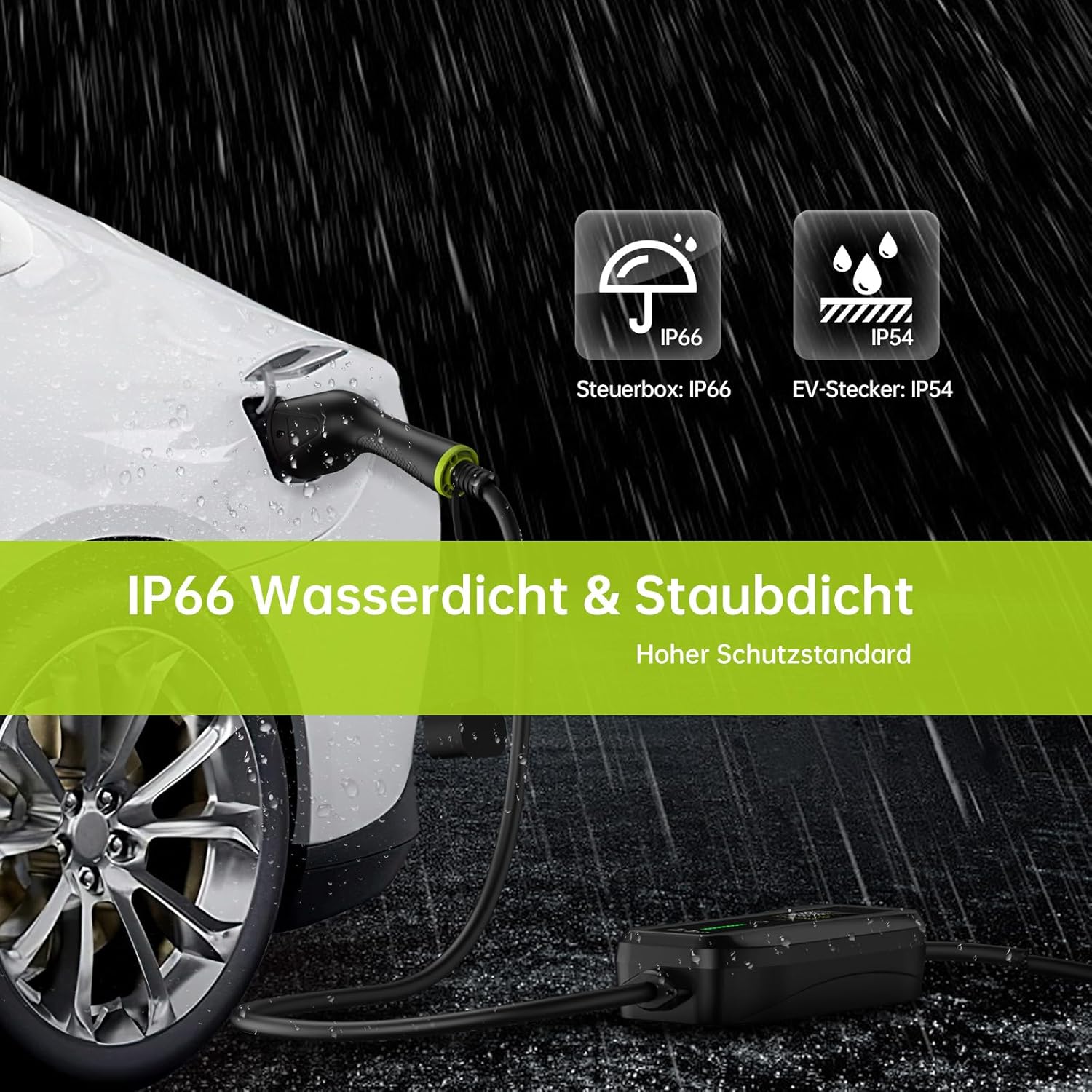
Foto nke 9.1: The Syncwire EV charger demonstrating its IP66 waterproof and dustproof rating for the control box and IP54 rating for the EV plug, suitable for outdoor use.
10. Ndakọrịta ụgbọ ala
The Syncwire 11 kW 3-Phase EV Charger with a Type 2 connector is compatible with a wide range of electric vehicles. Below is a list of commonly compatible brands and models:

Foto nke 10.1: A visual representation of various electric vehicle brands and models compatible with the Type 2 EV charger, including Tesla, Volkswagen, Renault, Hyundai, Peugeot, Kia, BMW, Smart, Audi, Fiat, Nissan, Opel, Skoda, Mercedes-Benz, Mini, Dacia, MG, Polestar, Ford, Jaguar, and Porsche.
- Tesla: Model 3/Model Y/Model S/Model X
- Volkswagen: ID.3/ID.4/ID.5/e-UP!/e-Golf
- Renault: ZOE/Twingo/Megane E-Tech
- Hyundai: Kona/IONIQ 5/IONIQ
- Peugeot: e-208/e-2008/e-Expert
- Kia: Niro/Soul EV (39/64 KWH)/EV6
- BMW: i3/iX3/i4/i7/i8/X1
- Smart: EQ Fortwo/EQ Forfour
- Audi: e-Tron/Q4 e-Tron/e-Tron GT
- Fiat: 500e
- Nissan: Leaf/Ariya
- Opel: Corsa-E/Mokka-E
- Skoda: Enyaq/Citigo
- Mercedes-Benz: EQA/EQC/EQB/EQV/EQS
- Obere: MINI Cooper SE
- Dacia: Mmiri
- MG: Zs/Marvel R/5
- Polestar: 2
- Ford: Mustang Mach-E
- Jaguar: I-Pace
- Porsche: Taycan
Note: This list is not exhaustive. Always confirm your vehicle's charging port type (Type 2) before use.
11. Akwụkwọ ikike na nkwado
11.1 Ozi akwụkwọ ikike
Syncwire products are manufactured to high-quality standards. For specific warranty details, including coverage period and terms, please refer to the warranty card included with your purchase or visit the official Syncwire websaịtị. Debe ihe akaebe nke ịzụrụ maka akwụkwọ ikike.
11.2 Nkwado ndị ahịa
If you have any questions, require technical assistance, or need to report an issue with your Syncwire 11 kW 3-Phase EV Charger, please contact Syncwire customer support through the following channels:
- Websaịtị: Visit the official Syncwire websaịtị maka FAQs, akụrụngwa nkwado, na fọm kọntaktị.
- Email: Refer to your product packaging or the Syncwire webebe nrụọrụ weebụ maka adreesị ozi-e nkwado ndị ahịa.
- Purchase Platform: For issues related to your order, you may also contact the seller directly through the platform where you made your purchase.


