SSK SST-DS14

SSK 14-in-1 USB C Laptop Docking Station Instruction Manual (Model: SST-DS14)

Comprehensive guide for setup, operation, and troubleshooting.

1. Okwu mmalite

This manual provides detailed instructions for the SSK 14-in-1 USB C Laptop Docking Station. Please read this manual carefully before using the product to ensure proper functionality and to maximize your experience.

The SSK 14-in-1 docking station is designed to expand the connectivity of your USB-C enabled laptop or device, offering a wide array of ports for various peripherals and display configurations.

2. Ihe ngwugwu

Chọpụta na ihe niile dị na ngwugwu gị:

3. Akụrụngwa Ngwaahịa

The SSK 14-in-1 USB C Laptop Docking Station offers extensive connectivity options:

SSK 14-in-1 USB C Docking Station with all ports labeled

Nyocha 1: N'eluview of the SSK 14-in-1 Docking Station with labeled ports. This image illustrates the various input and output ports available on the device, including HDMI, VGA, USB, Ethernet, and card reader slots.

4. Ihe achọrọ maka ndakọrịta

For full functionality, your host device (laptop, tablet, or smartphone) must meet the following criteria:

Compatibility chart for USB-C ports

Figure 2: USB-C port compatibility guide. This diagram helps users identify if their laptop's USB-C port supports data, DisplayPort Alt Mode, and Power Delivery, which are crucial for the docking station's full functionality.

5. Nhazi ntuziaka

  1. Jikọọ na ngwaọrụ nnabata: Plug the integrated USB-C cable from the docking station into a compatible USB-C port on your laptop or host device.
  2. Jikọọ Ike (Nhọrọ mana akwadoro): For stable operation and laptop charging, connect a USB-C Power Delivery (PD) charger (up to 100W) to the PD 3.0 USB-C port on the docking station. (Wall charger and cable are not included.)
    Connecting power to the docking station

    Figure 3: Power Delivery connection. This image shows how to connect a USB-C power adapter to the docking station to provide power to both the dock and the connected laptop.

  3. Jikọọ Ngosipụta Mpụga:
    • For HDMI displays, connect HDMI cables from your monitors to the HDMI ports on the docking station.
    • For VGA displays, connect a VGA cable from your monitor to the VGA port on the docking station.
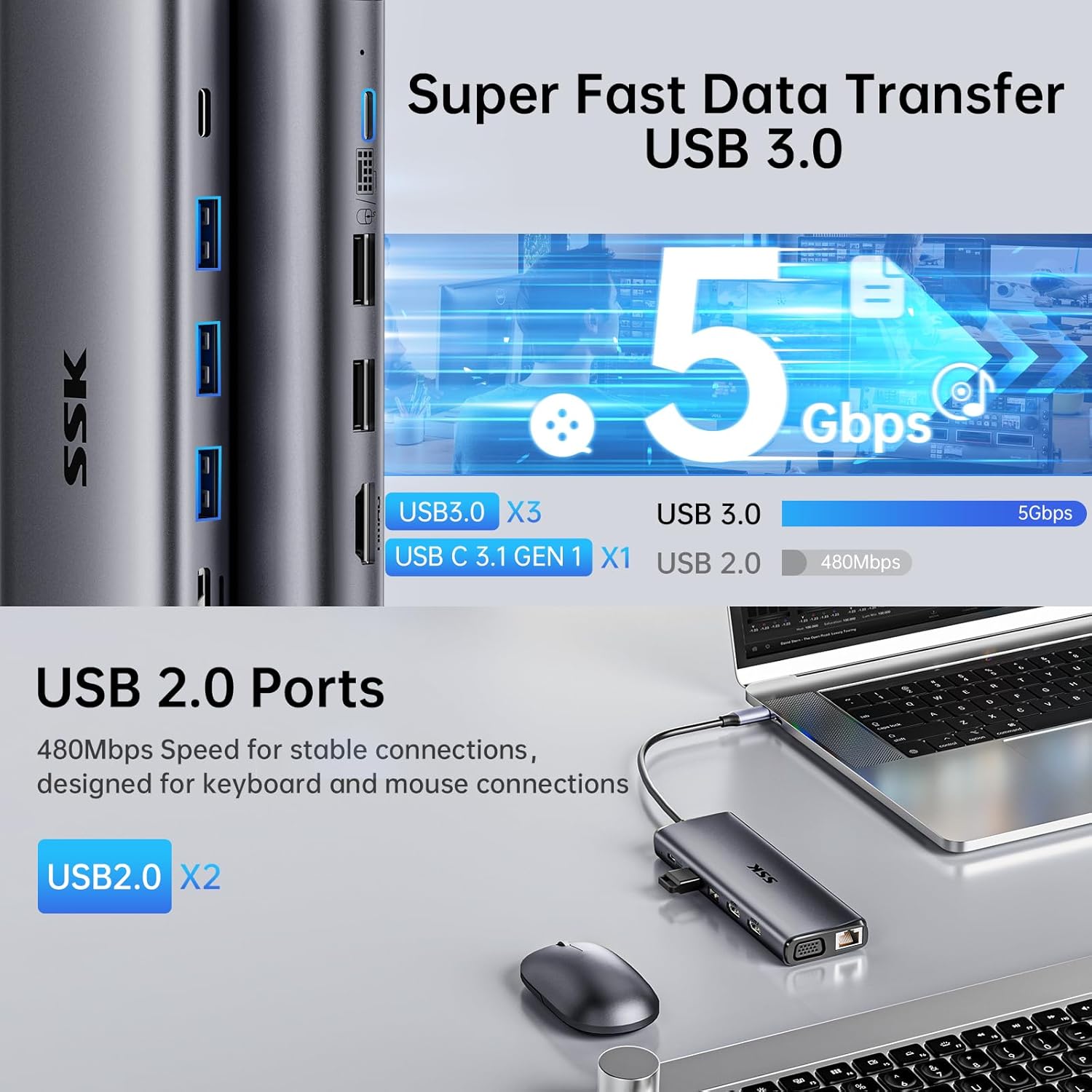
  4. Ngwa njikọ: Plug your USB devices (keyboard, mouse, external drives, etc.) into the available USB 3.0, USB 2.0, or USB C data ports.
    Connecting USB devices to the docking station

    Figure 4: USB data transfer ports. This image highlights the USB 3.0 and USB 2.0 ports, demonstrating their use for connecting various peripherals like mice, keyboards, and external storage devices.

  5. Jikọọ Ethernet: For a wired network connection, plug an Ethernet cable into the RJ45 port.
    Connecting Ethernet and audio to the docking station

    Figure 5: RJ45 Ethernet and 3.5mm audio port. This image shows the connection of an Ethernet cable for a stable network and headphones to the audio jack.

  6. Fanye kaadị SD/TF: If needed, insert your SD or TF cards into the corresponding slots.
    Inserting SD and TF cards into the docking station

    Figure 6: SD/TF card reader. This image demonstrates how to insert SD and MicroSD (TF) cards into the dedicated slots for data transfer.

  7. Jikọọ ọdịyo: Plug headphones or speakers into the 3.5mm audio/mic port.

6. Ntuziaka ọrụ

6.1. Ụdị ngosi

Ebe ọdụ ụgbọ mmiri na-akwado nhazi ngosi dị iche iche dabere na sistemụ arụmọrụ gị:

Triple monitor display modes for Windows and Mac OS

Figure 7: Display mode configurations. This image illustrates the different display modes (Mirror and Extend) available for both Windows and Mac OS, showing how multiple monitors can be arranged.

Resolution Notes:

6.2. Audio Output Configuration

If using the 3.5mm audio port, you may need to select the correct audio output device in your operating system settings:

7. Nlekọta na nlekọta

8. Nchọpụta nsogbu

Q: No video output to external monitors.
A: Ensure your laptop's USB-C port supports DisplayPort Alternate Mode. Check all cable connections. Try restarting your laptop and reconnecting the docking station.
Q: Laptop is not charging.
A: Verify that your laptop's USB-C port supports Power Delivery. Ensure a compatible USB-C PD charger (up to 100W) is connected to the docking station's PD port.
Q: Ethernet connection is not working (Windows 7/XP/Linux).
A: You may need to manually install the Gigabit RJ45 Ethernet driver. Refer to the manufacturer's websaịtị maka nbudata ọkwọ ụgbọala.
Q: External monitors show the same content on macOS in Extend Mode.
A: This is a limitation of macOS, which does not support Multi-Stream Transport (MST). The docking station will mirror the extended display across all external monitors (A-BBB).
Q: USB devices are not recognized.
A: Ensure the docking station is properly connected to your host device. Try connecting the USB device directly to your laptop to confirm functionality. If using high-power devices, ensure the docking station is connected to a power source.

9. Nka na ụzụ nkọwa

NjirimaraNkọwa
NlereanyaSST-DS14
ỤdịSSK
NjikọtaUSB-C (njikọ onye ọbịa)
ọdụ ụgbọ mmiri HDMI2 (Max 4K@60Hz single, 4K@30Hz dual)
Port VGA1 (Max 1080P@60Hz)
USB 3.0 ọdụ ụgbọ mmiri3 (Up to 5Gbps)
USB 2.0 ọdụ ụgbọ mmiri2
USB C Data Port1 (USB C 3.1 Gen1, up to 5Gbps)
USB C PD Port1 (PD 3.0, 100W input, 85W output)
Ọdụ ụgbọ mmiri EthernetRJ45 Gigabit (1000Mbps)
Onye na-agụ kaadịSD/TF (simultaneous, up to 104MB/s)
Ọdụ ọdịyo3.5mm Audio/Mik
Akụkụ9.02 x 3.98 x 0.87 sentimita asatọ
Ibu7.4 ounces

10. Akwụkwọ ikike na nkwado

SSK products are designed for reliability and performance. For warranty information and technical support, please refer to the official SSK websaịtị ma ọ bụ kpọtụrụ ndị ahịa ha ozugbo.

Biko dowe ihe akaebe nke ịzụrụ ihe maka akwụkwọ ikike.