1. Okwu mmalite
This manual provides comprehensive instructions for the safe and efficient operation of your Anern ECO-4200 4200W 24V Hybrid Solar Inverter. This all-in-one unit combines the functions of an inverter, solar charger, and battery charger to provide uninterrupted power support. Please read this manual thoroughly before installation and use, and retain it for future reference.
2. Ozi nchekwa
ỊDỌ AKA NA NTỊ: Ọdịda ịgbaso ntuziaka nchekwa ndị a nwere ike bute ujo ọkụ eletrik, ọkụ ma ọ bụ mmerụ ahụ dị egwu.
- Ndị ọrụ ruru eru ga-arụrịrị nrụnye.
- Gbaa mbọ hụ na wiwi niile dabara na koodu eletriki mpaghara na nke mba.
- Ekwula ihe na-agbanwe agbanwe. Enweghị akụkụ ọ bụla dị n'ime ya nke a ga-eji rụọ ọrụ.
- Disconnect all power sources (PV array, battery, utility) before performing any maintenance or wiring.
- This inverter is designed for 220V/230V AC output. It does not support 110V/120V AC output directly or parallel operation. For 110V/120V appliances, an external step-down converter (not included) is required.
- Gbaa mbọ hụ na ikuku ventilashị kwesịrị ekwesị na gburugburu inverter iji gbochie ikpo oke ọkụ.
- Zere itinye inverter n'ime ebe anwụ na-acha kpọmkwem, oke iru mmiri, ma ọ bụ ebe ájá jupụtara.
3. Akụrụngwa Ngwaahịa
The Anern ECO-4200 Hybrid Solar Inverter offers advanced functionalities for reliable power management:
- Mpụta Sine Wave dị ọcha: Provides high-quality AC power suitable for sensitive electronics.
- Integrated MPPT Charge Controller: Features a 120A Maximum Power Point Tracking (MPPT) solar charge controller for efficient solar energy harvesting.
- Ntọala enwere ike ịhazi: LCD display allows configuration of input voltage range for home appliances or personal computers, battery charging current, and AC/solar charger priority.
- Versatile Power Source Compatibility: Compatible with utility grid or generator power.
- Malitegharịa ekwentị na akpaghị aka: Automatically restarts when AC power is restored.
- Nchedo zuru oke: Includes overload, over-temperature, and short-circuit protection.
- Chaja batrị Smart: Designed to optimize battery performance and extend lifespan.
- Ọrụ mmalite oyi: Enables the inverter to start without an AC input.
- Dual AC Output: Features a primary output of 4200W and a secondary output of 1400W. The secondary output can maintain power during low battery or no mains conditions to save energy.
- Ndakọrịta batrị: Supports various battery types including GEL, FLD, Li-on (Lithium), and AGM.
- Nlekota Wi-Fi: Allows control and monitoring of the system via a mobile application.

Foto: Ofeview of the Anern ECO-4200 inverter highlighting multiple protection features, Wi-Fi monitoring capability, and its ability to operate with or without a battery.
4. Nwụnye
This section outlines the basic system architecture and wiring for the Anern ECO-4200 Hybrid Solar Inverter. Consult a qualified system integrator for specific requirements.
4.1 Nhazi Sistemụ Nhazi
The inverter/charger forms the core of your solar power system. A complete operational system typically includes:
- The Anern ECO-4200 Hybrid Solar Inverter
- PV Modules (Solar Panels)
- Battery Bank (e.g., 48V lead-acid or lithium battery)
- Utility Grid or Generator (as an optional AC input source)
4.2 eserese waya
Refer to the diagram below for a typical wiring configuration. Ensure all connections are secure and correctly polarized.

Image: Detailed wiring diagram illustrating connections for photovoltaic panels, battery bank, AC input from utility or generator, and AC output to household loads. Recommended wire gauges and fuse sizes are indicated.
Key Wiring Recommendations:
- Photovoltaic (PV) Input: Max mepere sekit voltage 500VDC. MPPT PV voltage range 90VDC-450VDC. Suggested wire: 10 AWG/6mm². Connect panels in series.
- Njikọ batrị: For a 48V battery system, use 2 AWG cable (25mm²) and a 150A fuse.
- Ntinye AC: Ihe ntinye AC kacha elu voltage 300VAC. Max AC charging current 160A. Suggested cable: 10 AWG/6mm². Recommended switch: 63A.
- Mmepụta AC: Rated output 220V/230V. Suggested cable: 10 AWG/6mm². Recommended switch: 63A.
Important Note: The inverter output is 230V. A separate converter (not included) is required for 110V appliances.
5. Ntuziaka ọrụ
The inverter features an LCD display for monitoring and configuring operational parameters.
5.1 Configurable Settings via LCD
You can adjust various settings to suit your application requirements:
- Ntinye Voltage Oke: Select between appliance mode or personal computer mode.
- Ịchaji batrị ugbu a: Adjust the charging current based on your battery specifications.
- Charger Priority: Set the priority for AC charger or solar charger.
5.2 Charge Modes
The inverter supports four distinct charge modes:
- Anyanwụ Mbụ: Na-ebute ike anyanwụ ụzọ maka ịchaji.
- Utility First: Prioritizes utility power for charging.
- Solar and Utility: Ọ na-eji ike anyanwụ na ike ọrụ eme ihe maka ịchaji.
- Battery and Solar: Charges from both battery and solar (specific to certain configurations).
Ụdị mmepụta 5.3
Three output modes are available to manage power distribution:
- Ihe kacha mkpa n'anwụ: Prioritizes solar power for loads.
- Ihe kacha mkpa n'ọrụ: Prioritizes utility power for loads.
- SBU Mode (Solar-Battery-Utility): Prioritizes solar, then battery, then utility for loads.
The inverter can power various household and office appliances, including refrigerators, lamps, fans, and air conditioners.
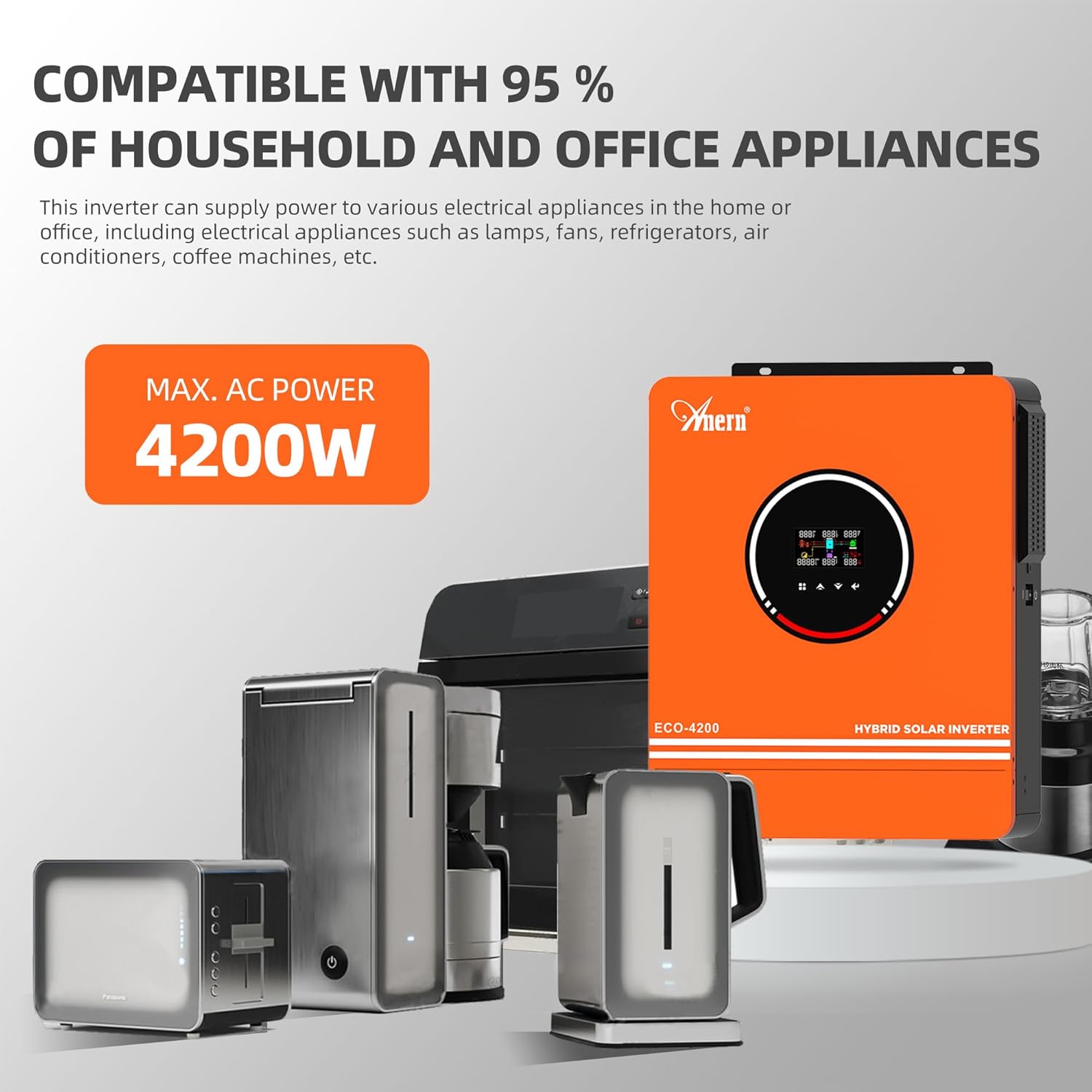
Image: The Anern ECO-4200 inverter demonstrating compatibility with a wide range of household and office appliances, including coffee makers, toasters, and kettles.
6. Nlekọta
Mmezi mgbe niile na-eme ka ogologo ndụ na arụmọrụ kachasị mma nke inverter gị.
- Nhicha: Keep the inverter's exterior clean and free from dust. Use a dry cloth. Do not use liquid cleaners.
- Igwe ikuku: Ensure ventilation openings are clear and unobstructed. The intelligent variable speed fan helps dissipate heat efficiently.
- Njikọ: Na-elele njikọ eletriki niile mgbe niile maka ike na ihe ịrịba ama nke ire ere.
- gburugburu: Maintain the inverter in a cool, dry, and well-ventilated area.
7. Nchọpụta nsogbu
This section provides guidance for common issues. For complex problems, contact technical support.
- Inverter Anaghị agbanyụ: Check battery connections, battery voltage, and AC input (if applicable). Ensure the power switch is in the 'ON' position.
- Enweghị mmepụta AC: Verify input power sources (PV, battery, utility). Check for overload or short-circuit conditions. The inverter has built-in protection that may temporarily shut down output.
- Low Battery Performance: Ensure correct battery type settings are configured. Check battery health and charging current settings.
- Ịdọ aka ná ntị bufee ibu: Reduce the connected load. The inverter will automatically attempt to restart after an overload event.
- Ịdọ Aka Na Ntị Maka Oke Okpomọkụ: Ensure adequate ventilation. Clear any obstructions from the fan or vents.
8. Nkọwapụta
Detailed technical specifications for the Anern ECO-4200 4200W 24V Hybrid Solar Inverter.

Image: Summary of key technical specifications for the Anern 4200W Hybrid Solar Inverter, including Max. AC Output, Max. MPPT PV Charging Current, Minimum voltage for solar modules, and Max. PV Array Open Circuit Voltage.
| Nkọwapụta | Uru |
|---|---|
| Ụdị | Anern |
| Nọmba nlereanya | AKA-4200 |
| Ike | 4200 Watt |
| Voltage | 24 Volts (DC Input) |
| Mmepụta Voltage | 220-230 VAC (Single Phase) |
| Max. PV Ike Ike | 6500 W |
| Oke. PV Array Open Circuit Voltage | 500 VDC |
| MPPT PV Voltage Oke | 90-450 VDC |
| Oke. Ụgwọ PV ugbu a | 120 A |
| Onyinye mmepụta Ugbu a | 44.3 A |
| Battery Capacity (Charge Controller) | 120 Amp-hours (Max. charging current) |
| Akwadoro ojiji | Ụlọ |
| Isi Iyi Ike | Ike anyanwụ |
| Agba | oroma |
9. Akwụkwọ ikike na nkwado
For warranty information and technical support, please refer to the documentation included with your product or visit the official Anern websaịtị. Debe akwụkwọ nnata ịzụrụ maka akwụkwọ ikike.