Okwu mmalite
The AUTOOL SPT101 Automotive Spark Plug Tester is a specialized device designed for the efficient and safe evaluation of spark plug performance. This tool simulates actual engine working conditions, enabling users to observe and compare the flashover strength of spark plugs. This comparison facilitates an accurate assessment of spark plug quality and helps identify faulty units, supporting precise maintenance or timely replacement.
Key features include dual-hole simultaneous testing, adjustable working frequency from 0 to 6000 RPM, and a protective cover for enhanced safety during operation. The SPT101 is suitable for 12V gasoline vehicle spark plugs with a 12mm diameter.
Ozi nchekwa
WARNING: This device generates high voltage. Failure to follow safety instructions can result in serious injury or electric shock.
- Always ensure the transparent protective cover is securely closed over the spark plugs before connecting power or operating the device.
- Do not touch the spark plugs or the test sockets while the device is powered on or in operation.
- Operate the device in a dry environment. Avoid exposure to moisture or liquids.
- Debe ngwaọrụ ahụ ka ụmụaka ghara iru ya.
- Inspect the power cord and the device for any damage before each use. Do not use if damaged.

Image: The AUTOOL SPT101 Spark Plug Tester demonstrating the protective cover design. The clear cover is shown closed over the spark plug sockets, emphasizing the safety feature to prevent accidental contact with high voltage during testing.
Ngwaahịa gafereview na akụrụngwa
The AUTOOL SPT101 features a compact and durable design, facilitating easy handling and storage. It is equipped with two test holes for simultaneous comparison of spark plugs.
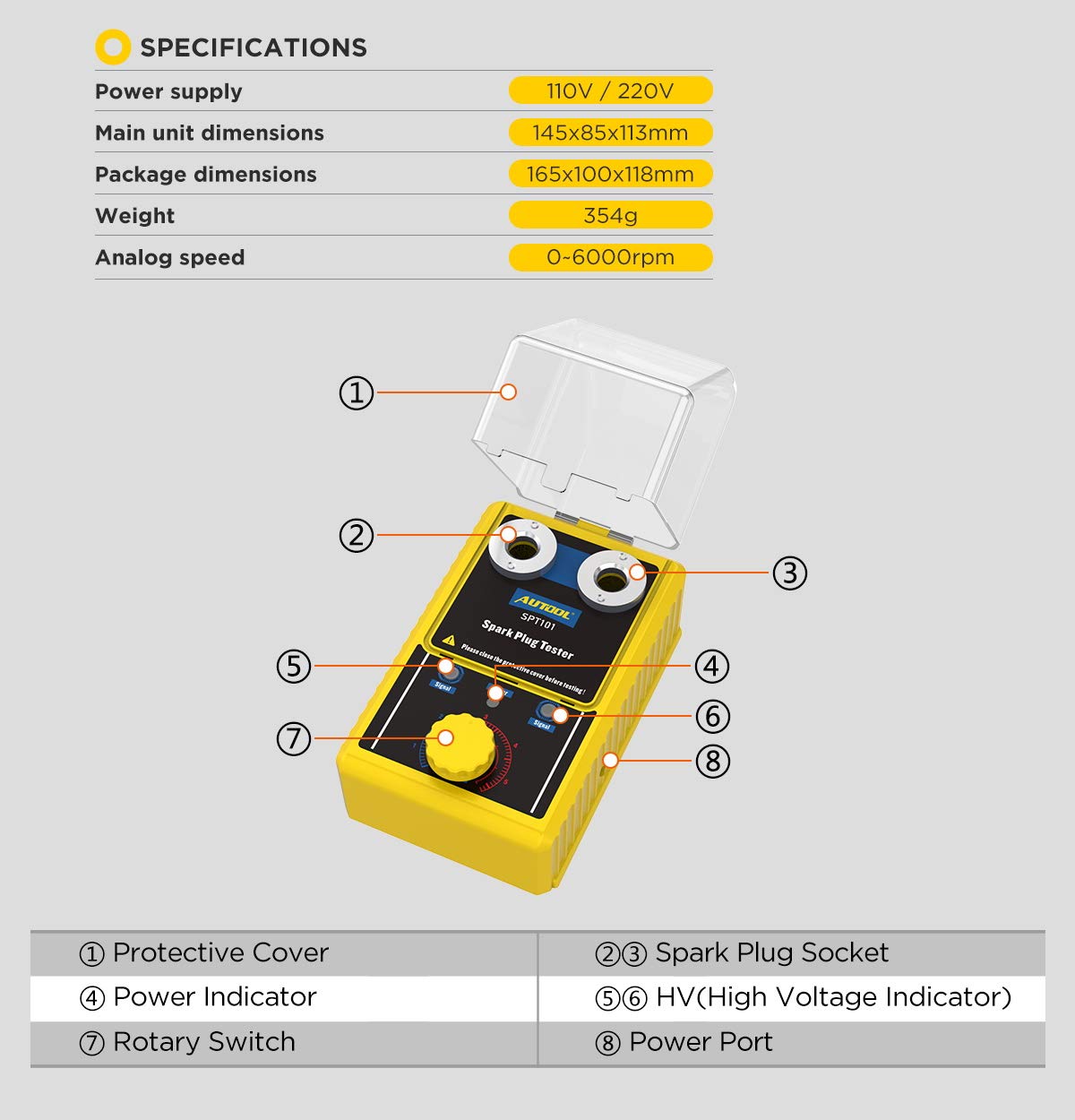
Image: A detailed diagram labeling the key components of the AUTOOL SPT101 Spark Plug Tester. Labels include the protective cover, spark plug sockets, power indicator, HV (High Voltage) indicator, rotary switch for frequency adjustment, and power port.
- Mkpuchi mkpuchi: Transparent cover for safety during operation.
- Spark Plug Socket: Two sockets for inserting spark plugs for testing.
- Ihe ngosi ike: Na-enwu mgbe ngwaọrụ ahụ gbanyere ọkụ.
- HV (High Voltage) Ngosi: Illuminates when high voltage na-arụ ọrụ.
- Ngbanwe Rotary: Used to adjust the working frequency (RPM) of the spark.
- Ike Port: Connection point for the power adapter.
Nkọwapụta
| Nọmba Nlereanya ihe | Ụgbọ ala SPT101 |
| Ntinye Voltage | 110V / 220V |
| Analog Speed (Working Frequency) | 0-6000 RPM |
| Ibu ngwaahịa | 354g (12.49 ounces) |
| Akụkụ ngwaahịa (L x W x H) | 145 x 85 x 113 mm (5.7 x 3.3 x 4.4 inch) |
| Akụkụ ngwugwu (L x W x H) | 165 x 100 x 118 mm |
| Isi Iyi Ike | Igwe ọkụ eletrik |
| Compatible Spark Plug Diameter | 12mm (for 12V gasoline vehicles) |
Melite
- Ịkwapu: Carefully remove the AUTOOL SPT101 Spark Plug Tester and its accessories from the packaging. Verify all components are present: the main unit, power adapter, and user manual.
- Nkwanye: Place the tester on a stable, dry, and non-conductive surface. Ensure adequate clearance around the device for safe operation.
- Njikọ ike: Connect the provided power adapter to the power port on the side of the SPT101 unit. Plug the adapter into a suitable 110V or 220V AC power outlet. The power indicator light should illuminate.
- Spark Plug Insertion: Open the transparent protective cover. Insert the spark plug(s) you wish to test into the designated spark plug sockets. Ensure they are seated firmly.

Image: The AUTOOL SPT101 Spark Plug Tester shown with two spark plugs inserted into its sockets, and the protective cover open, indicating readiness for the next step of operation.
Ntuziaka ọrụ
Follow these steps to test spark plugs using the AUTOOL SPT101:
- Tinye Spark Plugs: With the protective cover open, firmly insert one or two spark plugs into the test sockets.
- Close Protective Cover: Crucially, close the transparent protective cover completely over the spark plugs before proceeding. This is a vital safety measure.
- Connect Power and Adjust Frequency: Ensure the power adapter is connected to the device and a power outlet. The power indicator should be lit. Use the rotary switch to adjust the desired working frequency (RPM). Start at a lower RPM and gradually increase it. The HV indicator will light up when high voltage na-arụ ọrụ.
- Lee Spark: Through the transparent protective cover, observe the spark generated by the spark plugs.
- A healthy spark plug should produce a strong, consistent, blue spark across its gap.
- Compare the spark intensity and consistency between two spark plugs if testing simultaneously.
- Irregular, weak, or absent sparks, or sparks that occur outside the electrode gap, indicate a faulty spark plug.
- Gbanyụọ: Once testing is complete, turn the rotary switch to the minimum RPM (0) and disconnect the power adapter from the wall outlet.
- Remove Spark Plugs: Open the protective cover and carefully remove the spark plugs.

Image: A visual guide illustrating the four main operation steps: 1. Placing the spark plug, 2. Covering with the protective cover, 3. Connecting power and adjusting frequency, and 4. Observing the spark through the cover.
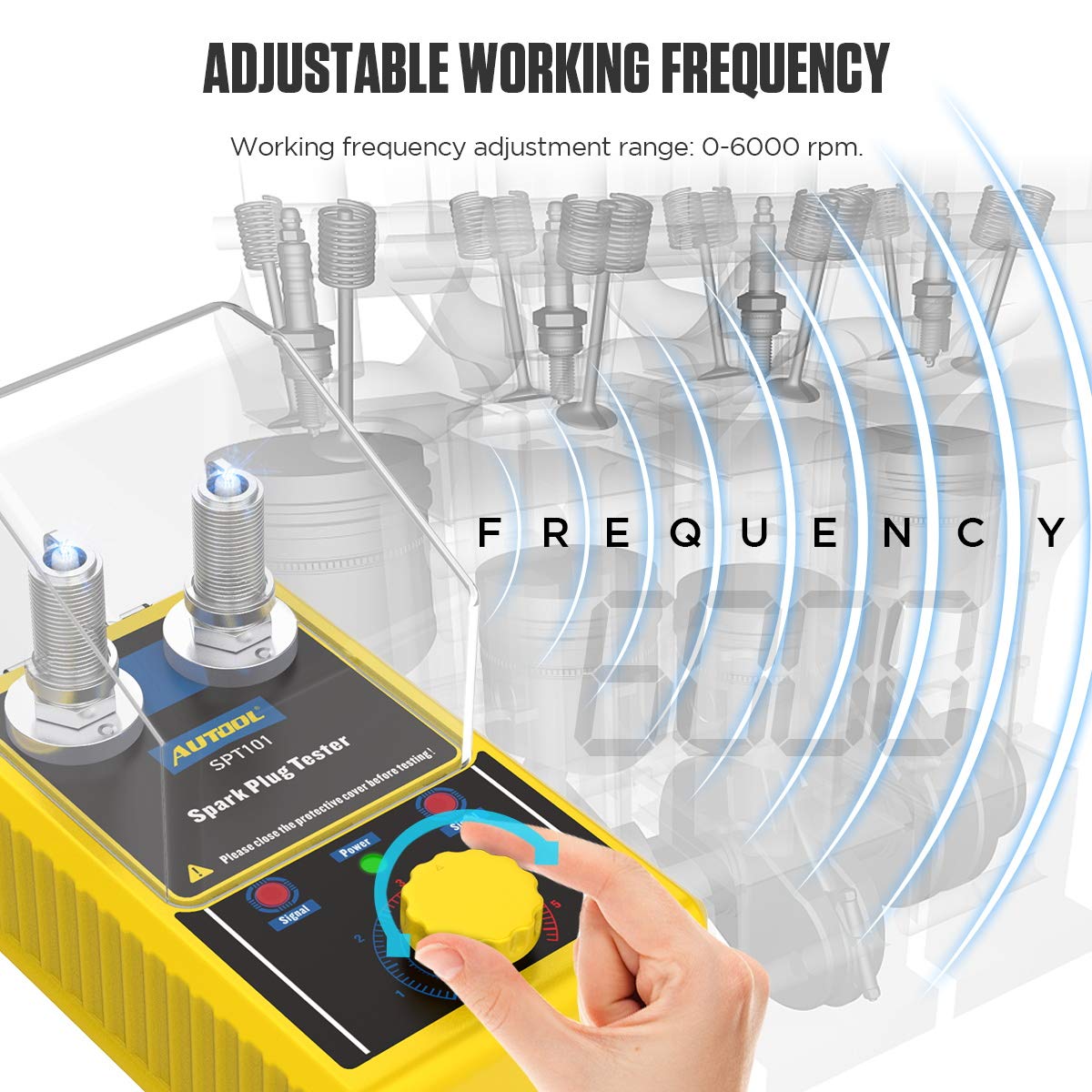
Image: The AUTOOL SPT101 Spark Plug Tester highlighting the rotary knob used to adjust the working frequency from 0 to 6000 RPM, simulating various engine speeds for comprehensive testing.

Image: The AUTOOL SPT101 Spark Plug Tester demonstrating its dual-hole capability, allowing two spark plugs to be tested simultaneously for direct comparison of their performance.
Nlekọta
- Nhicha: After each use, ensure the device is powered off and unplugged. Use a soft, dry cloth to wipe down the exterior of the tester. Do not use abrasive cleaners or solvents.
- Nchekwa: Store the AUTOOL SPT101 in a cool, dry place, away from direct sunlight and extreme temperatures. Keep the protective cover closed to prevent dust accumulation in the sockets.
- Nyocha: Periodically inspect the power cord for any signs of wear, cuts, or damage. Ensure the spark plug sockets are free from debris.
Nchọpụta nsogbu
| Nsogbu | Ihe nwere ike ime | Ngwọta |
|---|---|---|
| Enweghị ọkụ egosi ike | Njikọghị ihe nkwụnye ọkụ eletrik ma ọ bụ nsogbu; nsogbu nke ebe ọkụ eletrik. | Ensure power adapter is securely connected to both the device and a working power outlet. Test the outlet with another device. |
| No spark from spark plug | Spark plug is faulty; spark plug not properly seated; protective cover not closed; RPM set to 0. | Replace the spark plug. Ensure the spark plug is firmly seated in the socket. Close the protective cover. Increase the RPM using the rotary switch. |
| Weak or inconsistent spark | Spark plug is worn or faulty; incorrect RPM setting. | This indicates a potentially faulty spark plug that needs replacement. Adjust the RPM to observe performance at different simulated engine speeds. |
| Spark occurs outside the electrode gap | Spark plug ceramic insulator is cracked or damaged. | Immediately replace the spark plug. This indicates a critical failure of the spark plug. |
Akwụkwọ ikike na nkwado
AUTOOL provides a comprehensive warranty and support for the SPT101 Spark Plug Tester:
- Akwụkwọ ikike nke afọ atọ: For damage caused by non-human factors, AUTOOL promises to resend replacement parts free of charge within 3 years from the date of purchase.
- Lifelong Maintenance: AUTOOL is committed to providing lifelong maintenance support for the product.
- Nkwado ndị ahịa: For any inquiries, technical assistance, or warranty claims, please contact AUTOOL customer support. They aim to respond as soon as possible within 24 hours.

Image: Icons representing AUTOOL's 24/7 customer support, 3-year warranty, and certifications (FCC, CE, RoHS), highlighting their commitment to product quality and customer service.


