Okwu mmalite
This manual provides essential information for the safe and efficient operation, maintenance, and troubleshooting of your ECHO eFORCE 56V DCS-2500T Top Handle Chainsaw. This chainsaw is designed for professional and demanding tasks, offering superior performance and lightweight handling.
Ozi nchekwa
Always read and understand all safety warnings and instructions before operating the chainsaw. Failure to follow the warnings and instructions may result in electric shock, fire, and/or serious injury.
Iwu nchekwa izugbe
- Wear appropriate personal protective equipment (PPE) including head protection, eye protection, hearing protection, gloves, and safety footwear.
- Keep all bystanders, children, and pets at least 50 feet (15 meters) away from the work area.
- Do not operate the chainsaw in explosive atmospheres, such as in the presence of flammable liquids, gases, or dust.
- Na-echekwa ụkwụ na nguzozi kwesịrị ekwesị mgbe niile. Emechala oke.
- Avoid accidental starting. Ensure the power button is off before picking up or carrying the tool.
Nchekwa Chainsaw akọwapụtara
- Jiri aka abụọ jide chainsaw mgbe niile mgbe ị na-arụ ọrụ.
- Be aware of kickback. Kickback may occur when the moving chain contacts an object at the upper quadrant of the guide bar or when the wood closes in and pinches the saw chain in the cut.
- Do not operate the chainsaw with one hand. One-handed operation may result in serious injury to the operator, helpers, or bystanders.
- Gbaa mbọ hụ na breeki yinye agbagoro mgbe ị na-amalite chainsaw na mgbe ị na-aga n'etiti mbepụ.
- Na-elele esemokwu n'agbụ na mmanu mmanu mgbe niile.
Melite
Your ECHO DCS-2500T chainsaw requires minimal assembly before first use.
Ihe ngwugwu
- ECHO DCS-2500T Chainsaw Unit
- 12-inch Guide Bar
- Hụrụ Chain
- 56V 2.5Ah eFORCE Battery
- eFORCE Battery Charger
- Akwụkwọ ntuziaka Bar mkpuchi
- Akwụkwọ ntuziaka onye ọrụ
Ntuziaka Mgbakọ
- Install Guide Bar and Chain:
Remove the side cover by loosening the bolt.
Carefully place the chain around the drive sprocket and then align it with the groove of the guide bar.
Position the guide bar and chain onto the chainsaw body, ensuring the chain tension pin fits into the hole on the guide bar.
Replace the side cover and hand-tighten the bolt. Do not fully tighten yet.

Image: A user demonstrating the assembly of the chainsaw, highlighting the guide bar and chain attachment point.
- Dezie Chain esemokwu:
Use the chain tensioning screw (usually located on the side cover) to adjust the chain tension. The chain should be snug against the guide bar but still able to be pulled freely by hand.
Once tension is correct, fully tighten the side cover bolt.
- Fill Oil Reservoir:
Chọta mkpuchi ebe a na-echekwa mmanụ n'ahụ chainsaw ahụ.
Fill the reservoir with high-quality bar and chain oil. Do not use motor oil or other lubricants.
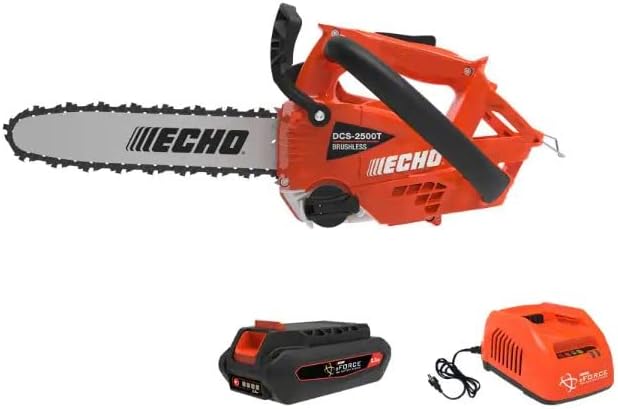
Image: The Echo DCS-2500T chainsaw, its battery, and charger. The oil reservoir cap is visible on the chainsaw body.
Ịchaji batrị
- Chajịa batrị:
Insert the 56V eFORCE battery into the charger. Ensure it clicks into place.
Jikọọ chaja na oghere ọkụ ọkọlọtọ.
The charger's LED indicators will show the charging status (e.g., red for charging, green for fully charged).
Kwe ka batrị chajị nke ọma tupu ejie ya mbụ.
- Wụnye batrị:
Ozugbo chajịchara zuru oke, wepụ batrị na chaja.
Insert the battery into the battery compartment of the chainsaw until it locks securely.
Ntuziaka ọrụ
Malite na Chainsaw
- Gbaa mbọ hụ na agbajila breeki yinye (a dọtara azụ n'ihu aka).
- Press the power button (usually indicated by a power symbol) to turn on the chainsaw. A green indicator light will illuminate.
- Grasp the front handle with your left hand and the rear handle with your right hand.
- Depress the safety lock-out button (if present) and then squeeze the trigger to start the chain.
Usoro ịkpụcha
- Na -agbatị: Remove branches from a fallen tree. Work from the bottom up, cutting small branches first.
- Bukpọchi: Cut a fallen log into sections. Use a sawhorse or elevated support to prevent the chain from hitting the ground.
- Na-ada: (For experienced users only) Carefully plan the felling direction, clear the area, and make proper felling cuts.
Stopping the Chainsaw
Release the trigger. The chain will stop immediately.
Engage the chain brake by pushing it forward.
Press the power button to turn off the chainsaw for storage or extended breaks.
Nlekọta
Nlekọta mgbe niile na-eme ka arụmọrụ kachasị mma ma na-agbatị ndụ nke chainsaw gị.
Mgbe ojiji ọ bụla
- Clean the Chainsaw: Remove sawdust, chips, and debris from the guide bar, chain, and motor housing.
- Lelee Chain Esemokwu: Adjust if necessary.
- Lelee ọkwa mmanụ: Refill the bar and chain oil reservoir.
- Inspect Chain: Check for dullness, damage, or loose rivets. Sharpen or replace as needed.
- Inspect Guide Bar: Check for burrs or wear.
Nlekọta oge
- Sharpen Chain: A sharp chain cuts efficiently and safely. Use a round file of the correct size for your chain.
- Filter ikuku dị ọcha: (If applicable, though battery models often have less complex filters) Refer to the specific instructions for your model.
- Check Battery and Charger: Ensure they are free from damage and functioning correctly.
Nchọpụta nsogbu
| Nsogbu | Ihe nwere ike ime | Ngwọta |
|---|---|---|
| Chainsaw anaghị amalite | Battery not charged; Battery not inserted correctly; Power button off; Chain brake engaged. | Charge battery; Reinsert battery; Press power button; Disengage chain brake. |
| Agbụ anaghị egbutu nke ọma | Dull chain; Incorrect chain tension; Low bar oil. | Sharpen or replace chain; Adjust chain tension; Refill bar oil. |
| Chainsaw na-ekpo oke ọkụ | Overuse; Dull chain; Insufficient lubrication. | Allow to cool; Sharpen chain; Check bar oil level and flow. |
Nkọwapụta
- Nlereanya: DCS-2500-12C1
- Ụdị: Echo
- Ogologo Ogwe: 12 sentimita asatọ
- Sistemu batrị: ECHO eFORCE 56V
- Ike batrị: 2.5ah
- Ụdị moto: enweghị ahịhịa
- Ibu Ibu: 1 ounce
- Akụkụ ngwaahịa: 14"L x 14"W x 14"H
- Ike inyinya: 5.3 hp
- Ụbọchị mbụ dị: Mee 6, 2022
Akwụkwọ ikike na nkwado
For warranty information and technical support, please refer to the official Echo product registration or contact Echo customer service directly. Keep your purchase receipt for warranty claims.


