Okwu mmalite
This manual provides detailed instructions for the installation, operation, and maintenance of the Turing TP-MFD4A4 Smart Series TwilightVision 4MP IR Dome IP Camera. This camera is designed for outdoor surveillance, featuring 4MP resolution, TwilightVision for low-light clarity, Smart IR up to 30m (98ft), and robust protection ratings (IP67, IK10).
Atụmatụ igodo
- Max. 4MP (2688x1520) resolution at 30/25fps.
- TwilightVision technology for optimal image clarity in low light conditions.
- Support for up to 256 GB microSD card for local storage.
- Advanced analytics including line crossing detection, enter area detection, motion detection (up to four areas), tampering alarm, and audio detection.
- Smart IR illumination up to 30 meters (98 feet).
- IP67 weather resistance and IK10 vandal resistance.
- Power over Ethernet (PoE) support for simplified installation.
- Wide Dynamic Range (WDR) for clear images in varying light conditions.
Kedu ihe dị na Igbe ahụ
Upon unpacking, verify that all items are present and in good condition:
- Turing TP-MFD4A4 Smart Series TwilightVision 4MP IR Dome IP Camera
- Akụrụngwa mgbago (skru, arịlịka)
- Ntuziaka mmalite ngwa ngwa (anaghị etinye ya na ntuziaka a)
Melite
1. Nwụnye anụ ahụ
The TP-MFD4A4 camera is designed for ceiling mount installation. Ensure the mounting surface is strong enough to support the camera's weight.
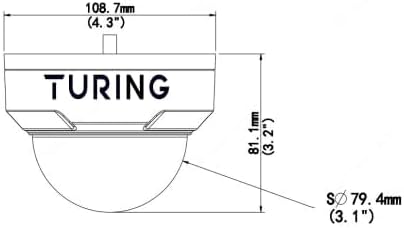
Foto: N'ihu view of the Turing TP-MFD4A4 Dome IP Camera, showing its compact design suitable for ceiling mounting.
- Họrọ ebe: Choose a suitable outdoor location for optimal surveillance coverage, considering the 4mm fixed lens angle of view (H: 83.7°, V: 44.9°, D: 89.2°).
- Ịkwanye: Use the provided mounting template (if applicable) to drill pilot holes. Secure the camera base to the ceiling using the screws and anchors.
- Gbanwee akụkụ: Once mounted, adjust the camera's dome to achieve the desired viewakụkụ n'akuku.
2. Ike na Njikọ netwọk
The camera supports Power over Ethernet (PoE) for simplified installation, allowing both power and data transmission over a single Ethernet cable. Alternatively, it can be powered via a DC 12V power adapter (not included).

Image: A standard Ethernet cable with an RJ45 connector, used for both power (PoE) and data connection to the camera.
- Njikọ PoE: Connect one end of an Ethernet cable to the camera's RJ45 port and the other end to a PoE-enabled switch or NVR.
- DC Power (Optional): If not using PoE, connect a 12V DC power adapter to the camera's power input and an Ethernet cable to a standard network switch or router.
- Nhazi netwọk: The camera will obtain an IP address automatically via DHCP. For advanced network settings, refer to the Turing Vision software or NVR manual.
3. MicroSD Card Installation (Optional)
The camera supports a microSD card up to 256 GB for onboard storage. This allows for local recording even if network connectivity is temporarily lost.
- Access Slot: Carefully open the camera housing to locate the microSD card slot. Refer to the camera's physical diagram for exact location.
- Fanye kaadị: Insert the microSD card into the slot with the contacts facing down until it clicks into place.
- Hazie Kaadị: After installation, it is recommended to format the microSD card via the camera's web interface or connected NVR for optimal performance.
Na-arụ ọrụ igwefoto
The Turing TP-MFD4A4 camera integrates with Turing Smart Series NVRs and the Turing Vision Cloud platform for comprehensive surveillance management.

Image: A tablet screen showing a multi-view display of live video feeds from several surveillance cameras, demonstrating remote monitoring capabilities.
1. Ịnweta Ndụ View na ndekọ
- Turing Smart Series NVR: Connect the camera to a compatible Turing Smart Series NVR to view live feeds, manage recordings, and configure settings.
- Turing Vision Cloud: Utilize the Turing Vision Cloud platform for remote access, monitoring, and cloud storage features. This requires a compatible NVR, Bridge, and CORE AI license.
- Web Ihuenyo: Nweta igwefoto ahụ web interface directly via its IP address for detailed configuration and live view.
2. Understanding Key Technologies
- TwilightVision: This technology enhances image clarity in extremely low-light environments, providing color images where traditional cameras would switch to black and white.
- Smart IR: The camera's Smart IR automatically adjusts the intensity of its infrared LEDs to prevent overexposure of objects closer to the camera, ensuring balanced night vision up to 30m (98ft).
- WDR (Ogologo Ebe Dị omimi): WDR technology balances areas of high contrast in a scene, ensuring details are visible in both very bright and very dark regions simultaneously.
3. Configuring Analytics
The TP-MFD4A4 camera offers advanced onboard analytics. These features must be used with Turing Smart Series NVRs for full functionality.
- Line Crossing Detection: Triggers an alert when an object crosses a predefined virtual line.
- Enter Area Detection: Generates an alert when an object enters a specified virtual area.
- Nchọpụta ngagharị: Detects movement within the camera's field of view. Up to four distinct motion detection areas can be configured.
- TampOti mkpu: Alerts if the camera is obstructed, moved, or spray-painted.
- Nchọpụta ọdịyo: Triggers an alert based on detected sound levels.
Refer to your Turing NVR or Turing Vision Cloud documentation for detailed instructions on configuring these analytics.
Nlekọta
Regular maintenance ensures optimal performance and longevity of your Turing TP-MFD4A4 camera.
- Nhicha: Periodically clean the camera lens and dome cover with a soft, damp akwa . Zenarị ihe nhicha nke nwere ike ịcha elu.
- Mmelite femụwe: Check the Turing website or your NVR/Cloud platform for available firmware updates. Keeping the firmware updated ensures the latest features and security patches.
- Njikwa kaadi MicroSD: If using a microSD card for storage, regularly review and back up important footage. Consider setting up automatic overwriting for continuous recording.
- Nyocha USB: Periodically inspect all cables (Ethernet, power) for any signs of wear or damage, especially in outdoor installations.
Nchọpụta nsogbu
This section addresses common issues you might encounter. For more complex problems, contact Turing technical support.
Enweghị nri vidiyo
- Lelee Ike: Ensure the camera is receiving power, either via PoE or a 12V DC adapter. Verify the PoE switch or injector is functioning.
- Lelee njikọ netwọkụ: Confirm the Ethernet cable is securely connected at both ends and that the network switch/router is operational.
- Esemokwu Adreesị IP: Ensure the camera has a unique IP address on your network. Check your router's DHCP client list.
- NVR/Software Connection: Verify the camera is properly added and configured within your Turing NVR or Turing Vision Cloud platform.
Ogo onyonyo adịghị mma
- Igwe anya dị ọcha: Ensure the camera lens and dome cover are clean and free from dirt, dust, or smudges.
- Ọnọdụ ọkụ: While TwilightVision and WDR improve image quality, extreme lighting conditions can still affect performance. Adjust camera placement if possible.
- Bandwit netwọk: Insufficient network bandwidth can lead to pixelated or choppy video. Ensure your network can handle the 4MP video stream.
- Ndozi anya: Although it has a fixed lens, ensure the camera is correctly positioned for the desired focal area.
Okwu ndekọ
- Kaadị MicroSD: Verify the microSD card is correctly inserted, formatted, and has sufficient free space. Check if it's corrupted.
- Usoro ndekọ: Ensure recording schedules are correctly configured on the NVR or through the camera's web interface.
- Ntọala nchọpụta ngagharị: If recording is motion-triggered, check the sensitivity and area settings for motion detection.
Nkọwapụta
Detailed technical specifications for the Turing TP-MFD4A4 Smart Series TwilightVision 4MP IR Dome IP Camera.
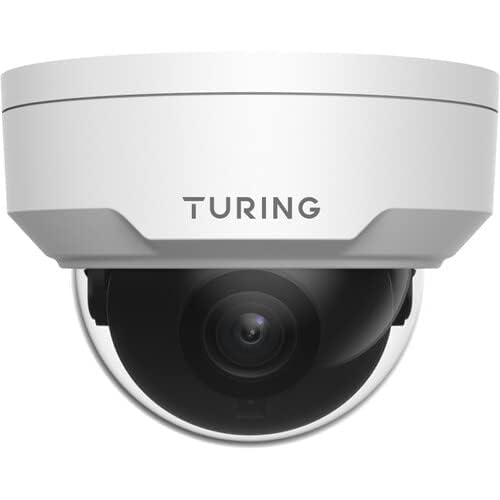
Image: Technical diagram showing the dimensions of the Turing TP-MFD4A4 Dome IP Camera, including height (81.1mm / 3.2") and diameter (108.7mm / 4.3").
| Njirimara | Nkọwapụta |
|---|---|
| Nlereanya | TP-MFD4A4 |
| Sensọ | 1/3-inch 4MP 16:9 Progressive Scan CMOS |
| oghere | 4 mm oghere oghere |
| N'akuku nke View | H: 83.7°; V: 44.9°; D: 89.2° |
| Opekempe ọkụ | Color: 0.002 Lux (F1.6, AGC on); 0 Lux with IR on |
| Ọnọdụ IR | Smart IR up to 30m (98ft) |
| Mkpebi vidiyo | Max. 4MP (2688x1520) at 30/25fps |
| Ndekọ vidiyo | Ultra 265, H.265, H.264, MJPEG |
| Nhazi Dijitalụ | 120 dB WDR; 2D/3D DNR; Defog |
| Audio | G.711; 64 Kbps; 8 KHz; noise suppression |
| Nchekwa onboard | microSD (not included), up to 256 GB |
| Ike | DC 12V+/-25% PoE (IEEE 802.3af); up to 4.5W |
| Ogo nchekwa | IP67, IK10, 4KV Surge Protection |
| Akụkụ (D x H) | 4.3 x 3.2 sentimita (108.7 x 81.1 mm) |
| Ibu | 0.93 lbs (0.42 n'arọ) |
| Ngwa dakọtara | Turing SMART Series NVRs, Turing Vision Cloud platform |
| NDAA Dabara | Ee |
Ozi akwụkwọ ikike
The Turing TP-MFD4A4 Smart Series TwilightVision 4MP IR Dome IP Camera comes with a 3-afọ akwụkwọ ikike site na ụbọchị ịzụrụ. Akwụkwọ ikike a na-ekpuchi ntụpọ dị na ngwa na arụ ọrụ n'okpuru ojiji nkịtị. Biko dowe ihe akaebe nke ịzụrụ ihe maka akwụkwọ ikike.
For detailed warranty terms and conditions, please refer to the official Turing websaịtị ma ọ bụ kpọtụrụ nkwado ndị ahịa.
Nkwado
For technical assistance, product inquiries, or warranty service, please contact Turing customer support through their official websaịtị ma ọ bụ ozi kọntaktị enyere na nkwakọ ngwaahịa gị.
Akụrụngwa dị n'ịntanetị: Visit the Turing official website for FAQs, software downloads, and additional documentation.


