1. Ozi nchekwa
Please read and understand all safety information and operating instructions before using this multimeter. Failure to follow these instructions may result in electric shock, fire, or damage to the meter.
- Always ensure the test leads are properly connected and the function switch is set to the correct range before making any measurements.
- Anwala ịtụ voltages or currents exceeding the maximum rated values for this meter.
- Kpachara anya nke ukwuu mgbe ị na-arụ ọrụ na sekit dị ndụ.tages nwere ike ịdị ize ndụ.
- Never open the meter casing unless specifically instructed for battery or fuse replacement. Ensure test leads are disconnected before opening.
- Replace the battery when the low battery indicator appears to ensure accurate readings.
- Ejila mita ahụ ma ọ bụrụ na o yiri ka ọ mebiri emebi ma ọ bụ ma ọ bụrụ na mkpuchi dị na ihe nlele ahụ emebiela.
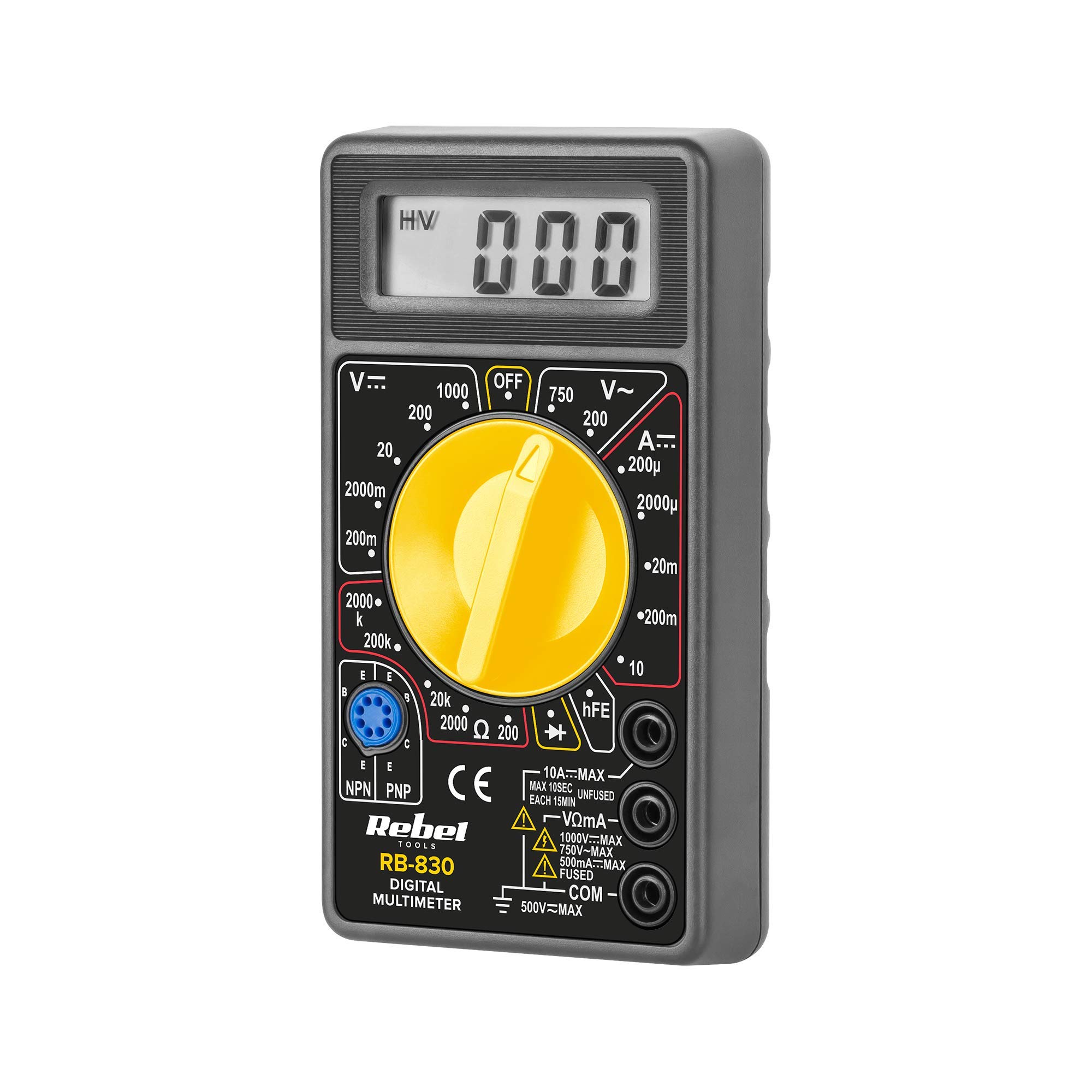
Foto 1: N'azụ view of the Rebel MIE-RB-830 Multimeter, showing the battery compartment cover and a warning label. The label advises removing test leads before opening the case to avoid electrical shock and to install fuses with correct amp/volt ratings. It also indicates the power supply is a 9V battery, type NEDA 1604 9V 6F22.
2. Ngwaahịa gafereview
The Rebel MIE-RB-830 is a compact, battery-operated digital multimeter designed for measuring DC/AC voltage, DC current, resistance, diode, and transistor (hFE) values. It is suitable for general electrical testing and troubleshooting.
2.1. Akụrụngwa
- Digital Multimeter Unit
- Nnwale Ndị Na-edu (Uhie na Oji)
- 9V Battery (may be included or sold separately)
- Akwụkwọ ntuziaka (akwụkwọ a)

Foto 2: The Rebel MIE-RB-830 Digital Multimeter shown with its accompanying red and black test leads. The multimeter features a large LCD display and a rotary function switch.

Foto 3: Agara nso view of the red and black test leads. These leads are essential for connecting the multimeter to the circuit under test.
3. Nhazi
3.1. Ntinye batrị
- Ensure the multimeter is turned OFF and all test leads are disconnected.
- Locate the battery compartment cover on the back of the meter (refer to Figure 1).
- Unscrew the retaining screw(s) and carefully remove the cover.
- Insert a new 9V battery (NEDA 1604 or 6F22 type), observing the correct polarity (+ and -).
- Replace the battery compartment cover and secure it with the screw(s).
3.2. Ijikọ ụzọ ule
- Jikọọ uhie test lead to the "VΩmA" input jack.
- Jikọọ nwa test lead to the "COM" (common) input jack.
- For current measurements exceeding 200mA (up to 10A), connect the red test lead to the "10A" input jack.
4. Ntuziaka ọrụ
4.1. Nhọrọ ọrụ
Turn the rotary switch to the desired measurement function and range. Always start with a higher range if the approximate value is unknown to prevent overloading the meter.
4.2. Ịtụ DC Voltage (V–)
- Tọọ mgba ọkụ rotary na DC Vol achọrọtage (V–) range (e.g., 20V, 200V).
- Jikọọ ihe nlele uhie ahụ n'akụkụ dị mma (+) nke sekit ahụ, tinyekwa ihe nlele ojii ahụ n'akụkụ adịghị mma (-).
- Gụọ voltage uru na LCD ngosi.
4.3. Atụ AC Voltage (V∼)
- Tọọ mgba ọkụ na-agbanwe agbanwe na AC Vol achọrọtage (V∼) range (e.g., 200V, 750V).
- Jikọọ ụzọ ule n'ofe AC voltage isi iyi.
- Gụọ voltage uru na LCD ngosi.
4.4. Measuring DC Current (A–)
Ịkpachara anya: To measure current, the meter must be connected in series with the circuit. Never connect the meter in parallel with a voltage source when in current mode, as this can damage the meter and the circuit.
- Set the rotary switch to the desired DC Current (A–) range (e.g., 20mA, 200mA, 10A).
- For currents up to 200mA, ensure the red lead is in the "VΩmA" jack. For currents up to 10A, move the red lead to the "10A" jack.
- Open the circuit where current is to be measured and connect the meter in series.
- Gụọ uru dị ugbu a na ngosipụta LCD.
4.5. Nguzogide Ịtụ (Ω)
Ịkpachara anya: Ensure the circuit or component under test is de-energized before measuring resistance.
- Set the rotary switch to the desired Resistance (Ω) range (e.g., 200Ω, 2kΩ, 200kΩ).
- Jikọọ ụzọ ule n'ofe akụrụngwa ma ọ bụ sekit a ga-atụ.
- Gụọ uru iguzogide na ngosipụta LCD.
4.6. Diode Test (→|–)
- Set the rotary switch to the Diode Test (→|–) position.
- Connect the red test lead to the anode of the diode and the black test lead to the cathode.
- Ngosipụta ga-egosi volta n'ihutage drop (typically 0.5V to 0.8V for silicon diodes).
- Weghachite ụzọ. Ngosipụta kwesịrị igosi "OL" (Open Loop) maka ezigbo diode.
4.7. Transistor (hFE) Test
- Tọọ ngbanwe rotary na ọnọdụ hFE.
- Identify if the transistor is NPN or PNP.
- Insert the transistor's emitter, base, and collector leads into the corresponding sockets on the hFE test socket.
- Read the hFE (DC current gain) value on the display.
5. Nlekọta
5.1. Ngbanwe batrị
When the low battery indicator appears on the display, replace the 9V battery as described in Section 3.1. Using a low battery can lead to inaccurate readings.
5.2. Fose nnọchi
If the current measurement function stops working, the fuse may need replacement. This operation should only be performed by qualified personnel.
- Ensure the multimeter is turned OFF and all test leads are disconnected.
- Open the back casing of the meter (this may involve more screws than just the battery compartment).
- Locate the blown fuse and replace it with a fuse of the exact same type and rating (e.g., F200mA/250V for mA range, F10A/250V for 10A range). Refer to the internal markings or specifications for precise fuse ratings.
- Carefully reassemble the meter, ensuring all screws are tightened.
5.3. Nhicha
Jiri mgbasa ozi hichaa mita ahụamp cloth and mild detergent. Do not use abrasives or solvents. Keep the meter dry.
6. Nchọpụta nsogbu
| Nsogbu | Ihe nwere ike ime | Ngwọta |
|---|---|---|
| Enweghị ngosipụta ma ọ bụ obere ngosipụta | Batrị dị ala ma ọ bụ nwụrụ anwụ | Dochie batrị 9V. |
| Ọgụgụ na-ezighi ezi | Low battery; Incorrect range selection; Poor test lead connection | Replace battery; Select appropriate range; Ensure leads are firmly connected. |
| Nha nha ugbu a anaghị arụ ọrụ | Blown fuse; Incorrect lead connection for current | Replace fuse (see Section 5.2); Ensure red lead is in "VΩmA" or "10A" jack as appropriate. |
| Egosipụtara "OL" (Oke ibu) | Measured value exceeds selected range; Open circuit (for resistance/continuity) | Select a higher range; Check circuit for breaks. |
7. Nkọwapụta
| Ọrụ nha | Oke | Izi ezi |
|---|---|---|
| DC Voltage (V–) | 200mV, 2V, 20V, 200V, 1000V | ± (0.5% + 2 nkeji) |
| AC Voltage (V∼) | 200V, 750V | ± (1.2% + 10 nkeji) |
| DC Current (A–) | 200µA, 2mA, 20mA, 200mA, 10A | ± (1.0% + 2 nkeji) |
| Nguzogide (Ω) | 200Ω, 2kΩ, 20kΩ, 200kΩ, 2MΩ | ± (0.8% + 2 nkeji) |
| Nnwale Diode | Ee | Gaa n'ihu voltage dobe |
| Ule Transistor (hFE) | Ee | hFE value |
| Ịnye ọkụ | 9V Battery (NEDA 1604 or 6F22) | |
| Ngosipụta | 3½ Digit LCD, Max. 1999 | |
| Akụkụ | Ihe ruru. 13.5 x 10 x 4 cm | |
| Ibu | Approx. 107 grams (without battery) | |
| Okpomọkụ na-arụ ọrụ | 0°C ruo 40°C (32°F ruo 104°F) | |
| Okpomọkụ nchekwa | -10°C ruo 50°C (14°F ruo 122°F) | |
| Ụkpụrụ nchekwa | CE, RoHS |
8. Akwụkwọ ikike na nkwado
This Rebel MIE-RB-830 Digital Multimeter is covered by a standard manufacturer's warranty against defects in materials and workmanship. Please refer to the warranty card included with your purchase or contact your retailer for specific warranty terms and conditions.
For technical support or service inquiries, please contact the point of purchase or visit the official Rebel websaịtị maka ozi kọntaktị.


