Okwu mmalite
This manual provides essential information for the setup, operation, and maintenance of your Fender American Professional II Precision Bass. Designed for musicians seeking a familiar yet versatile instrument, this bass features a comfortable '63 P Bass neck profile, smooth rolled fingerboard edges, and a "Super-Natural" satin finish. It is equipped with a new V-Mod II split-coil pickup for articulate sound and a HiMass Vintage Bridge for enhanced sustain and attack.
Melite
1. Iwepu ngwongwo
Carefully remove your bass from its case. Inspect the instrument for any visible damage that may have occurred during shipping. Retain all packaging materials for future transport or storage.
2. Nyocha mbụ
Examine the neck, body, hardware, and electronics. Ensure all components are securely fastened.
3. String Installation and Tuning
Your bass comes with factory strings. For optimal performance, ensure they are properly seated and tuned to standard E-A-D-G (from thickest to thinnest string). Use a reliable electronic tuner for accuracy.

Image: Full front view of the Fender American Professional II Precision Bass in Olympic White with a rosewood fingerboard and tortoise pickguard.
4. Mgbakwunye eriri
Attach a guitar strap to the strap buttons located on the upper horn and the bottom end of the body. Ensure the strap is securely fastened before playing.
Operating Your Bass
1. Ijikọ na Ampna -emegharị ihe
Insert a standard 1/4-inch instrument cable into the output jack located on the side of the bass body. Connect the other end of the cable to your bass amplifier's input.

Foto: nso nso view of the lower body of the Fender Precision Bass, highlighting the volume and tone control knobs, and the 1/4-inch output jack.
2. Njikwa
- Mpịakọta Mpịakọta: Controls the overall output level of the instrument. Turn clockwise to increase volume, counter-clockwise to decrease.
- Mkpọ ụda: Adjusts the treble frequencies. Turn clockwise for brighter tones, counter-clockwise for warmer, darker tones.
3. Playing Position
Hold the bass comfortably, whether standing or seated. Adjust your strap length to allow for easy access to all frets and controls.
Nlekọta
1. Nhicha
Regularly wipe down the body, neck, and strings with a soft, lint-free cloth after each use to remove sweat and grime. For the body finish, use a guitar-specific polish sparingly. For the rosewood fingerboard, a specialized fretboard conditioner can be applied periodically to prevent drying.
2. Ndochi eriri
Strings should be replaced regularly, depending on usage, to maintain optimal tone and playability. Replace one string at a time to maintain neck tension. Refer to the headstock image for proper string winding around the tuning machines.
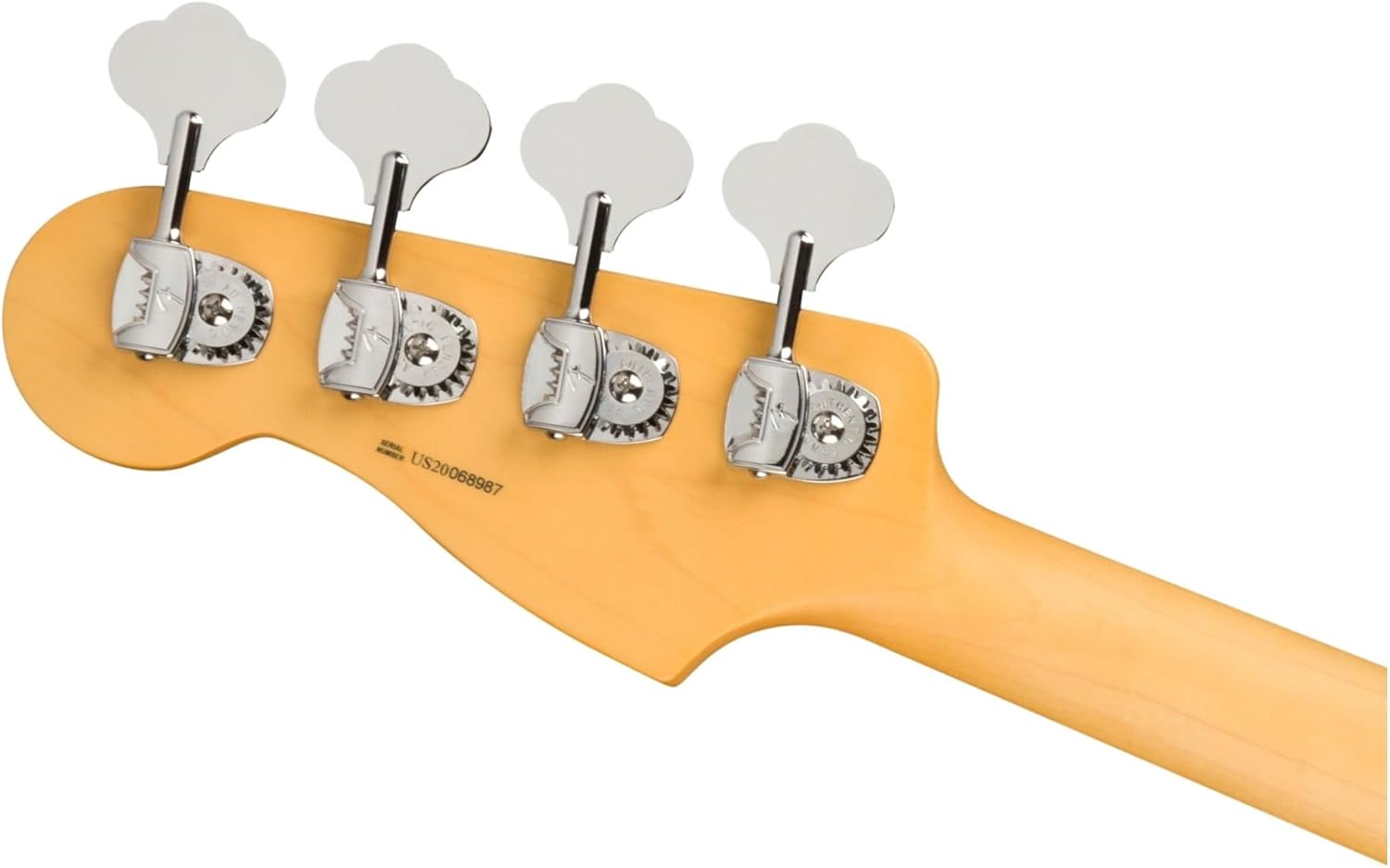
Foto: nso nso view of the Fender Precision Bass headstock, showing the four tuning machines and the Fender logo.
3. Nlekọta Fretboard
Keep the rosewood fretboard clean and moisturized. Avoid harsh chemicals. If the fretboard appears dry, apply a small amount of lemon oil or a dedicated fretboard conditioner.
4. Hardware Inspection
Periodically check all screws and nuts on the tuning machines, bridge, and pickguard for tightness. Do not overtighten.
Nchọpụta nsogbu
This section addresses common issues you might encounter with your bass.
1. Enweghị ụda ụda
- Lelee njikọ USB: Ensure the instrument cable is securely plugged into both the bass and the ampna -emegharị ihe.
- Amplifier Ike: Nyochaa nke ahụ amplifier is turned on and its volume is not set to zero.
- Olu Bass: Confirm the volume knob on your bass is turned up.
- Ịdị n'ezi nke eriri USB: Test with a different instrument cable to rule out a faulty cable.
2. Buzzing or Fret Noise
- Usoro Egwuregwu: Ensure proper finger placement and pressure on the frets.
- String Height (Action): If buzzing persists, the string action might be too low. This may require professional adjustment of the bridge saddles or truss rod.
- Fret Wear: Worn frets can cause buzzing. This typically requires professional fret leveling or replacement.
3. Ndabere na-adịghị mma
If notes played at the 12th fret do not match the harmonic at the 12th fret, the intonation needs adjustment. This involves adjusting the length of each string at the bridge saddles. This is a precise adjustment best performed by an experienced technician.

Foto: nso nso view of the Fender Precision Bass bridge, showing the individual saddles and the V-Mod II split-coil pickup.
Nkọwapụta
| Njirimara | Nkọwa |
|---|---|
| Aha Nlereanya | American Professional II Precision Bass |
| Nọmba nlereanya | 0193930705 |
| Akụrụngwa ahụ | Alder |
| Emecha ahụ | Gloss Urethane |
| Ihe olu olu | Maple |
| Neck Finish | "Super-Natural" Satin Urethane with Gloss Urethane Headstock Face |
| Ihe eji eme Fretboard | Rosewood |
| Ọnụọgụ nke Frets | 20 |
| Akụrụngwa | Ọkpụkpụ |
| Akwa akwa | 4-Saddle HiMass Vintage (String-Through-Body or Top-Load) |
| Ntugharị | V-Mod II Split Single-Coil Precision Bass |
| Njikwa | Olu ukwu, olu ukwu |
| Mechaa ngwaike | Nickel/Chrome |
| Ụdọ | Fender USA 7250M Nickel Plated Steel (.045-.105 Gauges) |
| Akụkụ (L x W x H) | 53 x 19 x 6 sentimita asatọ |
| Ibu Ibu | 3 pound (Note: This is likely shipping weight, actual instrument weight may vary) |
Akwụkwọ ikike na nkwado
Fender instruments are covered by a limited warranty. For specific details regarding your instrument's warranty coverage, please refer to the warranty card included with your purchase or visit the official Fender website. For technical support, service, or parts, contact Fender customer service directly.
Akụrụngwa dị n'ịntanetị: For additional resources, including FAQs, setup guides, and product registration, visit www.fender.com/support.


