1. Okwu mmalite
Thank you for choosing the OSD Black 300W Subwoofer Amplifier, Model BK-SAM300. This amplifier is designed to provide powerful and precise low-frequency amplification for passive subwoofers, enhancing your home theater or audio system experience. With its robust Class AB output stage and versatile connectivity options, the BK-SAM300 delivers deep, impactful bass for movies, music, and games.
This manual provides detailed instructions for the proper installation, operation, and maintenance of your subwoofer amplifier. Please read it thoroughly before use and retain it for future reference.
2. Ozi nchekwa
ỊDỌ AKA NA NTỊ: Iji belata ihe ize ndụ nke ọkụ ma ọ bụ ọkụ eletrik, ekpuchila ngwa a na mmiri ozuzo ma ọ bụ mmiri.
- Gụọ ntuziaka niile tupu ị rụọ ọrụ ampna -emegharị ihe.
- Debe akwụkwọ ntuziaka a maka ntụnye aka n'ọdịnihu.
- Heed all warnings on the amplifier and in this manual.
- Soro ntuziaka niile.
- Ejila ngwa a n'akụkụ mmiri.
- Jiri akwa kpọrọ nkụ hichaa naanị.
- Akwụsịla oghere ikuku ikuku ọ bụla. Wụnye dị ka ntuziaka onye nrụpụta si dị.
- Awụnyela n'akụkụ ebe okpomọkụ ọ bụla dị ka radiators, ndekọ okpomọkụ, stovu, ma ọ bụ ngwa ndị ọzọ (gụnyere amplifiers) nke na-emepụta okpomọkụ.
- Emebila ebumnuche nchekwa nke plọg a na-agbapụta ma ọ bụ ntọ ala. Plọg nwere agụba abụọ nwere otu sara mbara karịa nke ọzọ. Ụdị nkwụnye ala nwere agụba abụọ na oghere mgbada nke atọ. A na-enye oghere sara mbara ma ọ bụ akụkụ nke atọ maka nchekwa gị. Ọ bụrụ na plọg e nyere adabaghị n'ime oghere gị, kpọtụrụ onye na-ahụ maka ọkụ eletrik ka ọ dochie ebe nkwụnye ahụ ochie.
- Chebe eriri ọkụ ka ị ghara ịgagharị ma ọ bụ tuo ya, ọkachasị na plọg, ebe nchekwa dị mma, na ebe ha si na ngwa ahụ pụta.
- Jiri naanị mgbakwunye / ngwa ndị nrụpụta akọwapụtara.
- Kwupu ngwa a n'oge oke mmiri ozuzo ma ọ bụ mgbe ejighi ya ogologo oge.
- Tụtụ aka n'aka ndị ọrụ ruru eru. A na-achọ ọrụ mgbe ngwa ahụ mebiri emebi n'ụzọ ọ bụla, dị ka eriri ọkụ ma ọ bụ plọg mebiri emebi, mmiri mmiri wụfuru ma ọ bụ ihe dabara n'ime ngwa ahụ, ekpughere ngwa ahụ na mmiri ozuzo ma ọ bụ mmiri, anaghị arụ ọrụ nke ọma. , ma ọ bụ ahapụla ya.
3. Ihe ngwugwu
Biko lelee igbe maka ihe ndị a:
- OSD Black 300W Subwoofer Amplifier (BK-SAM300)
- Ụdọ ọkụ
- Akwụkwọ ntuziaka (akwụkwọ a)
4. Ngwaahịa gafereview
4.1 Njikwa ihu ihu
The front panel of the BK-SAM300 features essential controls for power and audio adjustments.

Foto 4.1: N'ihu na azụ View of the BK-SAM300 Amplifier. This image displays both the front panel with its controls and the rear panel with all input/output connections.
- Bọtịnụ ike: Na-atụgharị ya amplifier's power on or off.
- Phase Control (0° - 180°): Adjusts the phase of the subwoofer output relative to the main speakers. This helps to ensure that the subwoofer's sound waves align correctly with those of the main speakers, preventing cancellation or reinforcement issues at the crossover frequency.
- FREQ (Crossover Frequency) Control: Sets the upper frequency limit for the subwoofer. Frequencies above this setting will be filtered out. Adjustable from approximately 40Hz to 120Hz.
- GAIN (Volume) Control: Adjusts the overall output level of the subwoofer amplifier. Use this to balance the subwoofer's volume with the rest of your audio system.
4.2 Njikọ na njikwa azụ azụ
The rear panel houses all the input and output connections, along with additional settings for advanced configuration.
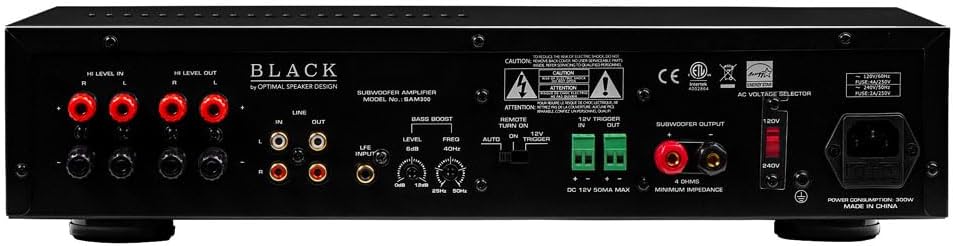
Figure 4.2: Rear Panel of the BK-SAM300 Amplifier. This image provides a detailed view of all input and output terminals, including Hi Level, Line, LFE, Bass Boost, 12V Trigger, and Subwoofer Output.
- HI LEVEL IN (Speaker Level Input): Connects directly to the speaker outputs of your receiver or amplifier. Use this if your receiver does not have a dedicated subwoofer output or LFE output.
- HI LEVEL OUT (Speaker Level Output): Passes the full-range audio signal from the HI LEVEL IN to your main speakers.
- LINE IN (RCA Input): Standard RCA stereo inputs for connecting to the pre-out or line-out of your receiver or audio source.
- LINE OUT (RCA Output): Passes the audio signal from the LINE IN to another ampngwa ọkụ ma ọ bụ ngwaọrụ ọdịyo.
- LFE INPUT (RCA Input): Dedicated input for connecting to the LFE (Low-Frequency Effects) output of an AV receiver. This bypasses the amplifier's internal crossover, relying on the receiver's bass management.
- BASS BOOST (Level & Freq):
- Level (0dB to 12dB): Adjusts the intensity of the bass boost.
- Freq (25Hz to 50Hz): Selects the center frequency at which the bass boost is applied.

Figure 4.3: Detail of Bass Boost Controls. This image highlights the Level and Freq knobs for fine-tuning the bass boost.
- REMOTE TURN ON (Manual, Auto, 12V Trigger): Họrọ nke amplifier's power-on mode.
- Akwụkwọ ntuziaka: Amplifier is turned on/off manually via the front panel power button.
- Akpaaka: Amplifier automatically turns on when an audio signal is detected and enters standby mode when no signal is present for a period.
- 12V na-ebubata/mpụ: Na-enye ohere amplifier to be turned on/off by a 12V DC trigger signal from a compatible receiver or control system.
- SUBWOOFER OUTPUT (Binding Posts): Connects to your passive subwoofer using speaker wire. Ensure correct polarity (+ to + and - to -). The amplifier kwụsiri ike ruo 4 ohms impedance.

Figure 4.4: Detail of Subwoofer Output and 12V Trigger. This image shows the binding posts for subwoofer connection and the 12V trigger terminals.
- AC VOLTAGE SELECTOR (120V/240V): Na-ahọpụta ntinye kwesịrị ekwesị voltage maka mpaghara gị. Ensure this is set correctly before plugging in the ampna -emegharị ihe.
- Ntinye ike AC: Na-ejikọ eriri ọkụ ewepụtara.
5. Nhazi
5.1 Ntinye
Debe ya amplifier in a location that allows for adequate ventilation. Avoid enclosed spaces or stacking other components directly on top of the amplifier. Keep it away from direct sunlight, heat sources, and moisture. Ensure it is placed on a stable, level surface.
5.2 Ijikọ Ampna -emegharị ihe
Choose one of the following connection methods based on your audio system's capabilities:
Method A: Using LFE Input (Recommended for AV Receivers with Subwoofer Output)
- Connect an RCA cable from the LFE or Subwoofer Pre-Out jack on your AV receiver to the Ntinye LFE jack on the BK-SAM300.
- Connect your passive subwoofer to the AKW SKWỌ SUBWOOFER binding posts on the BK-SAM300 using appropriate gauge speaker wire. Ensure correct polarity (+ to + and - to -).
- Proceed to Section 5.3 for power connection.
Method B: Using Line Level Inputs (for Stereo Receivers or Pre-Outs)
- Connect RCA cables from the Pre-Out or Line-Out jacks of your receiver/pre-ampna -emegharị ahụ Akara IN (Left and Right) jacks on the BK-SAM300.
- Connect your passive subwoofer to the AKW SKWỌ SUBWOOFER binding posts on the BK-SAM300 using appropriate gauge speaker wire. Ensure correct polarity (+ to + and - to -).
- Proceed to Section 5.3 for power connection.
Method C: Using High Level Inputs (for Receivers without Dedicated Subwoofer/Pre-Outs)
- Connect speaker wires from the main speaker outputs of your receiver/ampna -emegharị ahụ Ọkwa HI IN (Left and Right) binding posts on the BK-SAM300. Ensure correct polarity.
- (Optional) If you wish to pass the signal through to your main speakers, connect speaker wires from the Ọkwa HI PỤTA binding posts on the BK-SAM300 to your main speakers.
- Connect your passive subwoofer to the AKW SKWỌ SUBWOOFER binding posts on the BK-SAM300 using appropriate gauge speaker wire. Ensure correct polarity (+ to + and - to -).
- Proceed to Section 5.3 for power connection.
5.3 Njikọ ike
- Tupu ijikọ eriri ọkụ, hụ na AC VOLTAGE onye nhọpụta switch on the rear panel is set to the correct voltage for your region (120V or 240V). Incorrect setting can damage the unit.
- Jikọọ eriri ọkụ enyere na Ntinye ike AC on the rear panel of the ampna -emegharị ihe.
- Tinye nsọtụ nke ọzọ nke eriri ọkụ eletrik n'ime oghere mgbidi kwesịrị ekwesị.
6. Ntuziaka ọrụ
6.1 Gbanyụọ/ gbanyụọ
The BK-SAM300 offers three power-on modes:
- Ụdị akwụkwọ ntuziaka: Tọọ nke Gbanye n'ebe dị anya switch to "Manual". Press the front panel bọtịnụ ike iji tụgharịa ampagbanyụ ọkụ ma ọ bụ gbanyụọ.
- Nchekwa onwe na ọnọdụ: Tọọ nke Gbanye n'ebe dị anya switch to "Auto". The amplifier will automatically turn on when an audio signal is detected at the inputs and will enter standby mode after approximately 15-20 minutes of no audio signal.
- 12V Trigger Mode: Connect a 12V DC trigger cable from your source component (e.g., AV receiver) to the 12V TRIGGER IN terminal. Set the Gbanye n'ebe dị anya switch to "12V Trigger". The amplifier will power on/off with the source component.
6.2 Njikwa Nhazi
Optimal sound quality depends on proper adjustment of the amplifier's controls to match your subwoofer and listening environment.
- GAIN (Volume): Start with the GAIN control at its minimum setting. Play some audio with significant bass content. Slowly increase the GAIN until the subwoofer's output blends seamlessly with your main speakers. Avoid setting the gain too high, as this can lead to distortion.
- FREQ (Crossover Frequency):
- Ọ bụrụ na ị na-eji Ntinye LFE, this control is bypassed. Set your AV receiver's subwoofer crossover frequency.
- Ọ bụrụ na-eji Akara IN or Ọkwa HI IN, adjust the FREQ control to blend the subwoofer's output with your main speakers. A good starting point is typically 80Hz-100Hz, but this may vary depending on the size and frequency response of your main speakers. Smaller main speakers usually require a higher crossover frequency.
- PHASE (0° - 180°): The phase control helps to ensure that the subwoofer's sound waves are in sync with your main speakers.
- Play music with a consistent bass line.
- While listening from your primary listening position, slowly adjust the PHASE control from 0° to 180°.
- Stop at the position where the bass sounds the loudest and most impactful. If the bass sounds weak or hollow, try adjusting the phase.
- AKWỤKWỌ BASS: Use the BASS BOOST controls (Level and Freq) to fine-tune the low-frequency response.
- Ugboro: Select the specific low frequency (25Hz to 50Hz) you wish to boost.
- Ọkwa: Adjust the amount of boost (0dB to 12dB) at the selected frequency. Use sparingly to avoid muddy or boomy bass.
7. Nlekọta
- Nhicha: Kwupu njikọ ahụ amplifier from power before cleaning. Use a soft, dry cloth to wipe down the exterior. Do not use liquid cleaners or aerosol sprays.
- Igwe ikuku: Ensure that the ventilation openings are not blocked by dust or debris. Periodically check and clean if necessary to maintain proper airflow.
- Nchekwa: Ọ bụrụ na-echekwa ampihe na-eme ka ihe na-agbapụta ọkụ ruo ogologo oge, wepụ ya na ọkụ eletrik ma debe ya n'ebe dị jụụ ma kpọọ nkụ, ebe anwụ na-acha kpọmkwem na oke okpomọkụ dị oke njọ.
8. Nchọpụta nsogbu
| Nsogbu | Ihe nwere ike ime | Ngwọta |
|---|---|---|
| Enweghị ike / Amplifier anaghị agbanwuo. |
|
|
| Enweghị ụda sitere na subwoofer. |
|
|
| Distorted or muddy bass. |
|
|
| Humming or buzzing noise. |
|
|
9. Nkọwapụta
| Njirimara | Nkọwa |
|---|---|
| Nlereanya | BK-SAM300 |
| Ike mmepụta | 300 watts (RMS) |
| Impedance Stability | 4-ohm Stable |
| AmpKlas liifier | Klas AB |
| Nzaghachi ugboro ugboro | 20Hz - 160Hz |
| Ogba aghara ugboro ole | Adjustable 40Hz - 120Hz |
| Njikwa usoro | 0° - 180° Variable |
| Bass Boost | 25Hz - 50Hz, up to 12dB |
| Ntinye | Low-level (RCA), High-level (Speaker), LFE (RCA), 12V Trigger |
| Nsonaazụ | Subwoofer Output (Binding Posts), High-level Pass-through, 12V Trigger |
| Ụdị ike | Manual, Auto-Sensing, 12V Trigger |
| Oriri Ike Njikere | Ihe na-erughị 1 Watt |
| Akụkụ (W x H x D) | 17.25 x 3.75 x 13.88 sentimita (43.8 x 9.5 x 35.2 cm) |
| Ibu | 20 pound (9.07 n'arọ) |
| Ihe onwunwe chassis | Heavy-duty steel with brushed aluminum faceplate |
| Voltage | Switchable 120V/240V |
10. Akwụkwọ ikike na nkwado
OSD Audio products are designed and manufactured to the highest quality standards. For specific warranty information regarding your BK-SAM300 Subwoofer Amplifier, please refer to the warranty card included with your product or visit the official OSD Audio webEbe a na-edebe akwụkwọ ikike. Usoro akwụkwọ ikike na-ekpuchi ntụpọ dị na ihe na ọrụ aka mgbe ejiri ya mee ihe nkịtị.
For technical support, troubleshooting assistance, or service inquiries, please contact OSD Audio customer support through their official website or the contact information provided with your purchase. Please have your model number (BK-SAM300) and purchase date ready when contacting support.
Akụrụngwa dị n'ịntanetị: For the latest information, FAQs, and additional support, please visit the OSD Audio websaịtị.


