1. Okwu mmalite
This manual provides essential instructions for the safe and effective operation of your AOPUTTRIVER AP-770D Digital Multimeter. Please read this manual thoroughly before use and retain it for future reference. This device is designed for accurate measurement of various electrical parameters in a wide range of applications.
Ozi nchekwa
- Na-agbaso koodu nchekwa mpaghara na nke obodo mgbe niile.
- Ejila mita ahụ ma ọ bụrụ na o yiri ka ọ mebiri emebi ma ọ bụ ma ọ bụrụ na mkpuchi dị na ihe nlele ahụ emebiela.
- Ensure the correct function and range are selected before making measurements.
- Avoid making measurements on circuits with voltages exceeding the meter's rated limits.
- Replace batteries and fuses only with the specified type and rating.
2. Ihe ngwugwu
Chọpụta na ihe niile edepụtara n'okpuru dị na ngwugwu gị:
- AOPUTTRIVER AP-770D Digital Multimeter
- Nnwale Ndị Na-edu (Uhie na Oji)
- K-Type Thermocouple (Temperature Probe)
- 9V batrị
- Akwụkwọ ntuziaka onye ọrụ
- Obere akpa
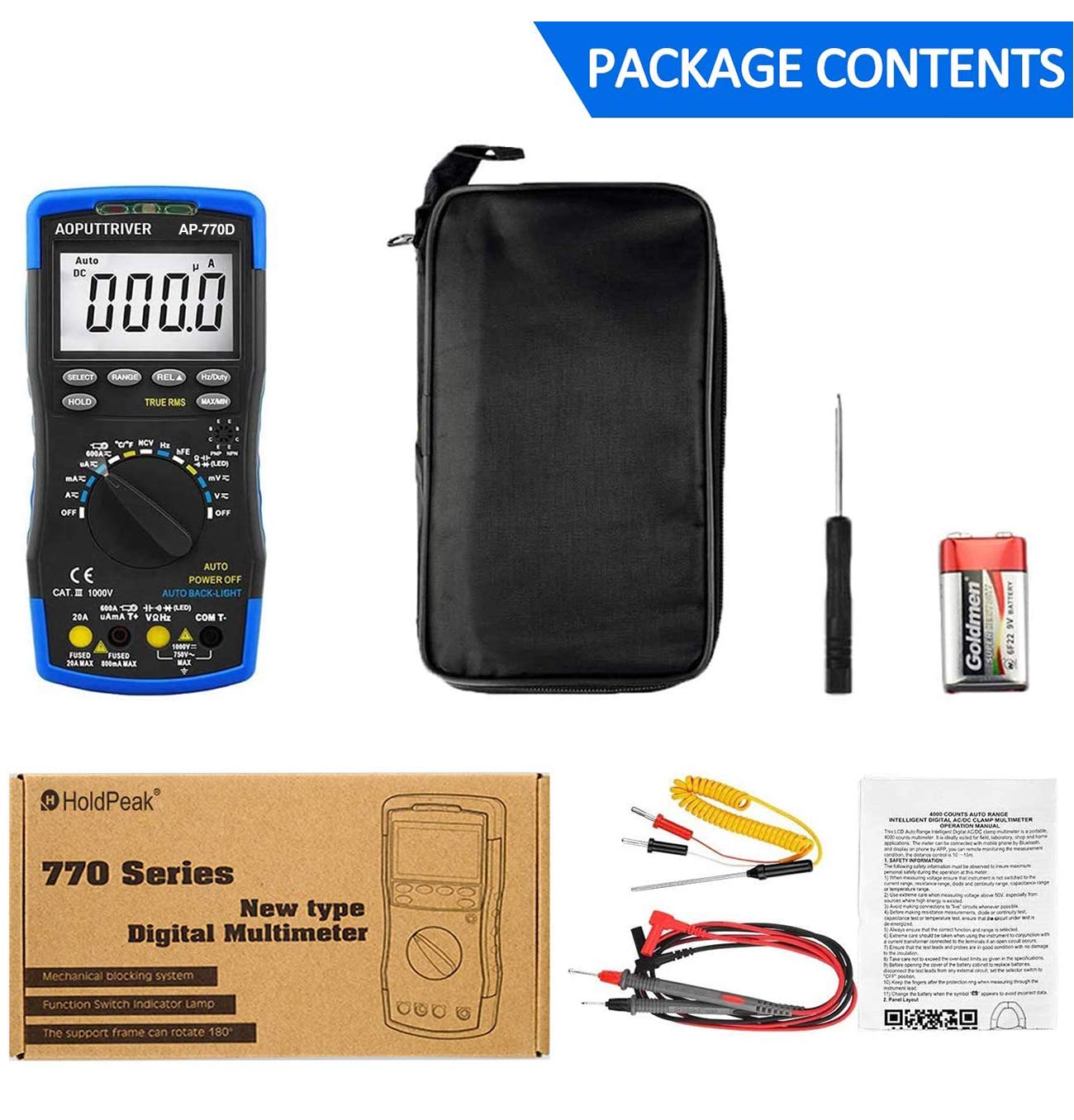
Figure 2.1: Contents of the AP-770D package, including the multimeter, test leads, temperature probe, battery, manual, and carrying pouch.
3. Ngwaahịa gafereview
Familiarize yourself with the components of your AP-770D Digital Multimeter:

Foto 3.1: N'ihu view of the AP-770D with key functions labeled.
- NCV Red Light: Indicates non-contact voltage nchọpụta.
- CDS Sensor: Light sensor for auto backlight.
- NCV Green Light: Indicates non-contact voltage nchọpụta.
- NCV Detection Area: Point for non-contact voltagna-aghọta.
- Ngosipụta: Large LCD for reading measurements.
- SELECT Key: Toggles between functions within a rotary switch position.
- Jide igodo: Na-akpọchi ọgụgụ ngosi dị ugbu a.
- RANGE Key: Switches between auto-ranging and manual ranging.
- REL ▲ Key: Activates relative measurement mode.
- Hz/Duty Key: Selects frequency or duty cycle measurement.
- Igodo MAX/MIN: Records maximum and minimum readings.
- Transistor hFE Test Input Jack: For testing transistor gain.
- Ngbanwe Rotary: Selects the desired measurement function.
- VΩHz Input: Ọnụ ntinye ntinye maka voltage, nguzogide, ugboro ole, ike, diode, na nhụta n'ihu.
- COM Input: Common (negative) terminal for all measurements.
- 20A Input Jack: Input terminal for high AC/DC current measurements (up to 20A).
- µA mA T+ Input: Input terminal for microampere/milliampere current and temperature measurements.

Figure 3.2: Dimensions of the AP-770D and its 180° swivel stand.
4. Nhazi
4.1 Ntinye batrị
The AP-770D requires one 9V battery for operation. To install or replace the battery:
- Ensure the multimeter is powered off and test leads are disconnected.
- Chọta ebe mkpuchi batrị n'azụ unit ahụ.
- Jiri skrudị mee ka skru ahụ dị jụụ nke na-ejide mkpuchi batrị ahụ.
- Remove the cover and insert the 9V battery, observing correct polarity.
- Dochie mkpuchi batrị wee mee ka ịghasa sie ike.
4.2 Agbanye ike mbụ
Turn the rotary switch from the 'OFF' position to any desired measurement function. The display will illuminate. The meter features an auto backlight that activates in low-light conditions.
5. Ụdị arụ ọrụ
The AP-770D offers a variety of measurement functions. Always ensure the correct function is selected and test leads are connected to the appropriate input jacks.
5.1 Ụgbọ elutagNha eletrọniki (AC/DC)
Iji tụọ voltage:
- Set the rotary switch to the 'V~' (AC Voltage) or 'V∓' (DC Voltage) ọnọdụ.
- Connect the red test lead to the 'VΩHz' input jack and the black test lead to the 'COM' input jack.
- Connect the test probes across the circuit or component to be measured.
- Gụọ voltage uru na ngosi.
5.2 Current Measurement (AC/DC)
Iji tụọ ugbu a:
- Set the rotary switch to the appropriate current range (µA, mA, or A). Use the 'SELECT' button to toggle between AC and DC current if applicable.
- Connect the red test lead to the 'µA mA T+' or '20A' input jack (depending on expected current) and the black test lead to the 'COM' input jack.
- Connect the test probes in series with the circuit to be measured.
- Gụọ uru dị ugbu a na ngosi.
5.3 Nledo Nguzogide
Iji tụọ nguzogide:
- Set the rotary switch to the 'Ω' (Resistance) position.
- Connect the red test lead to the 'VΩHz' input jack and the black test lead to the 'COM' input jack.
- Connect the test probes across the component to be measured. Ensure the circuit is de-energized.
- Gụọ uru ndị na-eguzogide na ngosipụta.
5.4 Mmesho ikike
Iji tụọ ike:
- Set the rotary switch to the '––||––' (Capacitance) position.
- Connect the red test lead to the 'VΩHz' input jack and the black test lead to the 'COM' input jack.
- Connect the test probes across the capacitor. Ensure the capacitor is discharged before testing.
- Gụọ uru capacitance na ngosipụta.
5.5 Frequency and Duty Cycle Measurement
To measure frequency or duty cycle:
- Set the rotary switch to the 'Hz' position.
- Connect the red test lead to the 'VΩHz' input jack and the black test lead to the 'COM' input jack.
- Jikọọ nyocha ule ahụ n'ofe isi iyi mgbaàmà ahụ.
- Press the 'Hz/Duty' button to toggle between frequency and duty cycle readings.
5.6 Diode Ule
To perform a diode test:
- Set the rotary switch to the '→|–' (Diode) position.
- Connect the red test lead to the 'VΩHz' input jack and the black test lead to the 'COM' input jack.
- Connect the red probe to the anode and the black probe to the cathode of the diode.
- A forward voltage drop will be displayed for a good diode. Reverse the probes; the display should show 'OL' (Open Loop).
5.7 Nnwale na-aga n'ihu
Iji mee ule na-aga n'ihu:
- Set the rotary switch to the '▪))' (Continuity) position.
- Connect the red test lead to the 'VΩHz' input jack and the black test lead to the 'COM' input jack.
- Jikọọ ihe nyocha ule n'ofe sekit ma ọ bụ akụkụ ahụ.
- Ọ bụrụ na ihe na-aga n'ihu dị (nguzogide dị n'okpuru oke ụfọdụ), ihe na-akpọ ụda ga-ada ụda.
5.8 Tụọ oke okpomọkụ
Iji tụọ okpomọkụ:
- Set the rotary switch to the '°C/°F' (Temperature) position.
- Connect the K-type thermocouple to the 'µA mA T+' and 'COM' input jacks, observing polarity.
- Place the thermocouple tip on or in the object whose temperature is to be measured.
- Read the temperature value on the display. Use the 'SELECT' button to switch between Celsius and Fahrenheit.

Figure 5.1: Measuring temperature of a liquid using the AP-770D's temperature probe.
5.9 Ndị anaghị akpọtụrụ Voltage (NCV) Nchọpụta
Iji chọpụta AC voltage enweghị kọntaktị:
- Set the rotary switch to the 'NCV' position.
- Move the NCV detection area (top of the meter) close to the conductor being tested.
- The NCV red and green lights will flash, and the buzzer will sound, indicating the presence of AC voltage. The intensity of the indication increases with stronger voltage.

Figure 5.2: Using the NCV function to detect live wires without direct contact.
5.10 hFE Test (Transistor Gain)
To test transistor hFE:
- Set the rotary switch to the 'hFE' position.
- Insert the transistor leads (Emitter, Base, Collector) into the corresponding holes in the 'Transistor hFE Test Input Jack'.
- Read the hFE value on the display.
6. Nkọwapụta
| Njirimara | Uru |
|---|---|
| Ngosipụta Ngosipụta | 40,000 Ọnụ |
| Ezi RMS | Ee |
| Ebe Nchekwa onwe | Ee |
| NCV | Ee |
| AC/DC Voltage | Ruo 1000V |
| AC/DC dị ugbu a | Ruo 20A |
| Nguzogide | Up to 60MΩ |
| Ike | Up to 60mF |
| Ugboro ugboro | Ruo 10MHz |
| Okpomọkụ | Yes (with K-type thermocouple) |
| Nnwale Diode | Ee |
| Nnwale na-aga n'ihu | Yes (with buzzer) |
| Nnwale hFE | Ee |
| Ìhè azụ akpaaka | Ee |
| Gbanyụọ ike akpaaka | Ee |
| Ụkpụrụ nchekwa | IEC-1010, CAT III 1000V |
| Isi Iyi Ike | 9V batrị |
| Akụkụ | 20cm x 9cm x 4cm (ihe dị ka) |
| Ibu | 350 grams |
7. Nlekọta
7.1 Nhicha
Hichapụ mita ahụ casing na adamp ákwà na ihe nchacha dị nro. Ejila ihe nchacha ma ọ bụ ihe mgbaze. Hụ na mita ahụ kpọrọ nkụ kpamkpam tupu e jiri ya.
7.2 nnọchi batrị
When the battery symbol appears on the display, replace the 9V battery as described in Section 4.1.
7.3 Mgbanwe Fuse
If the current measurement function fails, the fuse may need replacement. Refer to the full user manual for detailed instructions on fuse replacement. Always use fuses with the specified ratings (e.g., Fused 20A MAX, Fused 500mA MAX).

Figure 7.1: The mechanical blocking system helps prevent incorrect lead insertion, enhancing safety during use.
8. Nchọpụta nsogbu
- Enweghị Ngosipụta: Check battery installation and charge level. Replace battery if necessary.
- 'OL' on Display: Indicates an over-range condition or open circuit. Select a higher range or check connections.
- Ọgụgụ na-ezighi ezi: Ensure correct function and range are selected. Verify test lead connections and integrity.
- Current Measurement Failure: Check the fuse. Replace if blown (refer to Section 7.3).
9. Akwụkwọ ikike na nkwado
For warranty information or technical support, please refer to the contact details provided in your product packaging or visit the AOPUTTRIVER official website. Do not attempt to repair the device yourself, as this may void the warranty and pose a safety risk.


