Okwu mmalite
This manual provides essential instructions for the installation, operation, maintenance, and troubleshooting of your SonicWall TZ400 Network Security Appliance. Please read this document thoroughly before setting up your device to ensure proper functionality and security.
1. Ntọala na nwụnye
Ihe ngwugwu 1.1
Chọpụta na ihe niile dị na ngwugwu:
- SonicWall TZ400 Appliance
- Ihe nkwụnye ọkụ
- Ụdọ ọkụ
- eriri Ethernet
- Ntuziaka mmalite ngwa ngwa (tụ aka na ntuziaka a maka ntuziaka zuru ezu)
1.2 Nwụnye anụ ahụ
- Nkwanye: Position the appliance in a cool, dry, and well-ventilated area. Ensure adequate space around the device for airflow. Avoid placing it near heat sources or in direct sunlight.
- Njikọ ike: Connect the power adapter to the appliance's power input and then plug the power cord into a suitable electrical outlet. The device will power on automatically.
- Njikọ netwọk:
- Connect your Internet Service Provider's (ISP) modem or router to the WAN port (typically labeled X1) on the SonicWall TZ400 using an Ethernet cable.
- Connect your internal network devices (e.g., switch, computer) to the LAN ports (typically labeled X0, X2-X6) using Ethernet cables.
- For initial configuration, connect a computer directly to the X0 (LAN) port.

Foto nke 1.1: N'ihu view of the SonicWall TZ400 appliance, showing LED indicators, a USB port, and network port labels.
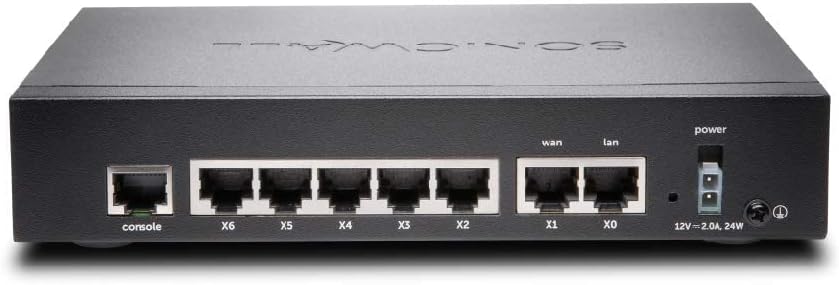
Foto nke 1.2: N'azụ view of the SonicWall TZ400 appliance, displaying the console port, multiple LAN/WAN Ethernet ports (X0-X6), and the power input.
1.3 Nweta nhazi izizi
- Ensure your computer is connected to the X0 (LAN) port of the TZ400.
- Configure your computer's network adapter to obtain an IP address automatically (DHCP). The TZ400's X0 interface typically acts as a DHCP server.
- Mepee a web browser and navigate to the default management IP address, usually http://192.168.168.168.
- Log in using the default credentials (refer to the Quick Start Guide or device label for initial username and password). You will be prompted to change the password upon first login.
- Follow the on-screen setup wizard to configure basic network settings, including WAN connectivity and time zone.
2. Ọrụ
2.1 Nhazi netwọkụ
The SonicWall TZ400 provides extensive options for network configuration. Access these settings via the web njikwa interface.
- Ntọala WAN: Configure your Internet connection type (e.g., Static IP, DHCP, PPPoE).
- Ntọala LAN: Manage IP addressing, DHCP server settings, and VLANs for your internal network.
- Wireless (if applicable): If your model includes wireless capabilities, configure SSIDs, security protocols, and wireless channels. The TZ400 supports 802.11ac wireless type.
2.2 Atụmatụ nchekwa
The TZ400 is designed to provide robust network security. Key features include:
- Iwu Firewall: Create and manage access rules to control traffic flow between network zones.
- Intrusion Prevention System (IPS): Protect against network-based attacks and vulnerabilities.
- Gateway Anti-Virus/Anti-Spyware: Scan incoming and outgoing traffic for malicious content.
- VPN (Netwọk nkeonwe mebere): Establish secure connections for remote access or site-to-site communication.
- Nzacha ọdịnaya: Control access to inappropriate or unproductive web ọdịnaya.
2.3 Monitoring and Reporting
The appliance offers tools to monitor network activity and generate reports:
- Ndekọ sistemụ: View detailed logs of network events, security alerts, and system status.
- Nleba anya oge: Observe current network traffic, connections, and resource utilization.
- Akụkọ: Generate customizable reports on security threats, user activity, and bandwidth usage.
3. Nlekọta
3.1 Mmelite firmware
Regularly update the appliance firmware to ensure optimal performance, security, and access to new features. Firmware updates can be performed via the web njikwa interface.
- Download the latest firmware from the official SonicWall support portal.
- Navigate to the firmware update section in the web interface.
- Bulite ngwa ngwa ebudatara file and follow the on-screen prompts. The device will reboot after the update.
3.2 Ndabere na weghachi nhazi
It is recommended to regularly back up your configuration settings. This allows for quick recovery in case of misconfiguration or system issues.
- Ndabere: From the management interface, locate the backup option to save your current configuration to your computer.
- Weghachi: Use the restore option to upload a previously saved configuration file na ngwa oru.
3.3 Nyocha oge niile
Perform periodic checks to ensure the appliance is functioning correctly:
- Monitor system logs for unusual activity or errors.
- Verify that all security services (e.g., IPS, Anti-Virus) are active and up-to-date.
- Check the physical connections and LED indicators for normal operation.
4. Nchọpụta nsogbu
4.1 Okwu nkịtị
- Enweghị ohere ịntanetị:
- Verify the WAN cable connection to your ISP modem.
- Check WAN status in the management interface.
- Ensure your ISP connection is active.
- Enweghị ike ịnweta interface njikwa:
- Confirm your computer is connected to a LAN port (e.g., X0) and has an IP address from the TZ400.
- Try pinging the default gateway (192.168.168.168).
- Clear your browser cache or try a different browser.
- Ịrụ ọrụ netwọk dị nwayọ:
- Check for high CPU or memory usage in the system monitoring section.
- Review firewall logs for excessive blocked traffic or attacks.
- Ensure firmware is up-to-date.
4.2 LED egosi
Igwe ọkụ ihu ihu na-enye ozi ọkwa:
- Igwe ọkụ ọkụ: Indicates power status. Solid green for normal operation.
- Activity LEDs (10/100/act, 1000/act): Indicate network activity and link speed for each port.
- Refer to the device's specific documentation for a complete list of LED behaviors and their meanings.
4.3 nrụpụta nrụpụta
A factory reset will revert all configuration settings to their default values. This should be used as a last resort for troubleshooting.
- Locate the reset button on the device (often recessed).
- With the device powered on, use a paperclip or similar pointed object to press and hold the reset button for approximately 10-15 seconds until the device reboots.
- After the reset, the device will return to its default IP address and credentials.
5. Nkọwapụta
| Njirimara | Nkọwa |
|---|---|
| Ụdị | Sonicwall |
| Aha Nlereanya | TZ400 |
| Nọmba Nlereanya ihe | TZ400 |
| Sistemụ nrụọrụ | SonicOS 6.x |
| Ụdị ikuku | 802.11 ac |
| Klaasị ugboro ugboro | Abụọ-Band |
| Teknụzụ Njikọta | Ethernet |
| Ụdị antenna | Ime |
| Ibu Ibu | 0.16 ounces (ihe dị ka 4.54 g) |
| Akụkụ ngwaahịa (LxWxH) | 5.28 x 7.48 x 3.26 sentimita asatọ |
| Ụbọchị mbụ dị | Ọnwa Isii 4, 2015 |
6. Akwụkwọ ikike na nkwado
6.1 Akwụkwọ ikike ngwaahịa
The SonicWall TZ400 Network Security Appliance typically comes with a manufacturer's limited warranty. For specific warranty terms and conditions, including duration and coverage, please refer to the documentation provided with your purchase or visit the official SonicWall website. Warranty details may vary based on region and reseller.
6.2 Nkwado nka na ụzụ
For technical assistance, firmware downloads, and additional resources, visit the official SonicWall support portal. Please note that access to certain technical support services, including direct assistance from SonicWall, may require an active support license or subscription. Ensure your device is registered on MySonicWALL to manage licenses and access available support options.
Maka ozi ndị ọzọ, gaa na: Nkwado SonicWall


