1. Okwu mmalite
This manual provides essential information for the safe and effective operation, maintenance, and troubleshooting of your Geko G02032 Low Profile 2.5 Ton Garage Jack. Please read and understand all instructions and safety warnings before using this product. Proper use and maintenance will ensure long-lasting performance and user safety.
2. Ozi nchekwa
Always prioritize safety when operating hydraulic lifting equipment. Failure to follow these instructions may result in property damage, personal injury, or death.
- Gụọ akwụkwọ ntuziaka a: Understand all operating procedures and warnings before use.
- Enyere ike: Never exceed the jack's rated capacity of 2.5 tons.
- Jiri n'elu siri ike, Ọkwa: Always operate the jack on a hard, level surface capable of supporting the load. Avoid soft or uneven ground.
- Jiri Jack Stands: After lifting a vehicle, immediately support it with appropriate jack stands. The hydraulic jack is a lifting device only, not a vehicle support device.
- N'etiti ibu: Ensure the load is centered on the jack saddle. Off-center loads can cause instability.
- Kpochapụ mpaghara ọrụ: Keep the work area clean and well-lit. Keep bystanders away from the vehicle and jack during operation.
- Lelee tupu eji: Tupu eji nke ọ bụla, lelee jakị maka mmebi ọ bụla, ntapu ma ọ bụ akụkụ rụrụ arụ. Ejila ya ma ọ bụrụ mebiri emebi.
- Proper Lowering: Lower the load slowly and in a controlled manner.
- Ngwa nchekwa nkeonwe: Wear appropriate safety gear, such as safety glasses and gloves.
- Zere mgbanwe: Do not modify the jack or use it for purposes other than its intended design.
3. Ngwa ngwaahịa
Familiarize yourself with the main components of your Geko G02032 garage jack.
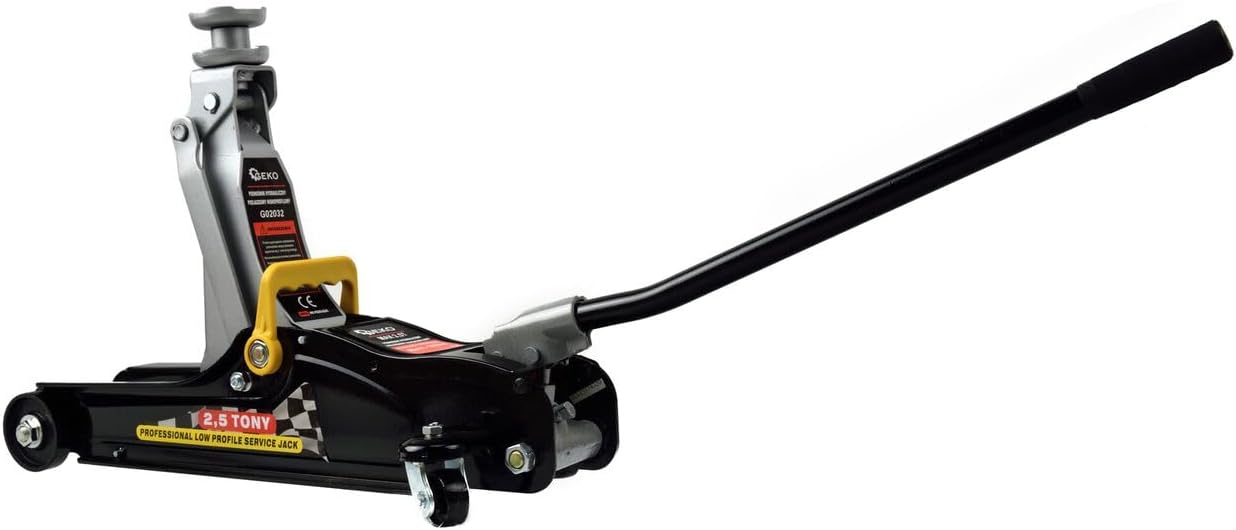
Foto nke 3.1: The Geko G02032 Low Profile 2.5 Ton Garage Jack, showcasing its full assembly with the handle attached. This image provides an overall view of the product's design and key features, including the low-profile chassis, lifting arm, saddle, and wheels.

Foto nke 3.2: The Geko G02032 garage jack with its operating handle detached, illustrating the two main components. This view helps in understanding the assembly process and the compact nature of the jack when stored.

Foto nke 3.3: A nso-elu view of the jack's saddle and the product label. The label displays important information such as the brand 'Geko', model 'G02032', and safety warnings, while the saddle is the contact point for lifting the vehicle.

Foto nke 3.4: A detailed shot of the product label on the Geko G02032 jack, highlighting the maximum lift capacity of 2.5 tons and the lifting height range of 80mm to 360mm. This information is crucial for safe operation.

Foto nke 3.5: A close-up of the handle attachment point on the Geko G02032 jack. This shows the mechanism where the two-piece handle connects to the hydraulic pump, enabling lifting and lowering operations.

Foto nke 3.6: A zuru ezu view of one of the swivel caster wheels on the Geko G02032 jack. These wheels allow for easy maneuverability and positioning of the jack under a vehicle.

Foto nke 3.7: A close-up of one of the fixed wheels located at the front of the Geko G02032 jack. These wheels provide stability and support during lifting operations.

Foto nke 3.8: A zuru ezu view of the hydraulic release valve mechanism on the Geko G02032 jack. This component is crucial for controlling the lowering speed of the jack.
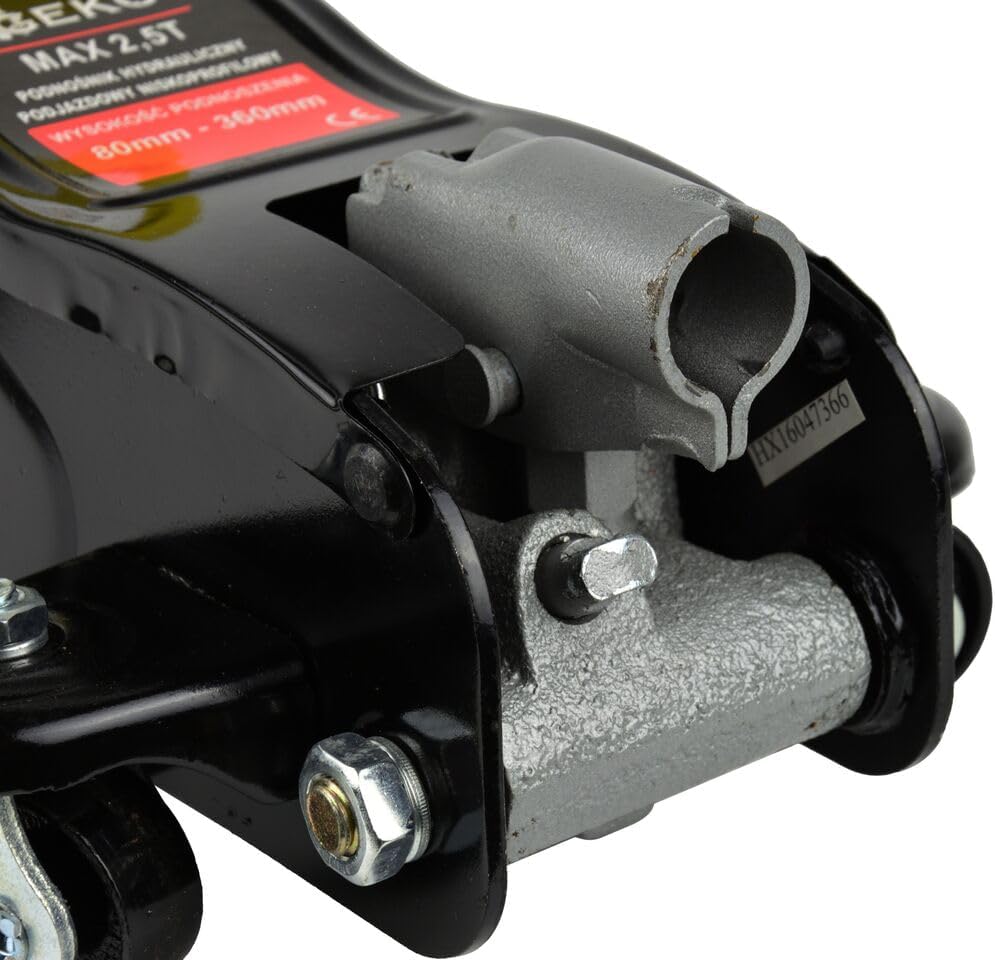
Foto nke 3.9: An alternative close-up perspective of the hydraulic mechanism and pivot points of the Geko G02032 jack, showing the robust construction and connection points for the lifting arm.
4. Nhazi
4.1 Mgbakọ izizi
- Tinye aka: Insert the lower handle section into the handle socket on the jack. Align the holes and secure it with the provided pin or bolt. Then, attach the upper handle section to the lower section, ensuring it is firmly connected.
4.2 Bleeding the Hydraulic System
Air can become trapped in the hydraulic system during shipping or storage, affecting performance. Bleed the system before first use:
- Tụgharịa aka ahụ n'akụkụ aka elekere ka imeghe valvụ ntọhapụ nke ọma.
- Pump the handle vigorously 10-15 times to force any trapped air out of the system.
- Tụgharịa aka n'akụkụ elekere ka imechi valvụ ntọhapụ.
- Test the jack by lifting it to its full height and then lowering it. Repeat if necessary until the jack operates smoothly.
5. Ntuziaka ọrụ
5.1 Lifting a Vehicle
- Kwadebe ụgbọ ala: Park the vehicle on a hard, level surface. Engage the parking brake and block the wheels that will remain on the ground.
- Debe Jack: Locate the manufacturer-recommended lifting points on the vehicle chassis. Position the jack so the saddle is directly under the lifting point.
- Close Release Valve: Turn the handle clockwise until the release valve is fully closed.
- Bulite ụgbọ ala: Pump the handle up and down to raise the vehicle to the desired height.
- Install Jack Stands: Immediately place appropriately rated jack stands under the vehicle's designated support points.
- Lower onto Stands: Slowly turn the handle counter-clockwise to open the release valve and lower the vehicle onto the jack stands. Once the vehicle is securely resting on the stands, remove the hydraulic jack.
5.2 Lowering a Vehicle
- Welie ntakịrị: If the vehicle is on jack stands, position the jack under the lifting point and pump the handle a few times to slightly raise the vehicle off the jack stands.
- Wepu Jack Stand: Jiri nlezianya wepụ jakị ahụ n'okpuru ụgbọ ala.
- Ụgbọ ala ala: Jiri nwayọ tụgharịa aka n'akụkụ elekere ka imepe valvụ ntọhapụ. Ụgbọ ala ahụ ga-amalite ibelata. Jikwaa ọsọ mgbada ahụ site n'ịgbanwe ego ole ị na-emepe valvụ ahụ.
- Wepụ Jack: Once the vehicle is fully lowered and resting on its wheels, remove the jack.
6. Nlekọta
Nlekọta mgbe niile na-eme ka jaak gị dị ogologo ndụ ma nwee nchekwa.
- mmanu mmanu: Periodically lubricate all moving parts, pivot points, and wheels with light machine oil.
- Mmiri hydraulic: Check the hydraulic fluid level every three months. To check, lower the jack completely, remove the oil filler plug, and ensure the fluid is level with the bottom of the filler hole. Use only high-quality hydraulic jack oil. Do not use brake fluid or motor oil.
- Nhicha: Keep the jack clean and free of dirt, grease, and corrosive materials.
- Nchekwa: Chekwaa jakị ahụ n'ebe kpọrọ nkụ, dị ọcha, ebule ahụ eweghachitere nke ọma iji gbochie nrụrụ na ịgbatị ndụ akara.
- Nyocha: Regularly inspect for damage, wear, or leaks. Any damaged parts should be replaced by qualified personnel.
7. Nchọpụta nsogbu
| Nsogbu | Ihe nwere ike ime | Ngwọta |
|---|---|---|
| Jack will not lift to full height or lifts slowly. | Low hydraulic fluid level. Air in the system. Overload. | Check and refill hydraulic fluid. Bleed the hydraulic system (refer to Section 4.2). Ensure load does not exceed 2.5 tons. |
| Jack na-agbada n'okpuru ibu. | Release valve not fully closed. Leaking seals. Overload. | Ensure release valve is fully closed. Inspect for fluid leaks; if found, seek professional repair. Ensure load does not exceed 2.5 tons. |
| Jack agaghị ala ala. | Release valve stuck or obstructed. | Ensure release valve is fully opened. Check for obstructions around the valve mechanism. |
| Jack feels spongy or inconsistent. | Ikuku na sistemu hydraulic. | Bleed the hydraulic system (refer to Section 4.2). |
8. Nkọwapụta
| Njirimara | Nkọwapụta |
|---|---|
| Ụdị | Geko |
| Nlereanya | G02032 |
| Ike ibu kacha | 2.5 tọn |
| Elu elu kacha nta | 80 mm |
| Kachasị Elu Elu | 360 mm |
| Ihe onwunwe | Ígwè Alloy, Ígwè anaghị agba nchara |
| Agba | Nwa |
| Ibu Ibu | 11.6 kilogram |
| Servicedị Ọrụ hicgbọ | Truck, Van, SUV, Car |
| Onye nrụpụta | Firma Handlowa GEKO |
| Koodu Akụkọ Mba Nile | 05901477123511 |
9. Akwụkwọ ikike Ozi
This Geko G02032 Low Profile 2.5 Ton Garage Jack is covered by a manufacturer's warranty against defects in materials and workmanship. For specific warranty terms, duration, and claim procedures, please refer to the warranty card included with your product or contact Geko customer support. Keep your proof of purchase for warranty claims.
10. Nkwado ndị ahịa
For technical assistance, parts replacement, or any questions regarding your Geko G02032 garage jack, please contact Geko customer support. Refer to the product packaging or the official Geko websaịtị maka ozi kọntaktị kacha ugbu a.


