Okwu mmalite
Thank you for choosing the SVBONY SV17 25-75x70mm Spotting Scope. This manual provides essential information for the proper setup, operation, and maintenance of your new spotting scope. Please read these instructions carefully before use to ensure optimal performance and longevity of your device.
Ihe ngwugwu
Mgbe ebupuchara, biko chọpụta na agụnyere ihe niile ndị a:
- SVBONY SV17 25-75x70mm Spotting Scope
- Isiokwu Isiokwu
- Ihe nkwụnye ekwentị
- Akpa na-ebu
- Ebumnuche oghere oghere
- Okpu anya anya
- Akwa nhicha
- Akwụkwọ ntuziaka (akwụkwọ a)

Image: The SVBONY SV17 spotting scope along with its accessories, including a tripod, phone adapter, carrying case, and cleaning cloth.
Ngwa ngwaahịa
Familiarize yourself with the main parts of your SVBONY SV17 spotting scope:
- Igwe anya ebumnobi: The large front lens that gathers light. (70mm diameter)
- Anya anya: The part you look through, with adjustable magnification.
- Knob elekwasị anya: Used to achieve a clear image.
- Mgbanaka mbugharị: Adjusts the magnification from 25x to 75x.
- Sunshade: Extendable tube to reduce glare.
- Ugwu Tripod: Standard threaded hole for attaching to a tripod.

Foto: Zuru ezu view of the spotting scope's focus knob, zoom ring, and tripod mounting base.
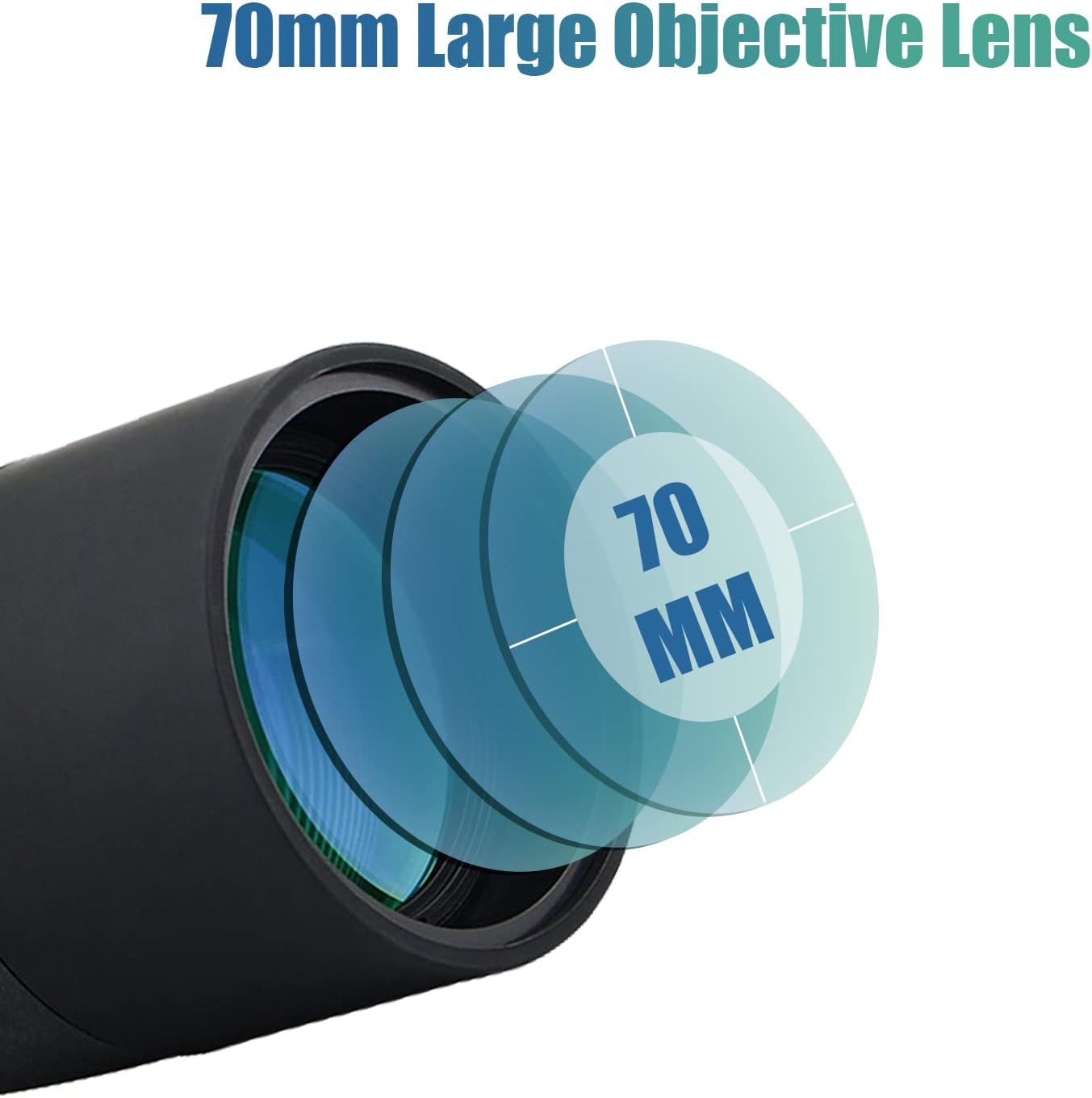
Image: Illustration highlighting the 70mm large objective lens of the SVBONY SV17 spotting scope.
Melite
- Mounting the Scope:
Attach the spotting scope to the included tabletop tripod or any standard photographic tripod using the threaded tripod mount on the scope's base. Ensure it is securely fastened.

Image: Close-up of the standard tapped hole base on the spotting scope, designed for tripod attachment.
- Removing Lens Caps:
Remove the objective lens cap and the eyepiece cap before use.
- Njikọta ihe nkwụnye ekwentị (Nhọrọ):
If using the phone adapter, attach it to the eyepiece of the spotting scope. Secure your smartphone into the adapter's clamp, aligning the phone's camera with the eyepiece. Ensure the adapter does not obstruct the zoom ring or focus knob.

Image: The SVBONY SV17 spotting scope mounted on a tripod with a smartphone attached via the phone adapter, ready for digiscoping.
Ntuziaka ọrụ
- Aiming the Scope:
Point the spotting scope towards your desired target. For initial aiming, it may be easier to start at the lowest magnification (25x).
- Adjusting Magnification (Zoom):
Rotate the zoom ring on the eyepiece to adjust the magnification from 25x to 75x. Start with lower magnification to locate your target, then increase as needed for more detail.

Image: The SVBONY SV17 spotting scope illustrating the adjustable zoom eyepiece, showing views at 25x, 50x, and 75x magnification.
- Na-elekwasị anya:
While looking through the eyepiece, slowly turn the focus knob until the image appears sharp and clear. Fine-tune the focus for optimal clarity at your chosen magnification.
- Adjusting the Sunshade:
Extend the retractable sunshade by pulling it forward from the objective lens housing. This helps to reduce glare and protect the lens from rain or dust.
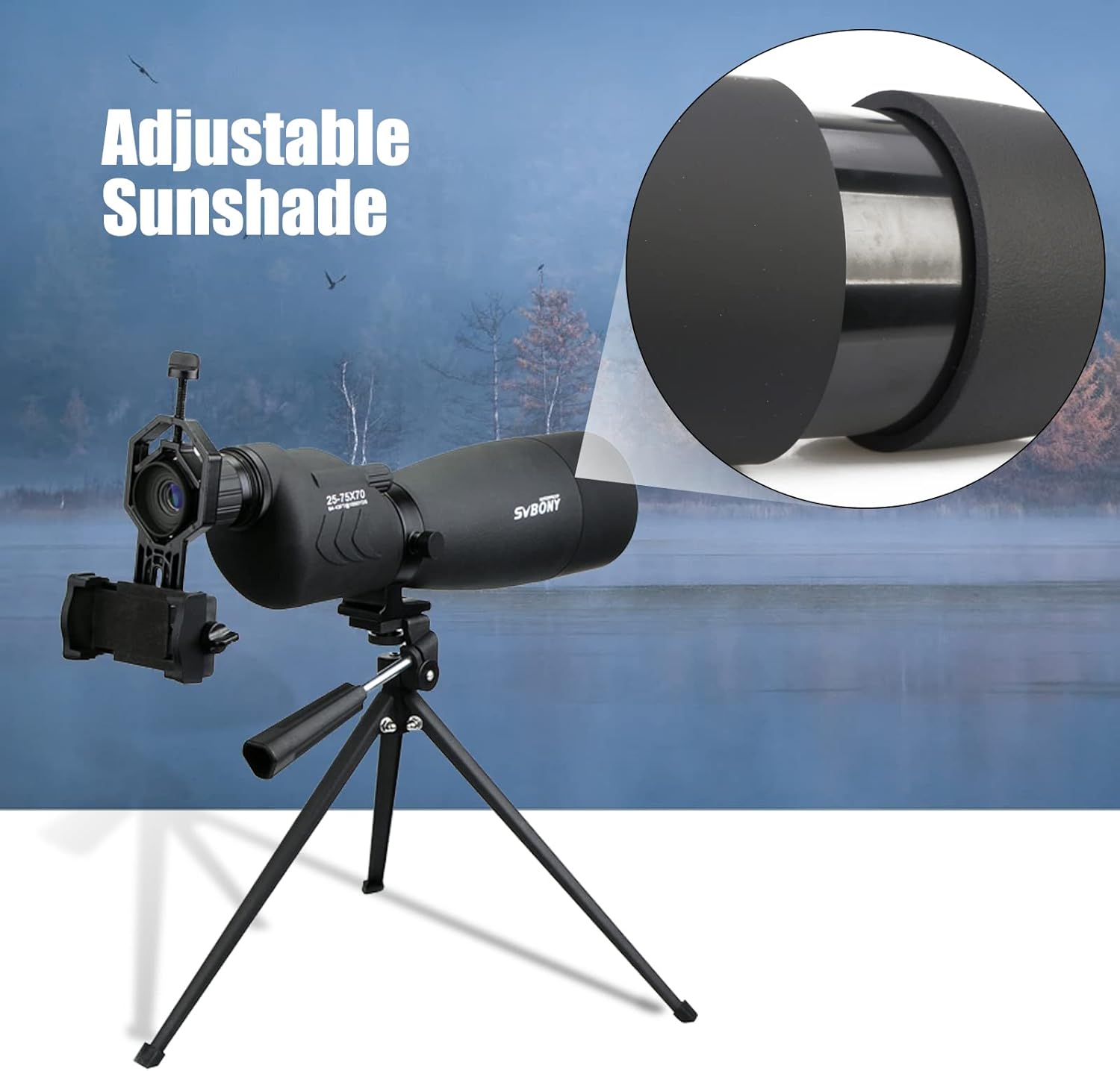
Image: The SVBONY SV17 spotting scope demonstrating its adjustable sunshade feature, extended to block glare.
Nlekọta na nlekọta
- anya anya nhicha:
Use the provided cleaning cloth or a soft, lint-free cloth to gently wipe lens surfaces. For stubborn smudges, use a lens cleaning solution specifically designed for optics. Avoid using abrasive materials or excessive force.
- Waterproof and Fogproof Features:
The SV17 spotting scope is IP65 waterproof and fogproof, allowing for use in various weather conditions. While it is resistant to water splashes and light rain, avoid submerging the scope in water.

Image: The SVBONY SV17 spotting scope in a natural setting, highlighting its IP65 waterproof and fogproof capabilities with water droplets on its surface.
- Nchekwa:
When not in use, store the spotting scope in its carrying case in a cool, dry place. Ensure lens caps are in place to protect the optics from dust and scratches.
Nchọpụta nsogbu
| Nsogbu | Ihe nwere ike ime | Ngwọta |
|---|---|---|
| Foto ahụ adịghị mma ma ọ bụ na-apụtaghị ìhè. | Focus knob not adjusted correctly; high magnification without fine-tuning. | Rotate the focus knob slowly until the image is sharp. At higher magnifications, minor adjustments are often needed. |
| Ọnụ gbara ọchịchịrị ma ọ bụ vignetting n'ime view. | Eyepiece not fully extended or eye not properly aligned. | Adjust your eye position relative to the eyepiece. Ensure the eyepiece is fully extended if it has an adjustable eyecup. |
| Foto ahụ dị ka ọ dị ka ọ dị ọchịchịrị. | Low light conditions; objective lens cap still on. | Ensure the objective lens cap is removed. Use in adequate lighting. |
| Scope shakes excessively. | Unstable tripod or surface. | Ensure the tripod is placed on a stable, level surface. Use a heavier or more stable tripod if necessary, especially at high magnifications. |
Nkọwapụta
| Njirimara | Nkọwa |
|---|---|
| Nlereanya | SV17 (FUSN6006A) |
| Nkwalite | 25-75x |
| Dayameta oghere ebumnuche | 70mm |
| Ụdị Prism | BAK4 Porro Prism |
| mkpuchi oghere | mkpuchi mkpuchi zuru oke (FMC) |
| Ngosi nke enweghị mmiri | IP65 |
| Ihe na-egbochi ikuku mmiri | Ee |
| Ibu Ibu | 3.4 pound (ihe dị ka 1.54 n'arọ) |
| Akụkụ ihe (LxWxH) | 14.88 x 3.94 x 3.66 sentimita (ihe dịka 37.8 x 10 x 9.3 cm) |

Image: Diagram illustrating the Fully Multi-Coated (FMC) optics and BAK4 Porro Prism for enhanced image quality.

Image: Visual comparison demonstrating the clearer and sharper image quality provided by BAK4 prisms compared to BK7 prisms.