1. Okwu mmalite
This manual provides essential information for the proper use, installation, and maintenance of the Littelfuse 0895040.Z 40 Amp Pro dị alafile JCASE Cartridge Fuse. Please read these instructions carefully before handling or installing the product to ensure safety and optimal performance.
2. Ngwaahịa gafereview
The Littelfuse 0895040.Z is a 40 Amp Pro dị alafile JCASE Cartridge Fuse designed for automotive and other low-voltage DC applications. JCASE fuses are known for their compact design and high current interruption capabilities, providing reliable circuit protection against overcurrent conditions. This specific fuse features a green polycarbonate housing and is rated for 58 Volts.

A single Littelfuse 0895040.Z 40 Amp Pro dị alafile JCASE Cartridge Fuse, green housing with a clear top indicating '40' for its ampọkwa erage.
3. Nkọwapụta
The Littelfuse 0895040.Z fuse adheres to the following technical specifications:
- Nọmba nlereanya: 0895040.Z
- Ogo dị ugbu a: 40 Amps
- Voltage Rating: 58 volts DC
- Ogo nkwụsị: 1000A @ 58 VDC
- Oke okpomoku na-arụ ọrụ: -40°C ruo +125°C
- Ihe eji eme ụlọ: PPA-GF13 (Polycarbonate)
- Ihe mkpuchi: PA66
- Ike ntinye: 53N Max. (12 lb)
- Extraction Force: 9N Min. (2 lb)
- Nkwenye: SAE 274 and ISO 8820-4 (except for the life test)
- RoHS kwadoro: Ee
- Akụkụ ngwugwu: Approximately 9.25 x 5.43 x 0.67 inches (overall packaging)

This image displays a detailed table of technical specifications for Low Profile JCASE Fuses, including voltage rating, interrupting rating, operating temperature, housing and cover materials, insertion and extraction forces, and compliance standards. It also includes a graph illustrating time-current characteristic curves and a table for ordering information and ratings based on current and housing material color.
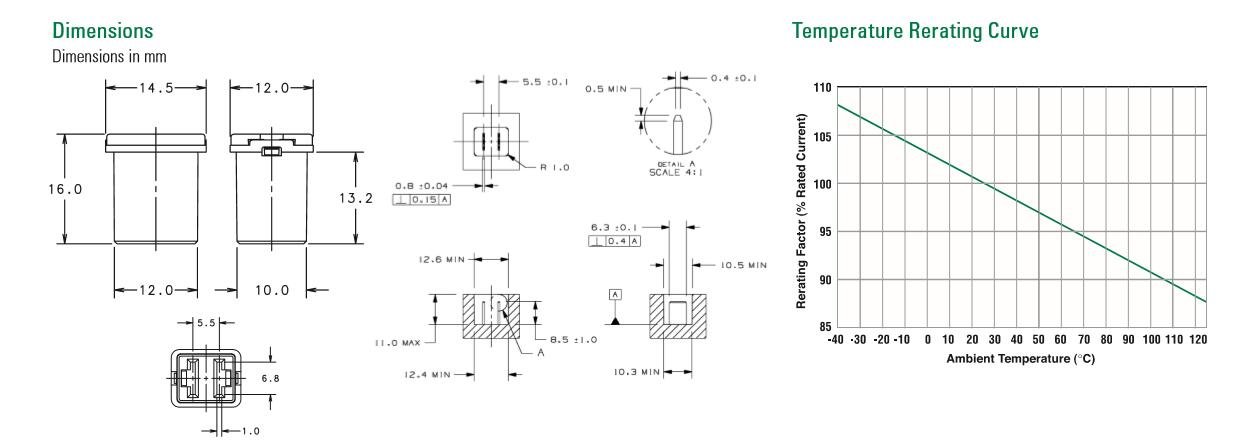
This image provides precise dimensional drawings of the Low Profile JCASE fuse in millimeters, showing various views and measurements. Additionally, it includes a graph illustrating the temperature rerating curve, which shows the derating factor as a percentage of rated current versus ambient temperature in Celsius.
4. Ntọala na nwụnye
Proper installation is crucial for the effective operation of the fuse. Always ensure the vehicle or equipment's power is disconnected before attempting any fuse replacement.
4.1 Nchekwa nchekwa
- Always disconnect the power source (e.g., vehicle battery) before working on electrical circuits.
- Use appropriate tools for fuse removal and installation.
- Never replace a fuse with one of a higher amperage rating than specified by the manufacturer. This can lead to severe damage or fire.
- Yiri ihe nchekwa onwe onye kwesịrị ekwesị (PPE), dịka ugogbe anya nchekwa.
4.2 Nzọụkwụ nwụnye
- Chọpụta Fuse a na-efe efe: Locate the fuse box in your vehicle or equipment. Consult your vehicle's owner's manual for the exact location and fuse diagram. A blown fuse typically has a broken filament or a discolored housing.
- Nyochaa Ampafọ: Kwenye nke ahụ amperage rating of the blown fuse. It is usually printed on the top of the fuse (e.g., '40' for 40 Amps).
- Wepu Fuse a na-afụ: Carefully pull out the blown fuse using a fuse puller or appropriate pliers.
- Tinye Fuse ọhụrụ: Insert the new Littelfuse 0895040.Z 40A fuse into the empty slot. Ensure it is seated firmly.
- Jikọọ ike: Once the new fuse is securely in place, reconnect the power source.

An assortment of colored JCASE fuses, each with a different amperage rating (e.g., 20A, 30A, 40A, 50A, 60A), displayed with their approximate dimensions in millimeters. This illustrates the standard sizing and color coding for different current ratings.
5. Ụkpụrụ ọrụ
A fuse is a safety device designed to protect an electrical circuit from overcurrent. When the current flowing through the circuit exceeds the fuse's rated amperage for a specific duration, the metallic element inside the fuse melts, breaking the circuit and preventing damage to components or wiring. The Littelfuse 0895040.Z fuse is specifically designed to open quickly under overload conditions, providing rapid protection.
6. Nlekọta
Fuses are generally maintenance-free components. However, periodic inspection can help ensure the integrity of your electrical system.
- Nlele anya: Occasionally inspect fuses in critical circuits for any signs of physical damage or discoloration.
- Ndochi: Fuses are single-use devices. Once a fuse blows, it must be replaced with a new fuse of the identical type and amperage rating. Do not attempt to repair a blown fuse.
7. Nchọpụta nsogbu
If an electrical component or system in your vehicle or equipment stops functioning, a blown fuse is a common cause.
- Mgbaàmà: A specific electrical device (e.g., radio, power window, light) is not working.
- Omume: Locate the fuse associated with that device in the fuse box. Visually inspect the fuse for a broken filament. If the fuse is blown, replace it with a new Littelfuse 0895040.Z 40A fuse (or the correct amperage for that circuit).
- Ịdọ aka ná ntị: If a newly installed fuse blows immediately or repeatedly, it indicates a more serious electrical problem (e.g., a short circuit or persistent overload) in the system. In such cases, consult a qualified automotive technician or electrician to diagnose and repair the underlying issue before replacing the fuse again.
8. Ozi nchekwa
Always prioritize safety when working with electrical components.
- Ensure the power source is disconnected before handling fuses.
- Ejila fuse nwere elu dị elu amperage rating than recommended for the circuit.
- Do not bypass a fuse with wire or foil, as this eliminates circuit protection and creates a fire hazard.
- If you are unsure about any electrical work, seek assistance from a certified professional.
9. Akwụkwọ ikike na nkwado
For specific warranty information regarding your Littelfuse product, please refer to the documentation provided at the point of purchase or visit the official Littelfuse website. For technical support or inquiries, contact Littelfuse customer service directly.


