1. Okwu mmalite
This manual provides detailed instructions for the installation, operation, and maintenance of your Focal FPX1.1000 Class D Mono Amplifier. Please read this manual thoroughly before attempting installation or operation to ensure proper function and safety. Retain this manual for future reference.
2. Ntuziaka nchekwa
Observe the following safety precautions to prevent injury or damage to the amplifier and vehicle:
- Akwadoro nwụnye ọkachamara: Installation of car audio equipment can be complex. It is highly recommended that a qualified professional install this ampna -emegharị ihe.
- Kwupu batrị: Always disconnect the vehicle's negative battery terminal before starting any electrical work to prevent short circuits.
- Wiwi kwesịrị ekwesị: Use appropriate gauge wiring for power, ground, and speaker connections as specified in the installation section. Incorrect wiring can cause overheating, fire, or damage to components.
- Igwe ikuku: Gbaa mbọ hụ na amplifier is mounted in a location with adequate ventilation to prevent overheating. Do not block cooling fins.
- Zere mmiri mmiri: Ekpughela ihe ndị ahụ amplifier to moisture or water.
- Nkwanye echekwabara: Ugwu ahụ amplifier securely to prevent it from coming loose during vehicle operation, which could cause injury or damage.
- Nchekwa fiusi: Always use an external fuse on the main power wire, close to the battery, with the recommended ampoge.
3. Ngwaahịa gafereview
3.1 Atụmatụ
- CEA Power (4 Ohms): 1×420 Wrms
- Maximum Power (2 Ohms): 1×700 Wrms
- Maximum Power (1 Ohm): 1×1000 Wrms
- Bandwidth: 15Hz–250Hz
- Integrated Protections: Short Circuit, low impedance, reversal of polarity, DC, power drop, heat protection.
- Klas D Mono Amplifier design for high power and efficiency.
3.2 Kedu ihe dị na igbe ahụ
- Focal FPX1.1000 Mono Ampna -emegharị ihe
- Akwụkwọ ntuziaka (akwụkwọ a)
- Mounting hardware (screws, etc.)
4. Nwụnye na Ntọala
Proper installation is crucial for optimal performance and safety. Consult a professional installer if you are unsure about any steps.
4.1 Ebe nrịgo
Họrọ ebe a ga-etinye ya:
- Dry and free from moisture.
- E nwere ikuku dị mma iji mee ka okpomọkụ gbazee.
- Secure and protected from physical damage.
- Away from fuel lines, brake lines, and electrical wiring harnesses.
Common locations include under a seat, in the trunk, or behind a panel.
4.2 Njikọ njikọ
Tupu ị jikọọ ihe ọ bụla, gbanyụọ ebe batrị na-adịghị mma nke ụgbọala ahụ.
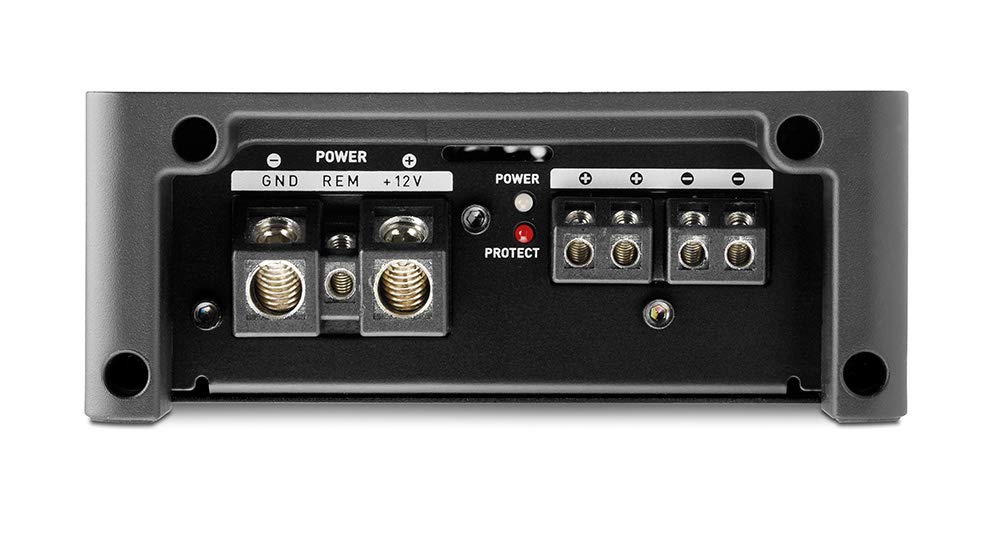
Image 1: Power and Speaker Terminal Connections. This image displays the rear panel of the amplifier, highlighting the power input terminals (GND, REM, +12V) and the speaker output terminals. A red 'PROTECT' indicator light is also visible.
- Waya Ike (+12V): Run a heavy-gauge power wire (e.g., 4 AWG or larger, depending on total system power) directly from the positive terminal of the vehicle's battery to the +12V terminal on the amplifier. Install an inline fuse holder with the appropriate fuse (refer to specifications for recommended fuse size) within 18 inches (45 cm) of the battery.
- Waya Ala (GND): Connect a heavy-gauge ground wire (same gauge as power wire) from the GND terminal on the amplifier to a clean, unpainted metal surface on the vehicle's chassis. Ensure a good electrical connection by scraping away any paint or rust. The ground wire should be as short as possible, ideally less than 3 feet (1 meter).
- Waya Mgbakwụnye N'ime Ime Obodo (REM): Connect a smaller gauge wire (e.g., 18 AWG) from the REM terminal on the amplifier to the remote turn-on output of your head unit or other switched 12V source. This wire turns the amplifier on and off with your audio system.
- Mpụta okwu: Connect your subwoofer(s) to the speaker output terminals. Ensure correct polarity (+ to + and - to -). This is a mono amplifier, designed for a single subwoofer or multiple subwoofers wired to present a 1-ohm or 2-ohm load. Refer to your subwoofer's specifications for impedance matching.
- Ntinye RCA: Connect RCA cables from the subwoofer output of your head unit to the INPUT CH1/CH2 RCA jacks on the ampna -emegharị ihe.

Image 2: Input and Control Panel. This image shows the front panel of the amplifier, featuring RCA input and output jacks, a remote port, and various control knobs for Gain, Subsonic filter, Bass Boost, Phase, and Low Pass Filter (LPF).
5. Ntuziaka ọrụ
Once installed, adjust the amplifier settings for optimal sound performance.
5.1 Control Panel Adjustments
- GAIN (Input Sensitivity): Njikwa a dabara na amplifier's input sensitivity to the output level of your head unit. Start with the gain at minimum (Min) and slowly increase it until you hear distortion, then back off slightly. Do not use the gain control as a volume knob.
- SUBSONIC: This filter removes extremely low frequencies that are inaudible and can waste amplifier power or damage subwoofers. Adjust it to a frequency below your subwoofer's resonant frequency or port tuning frequency (typically 15-30Hz).
- AKWỤKWỌ BASS: This control provides an increase in bass output at a specific frequency. Use sparingly to avoid distortion and potential damage to subwoofers.
- OGE: This control adjusts the phase of the subwoofer output relative to the main speakers (0° to 180°). Adjust for the best blend and impact with your front speakers.
- LPF (Nyocha ngafe dị ala): This filter allows only frequencies below the set point to pass through to the subwoofer. Adjust it to blend smoothly with your main speakers, typically between 50Hz and 80Hz.
5.2 Power and Protection Indicators
- Ihe ngosi ike: Na-enwu mgbe amplifier is receiving power and operating normally.
- Protect Indicator: Na-enwu mgbe amplifier detects a fault (e.g., short circuit, overheating, low impedance). If this light comes on, turn off your audio system immediately and troubleshoot the issue.
6. Nlekọta
The Focal FPX1.1000 amplifier requires minimal maintenance. Follow these guidelines to ensure longevity:
- Nhicha: Na-ehichapụkwa oge ụfọdụ ampJiri ákwà dị nro ma kpọọ nkụ mee ihe n'èzí lifier. Ejila kemịkalụ siri ike ma ọ bụ ihe nhicha na-eme ka ihe dị nro.
- Igwe ikuku: Ensure that the cooling fins remain free of dust and debris. Use compressed air to gently clear any blockages if necessary.
- Njikọ: Mgbe ụfọdụ lelee njikọ waya niile iji hụ na ha dị nchebe ma ghara imebi emebi.
7. Nchọpụta nsogbu
Ọ bụrụ na ị nwere nsogbu na ndụ gị amponye na-azọ ọkwa, gakwuru tebụl na-esonụ tupu ịchọọ ọrụ ọkachamara:
| Nsogbu | Ihe nwere ike ime | Ngwọta |
|---|---|---|
| Enweghị ike / Amplifier anaghị agbanye |
|
|
| Protect light is on |
|
|
| Enweghị ụda |
|
|
| Ụda agbagọ |
|
|
8. Nkọwapụta
| Njirimara | Nkọwa |
|---|---|
| Nọmba nlereanya | FPX1.1000 |
| Ụdị | Focal |
| Ike CEA (4 Ohms) | 1×420 Wrms |
| Maximum Power (2 Ohms) | 1×700 Wrms |
| Maximum Power (1 Ohm) | 1×1000 Wrms |
| Bandwit | 15Hz – 250Hz |
| Nchedo | Short Circuit, low impedance, reversal of polarity, DC, power drop, heat protection |
| Akụkụ ngwaahịa | 11.81 x 11.81 x 11.81 sentimita; 6 pound |
| Ụdị nkwụnye | Ugwu elu |
| Voltage | 10 Volts, 14.4 Volts, 5 Volts (Operating Voltage Range) |
9. Akwụkwọ ikike na nkwado
Focal products are designed and manufactured to high quality standards. This product is covered by a limited warranty against defects in materials and workmanship. The specific terms and duration of the warranty may vary by region and retailer. Please retain your proof of purchase for warranty claims.
For technical support, warranty service, or further assistance, please contact your authorized Focal dealer or visit the official Focal websaịtị maka ozi kọntaktị.


