1. Okwu mmalite
This manual provides essential information for the safe and efficient operation of your InFocus IN112a SVGA DLP Projector. Please read it thoroughly before using the projector and retain it for future reference. The InFocus IN112a is designed to deliver clear and bright projections for various applications, featuring SVGA resolution, HDMI connectivity, and 3D support.
2. Ozi nchekwa
Lee ihe ndị a iji gbochie mmebi na ihe ngosi ahụ ma hụ na onye ọrụ ahụ nwere nchekwa:
- Do not look directly into the projector lens mgbe lamp is on. The intense light can cause eye damage.
- Gbaa mbọ hụ na ikuku ikuku dị mma. Akwụsịla oghere ikuku.
- Only qualified service personnel should open the projector casing. Enweghị akụkụ ndị ọrụ ga-arụ ọrụ n'ime.
- Jiri naanị eriri ọkụ ewepụtara na ihe nrụpụta.
- Debe ihe nrụpụta ahụ pụọ na mmiri ma ọ bụ gburugburu iru mmiri.
- Onye na-eme ihe nkiri lamp contains mercury. Dispose of lamps according to local regulations. Visit www.o buruamprecycle.org maka ozi ndị ọzọ.

Foto: N'okpuru view of the InFocus IN112a projector, displaying various warning labels, regulatory compliance marks (like CE, FCC), and information regarding the mercury content in the lamp and recycling instructions.
3. Ngwaahịa gafereview
3.1. Projector Dimensions

Foto: N'ihu view of the InFocus IN112a projector, illustrating its physical dimensions. The projector measures approximately 292 mm in width, 220 mm in depth, and 108 mm in height.
3.2. Top Panel Controls
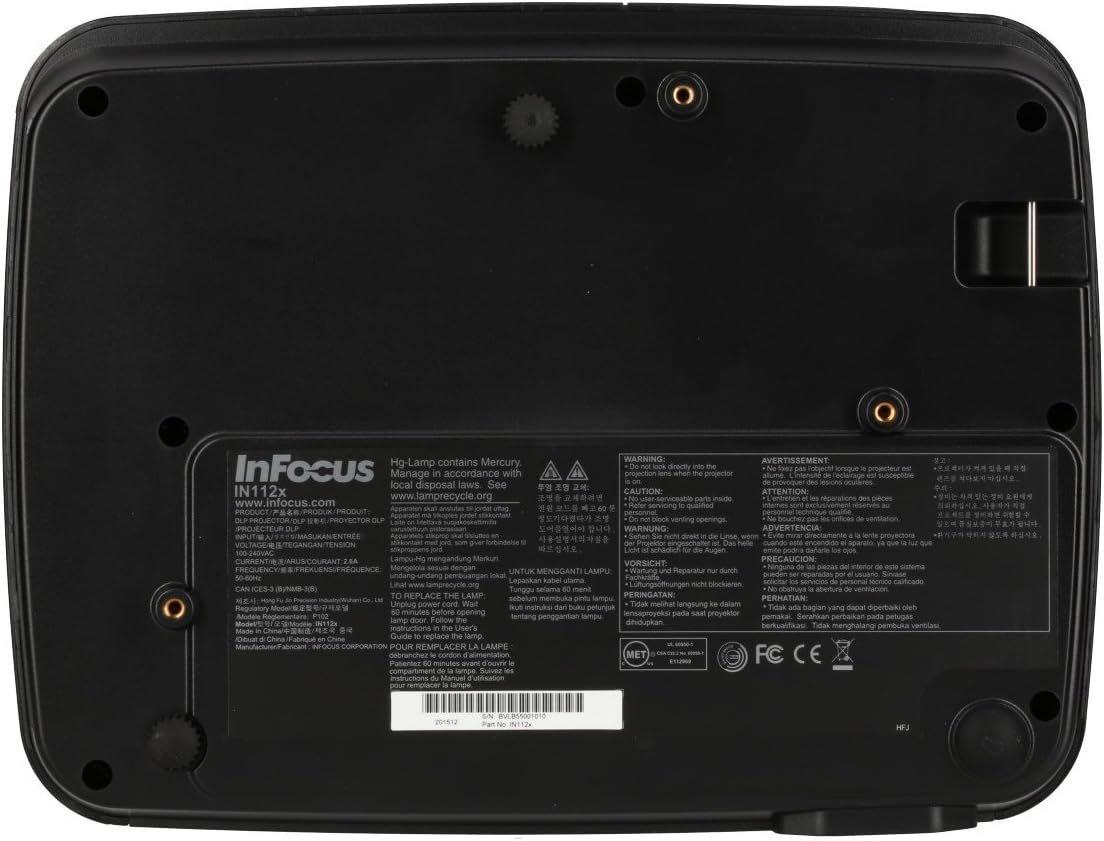
Foto: Top view of the InFocus IN112a projector, highlighting the control panel. This panel includes buttons for power, menu access, source selection, and directional navigation for menu adjustments.
The top panel features buttons for power on/off, menu access, input source selection, and navigation arrows for adjusting settings within the on-screen display (OSD) menu. The focus and zoom rings are located near the lens.
3.3. Njikọ azụ panel

Foto: N'azụ view of the InFocus IN112a projector, displaying its comprehensive array of connectivity ports. These include HDMI 1.4, two VGA inputs (Computer 1, Computer 2), a VGA monitor output, S-Video, Composite video, two 3.5mm stereo audio inputs, one 3.5mm stereo audio output, an RS232C control port, and a USB-B port.
The rear panel provides a variety of connection options:
- HDMI1.4: For digital video and audio input.
- VGA (Computer 1, Computer 2): Two inputs for analog computer signals.
- VGA Monitor Out: For connecting an external monitor.
- Vidiyo mejupụtara: Maka ntinye vidiyo nkọwa ọkọlọtọ.
- S-Video: For enhanced standard definition video input.
- Audio In (3.5mm x 2): For stereo audio input.
- Mwepụ Ọdịyo (3.5mm): For stereo audio output to external speakers.
- RS232C: For projector control via a computer or control system.
- USB-B: Maka mmelite ọrụ ma ọ bụ firmware.
4. Nhazi
4.1. Ntinye
Position the projector on a stable, flat surface or mount it securely to a ceiling. Ensure there is adequate space around the projector for ventilation. The distance from the screen will determine the image size. Refer to the specifications section for throw ratio details.
4.2. Ijikọ Ike
Connect the supplied power cord to the projector's power inlet and then to a grounded electrical outlet. The power LED will illuminate, indicating standby mode.
4.3. Connecting Video Sources
Connect your video source (e.g., computer, Blu-ray player, cable box) to the appropriate input port on the projector's rear panel using a compatible cable. For best quality, use the HDMI input.
- HDMI: Connect an HDMI cable from your source to the projector's HDMI port.
- VGA: Connect a VGA cable from your computer to either the Computer 1 or Computer 2 port.
- Composite/S-Video: Connect the respective cable for older video sources.
4.4. Ijikọ Audio
If using VGA, Composite, or S-Video inputs, connect an audio cable from your source's audio output to one of the projector's 3.5mm Audio In ports. HDMI carries both video and audio, so a separate audio connection is not typically needed for HDMI sources.
4.5. Ịgbanwe Nlekwasị Anya na Mbugharị
After powering on the projector and displaying an image, rotate the Mgbanaka mgbanaka around the lens until the image is sharp and clear. Use the Mgbanaka mbugharị to adjust the image size to fit your screen.
5. Ọrụ
5.1. Ịgbanye / gbanyụọ
- Iji gbanye: Press the Power button on the projector's top panel or the remote control. The power indicator will turn green.
- Iji gbanyụọ: Press the Power button twice. The projector will enter a cooling cycle, and the power indicator will turn red (standby) once complete.
5.2. Ịhọrọ isi mmalite ntinye
Press the "Source" button on the projector or remote control repeatedly to cycle through available input sources (HDMI, VGA1, VGA2, S-Video, Video). The projector will automatically detect an active signal if "Auto Source" is enabled in the menu.
5.3. Ntugharị menu
Press the "Menu" button to access the On-Screen Display (OSD) menu. Use the directional arrows to navigate through menu options and the "Enter" button to select. Press "Menu" again to exit.
5.4. 3D Content Playback
The IN112a supports 3D content from Blu-ray players, cable boxes, dish services (over HDMI), and PC-based 3D content at 120Hz. To view 3D content, you will need 144 Hz DLP Link 3D glasses (sold separately).
- Ensure your 3D source is connected via HDMI.
- Play 3D content from your source.
- Turn on your 144 Hz DLP Link 3D glasses. The projector should automatically detect the 3D signal.
6. Nlekọta
6.1. Cleaning the Projector Lens
Gently wipe the lens with a soft, lint-free cloth specifically designed for optical surfaces. Do not use abrasive cleaners or excessive force, as this can scratch the lens.
6.2. Lamp Ndochi
Onye na-eme ihe nkiri lamp has a lifespan of up to 10,000 hours. When the lamp life is nearing its end, a warning message may appear, or the lamp indicator LED may illuminate. Refer to the full service manual for detailed lamp nnọchi ntuziaka. Ịdọ aka ná ntị: The lamp nwere mercury. Tụfuo ihe eji lamps according to local environmental regulations.
6.3. Cleaning Air Filters
Regularly clean the air filters to ensure proper ventilation and prevent overheating. Dust and debris can accumulate, reducing cooling efficiency. Gently remove the filter cover and clean the filter with a soft brush or vacuum cleaner. Replace the filter cover securely.
7. Nchọpụta nsogbu
| Nsogbu | Ihe nwere ike ime | Ngwọta |
|---|---|---|
| Ọnweghị onyonyo egosiri |
|
|
| Onyonyo na-agba agba |
|
|
| Enweghị ọdịyo |
|
|
| Projector na-ekpo ọkụ ma mechie |
|
|
8. Nkọwapụta
| Njirimara | Nkọwa |
|---|---|
| Nọmba nlereanya | IN112X |
| Ngosipụta teknụzụ | DLP |
| Mkpebi obodo | SVGA (800 x 600) |
| Icha ọkụ | Ihe ruru 3200 lumens |
| Ọnụọgụ ọdịiche | 15,000:1 |
| Lamp Ndụ | Ruo awa iri abụọ |
| Njikọta | HDMI 1.4, VGA x 2, Composite video, S-Video, 3.5 mm stereo in x 2, 3.5mm stereo out, VGA monitor out, RS232C, USB-B |
| 3D Nkwado | Yes (requires 144 Hz DLP Link 3D glasses) |
| Tufu Ratio | 1.9-2.09 |
| Akụkụ ngwaahịa | 14.25 x 12 x 7.75 sentimita (ihe dịka 36.2 x 30.5 x 19.7 cm) |
| Ibu Ibu | 5.4 pound (ihe dị ka 2.45 n'arọ) |
| Akwadoro ojiji | Ime/n'èzí |
| Njirimara Pụrụ Iche | Ọkà okwu arụnyere n'ime ya |
9. Akwụkwọ ikike na nkwado
For warranty information and technical support, please refer to the documentation included with your purchase or visit the official InFocus websaịtị. Debe ihe akaebe nke ịzụrụ maka akwụkwọ ikike.


