1. Okwu mmalite
Thank you for choosing the LTC 3-Channel 60W Public Address Amplifier with USB/SD-MP3. This manual provides essential information for the safe and efficient operation of your new amplifier. Please read it thoroughly before use and keep it for future reference. This amplifier is designed for public address applications, offering versatile input options including microphones, auxiliary devices, and integrated USB/SD card playback.
2. Ntuziaka nchekwa
Iji hụ na ọrụ nchekwa na gbochie mmebi, biko debe ihe nchekwa nchekwa ndị a:
- Isi mmalite ike: Jikọọ amplifier only to the specified power sources (12V DC or 220V AC) as indicated on the unit. Ensure the voltage dakọtara ọkụ ọkụ mpaghara gị.
- Igwe ikuku: Ekpuchila oghere ikuku ọ bụla. Hụ na ikuku zuru oke gburugburu ngwaọrụ ahụ iji gbochie oke okpomọkụ.
- Mmiri: Ekpughela ihe ndị ahụ amplifier to rain, moisture, or excessive humidity. Keep it away from liquids.
- Nhicha: Disconnect the power before cleaning. Use a dry, soft cloth. Do not use liquid cleaners or aerosols.
- Ije ozi: Anwala ịrụzi ngwaahịa a n'onwe gị. Nye ndị ọrụ ọrụ ruru eru ọrụ niile. Imepe ngwaọrụ ahụ nwere ike itinye gị n'ihe ize ndụ.tages ma ọ bụ ihe egwu ndị ọzọ.
- Nkwanye: Debe ya amplifier on a stable, flat surface. Avoid placing it near heat sources or in direct sunlight.
- Ibu ibu: Ebubigala ihe ahụ amplifier. Ensure connected speakers match the amplifier's impedance and power ratings.
3. Ngwaahịa gafereview
The LTC 3-Channel 60W Public Address Amplifier is a versatile audio solution designed for various PA applications. It features multiple input options and an integrated MP3 player for convenience.
3.1 Njikwa ihu ihu na njikọ
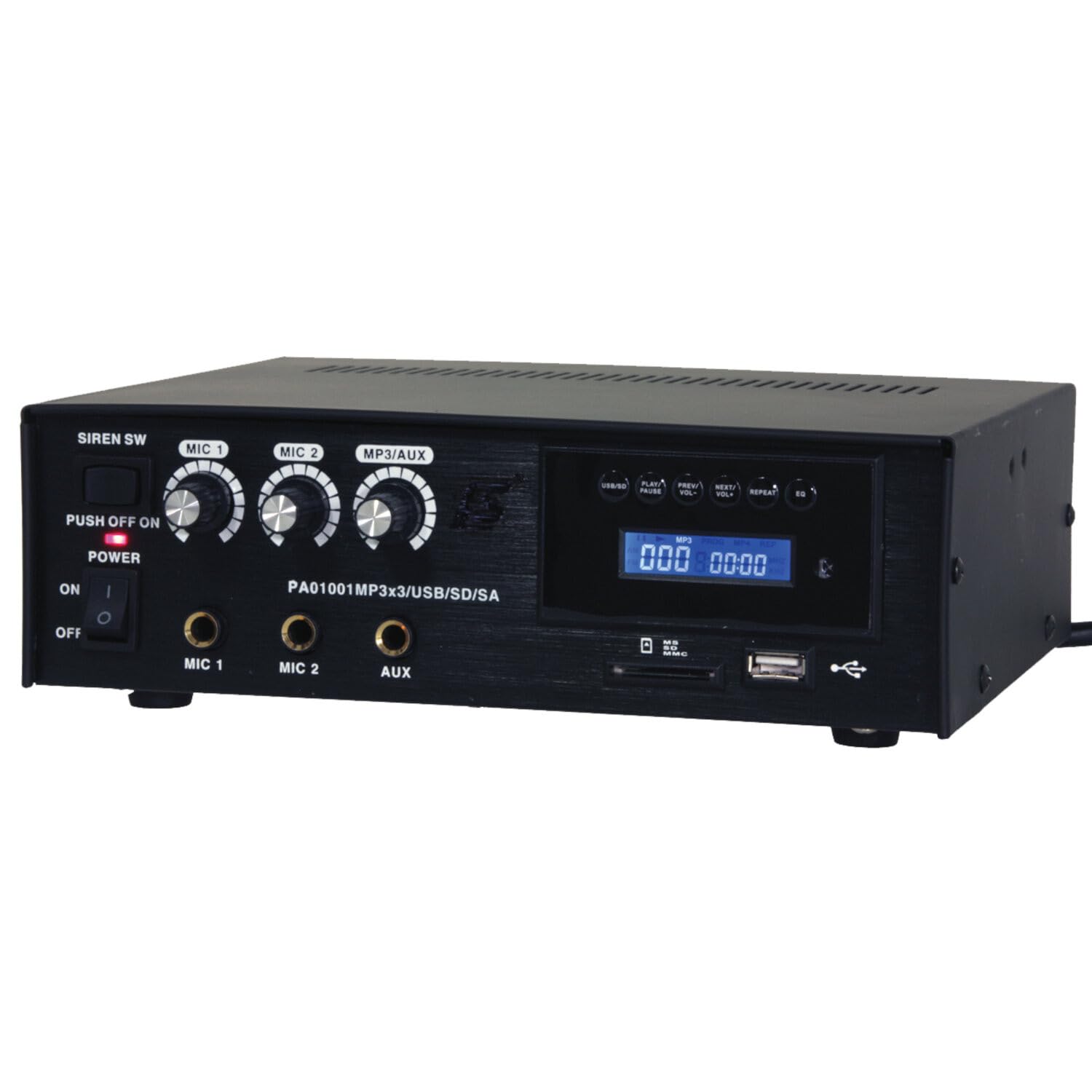
Image: Front panel of the LTC 3-Channel 60W Public Address Amplifier. Visible controls include volume knobs for MIC1, MIC2, and MP3/AUX, a Master volume knob, a Power switch, a Siren switch, and input jacks for MIC1, MIC2, and AUX. The MP3 player section features a display, USB port, and SD card slot.
- SIREN SW: Switch to activate the built-in siren sound.
- PUSH OFF / ON / OF Power Switch: Main power switch for the ampna -emegharị ihe.
- MIC 1 Volume: Rotary knob to adjust the volume level for Microphone Input 1.
- MIC 2 Volume: Rotary knob to adjust the volume level for Microphone Input 2.
- MP3/AUX Volume: Rotary knob to adjust the volume level for the MP3 player and Auxiliary input.
- MASTER Volume: Rotary knob to control the overall output volume of the ampna -emegharị ihe.
- Ntinye MIC 1: 6.3mm jack for connecting Microphone 1.
- Ntinye MIC 2: 6.3mm jack for connecting Microphone 2.
- Ntinye AUX: 6.3mm jack for connecting external audio sources (e.g., CD player, smartphone).
- USB/SD MP3 Player: Integrated player with USB port and SD card slot for direct playback of audio files. Includes control buttons (Play/Pause, Prev/Vol-, Next/Vol+, Repeat, EQ) and an LCD display.
3.2 Atụmatụ
- Mobile or fixed amplifier with 12V battery (car, boat) or 220V mains power supply.
- Integrated MP3 player with USB and SD ports for music playback.
- Includes a siren for powerful sound and an MP3 control screen with a blue LCD display.
4. Nhazi
Follow these steps to set up your ampntughari:
4.1 Njikọ ike
- For 220V AC Operation: Connect the supplied power cord to the AC input on the rear panel of the amplifier and then to a standard 220V AC wall outlet.
- Maka ịrụ ọrụ 12V DC: Connect a 12V DC power source (e.g., car battery) to the 12V DC input terminals on the rear panel. Ensure correct polarity (+ to + and - to -).
- Gbaa mbọ hụ na amplifier's power switch is in the 'OFF' position before connecting to power.
4.2 Njikọ Ọkà Okwu
- Locate the speaker output terminals on the rear panel of the ampna -emegharị ihe.
- Connect your speakers to these terminals, ensuring correct polarity (positive to positive, negative to negative).
- Verify that the total impedance of the connected speakers is compatible with the amplifier's output specifications to prevent damage.
4.3 Njikọ Ntinye Ọdịyo
- Igwe okwu: Insert your microphones into the MIC 1 and/or MIC 2 input jacks on the front panel.
- Auxiliary Devices: Connect external audio sources (e.g., smartphone, laptop, CD player) to the AUX input jack on the front panel using an appropriate 6.3mm audio cable.
- USB/SD Media: Insert a USB flash drive into the USB port or an SD card into the SD card slot on the front panel for MP3 playback.
5. Ntuziaka ọrụ
Ozugbo amplifier is set up, follow these steps for operation:
5.1 Gbanyụọ/ gbanyụọ
- Gbaa mbọ hụ na njikọ niile echekwara.
- Turn the MASTER volume knob to its minimum position.
- Flip the POWER switch to the 'ON' position. The power indicator light will illuminate.
- To power off, turn the MASTER volume to minimum and then flip the POWER switch to 'OFF'.
5.2 Igwe okwu
- Connect your microphone(s) to the MIC 1 and/or MIC 2 inputs.
- Slowly increase the MIC 1 and/or MIC 2 volume knob(s) to the desired level.
- Adjust the MASTER volume for overall output.
- Avoid pointing microphones directly at speakers to prevent feedback (howling).
5.3 Ojiji Ntinye AUX
- Connect your external audio device to the AUX input.
- Ensure the volume on your external device is set to a moderate level.
- Slowly increase the MP3/AUX volume knob to the desired level.
- Adjust the MASTER volume for overall output.
5.4 MP3/USB/SD Playback
- Insert a USB flash drive into the USB port or an SD card into the SD card slot. The amplifier will automatically detect the media and begin playback.
- Jiri bọtịnụ 'PLAY/PAUSE' malite ma ọ bụ kwụsịtụ igwu egwu.
- Use the 'PREV/VOL-' button to go to the previous track or press and hold to decrease volume.
- Use the 'NEXT/VOL+' button to go to the next track or press and hold to increase volume.
- Use the 'REPEAT' button to cycle through repeat modes (e.g., repeat one, repeat all).
- Use the 'EQ' button to cycle through equalizer presets.
- Adjust the MP3/AUX volume knob and MASTER volume for desired output.
5.5 Siren Function
- To activate the siren, flip the SIREN SW to the 'ON' position.
- To deactivate, flip the SIREN SW back to the 'OFF' position.
- Use the MASTER volume to control the siren's output level.
6. Nlekọta
Proper maintenance ensures the longevity of your ampntughari:
- Nhicha: Jiri ákwà dị nro ma kpọọ nkụ hichaa ihe ahụ mgbe niile. Ejila ihe nhicha, wax, ma ọ bụ ihe mgbaze.
- Igwe ikuku: Ensure that the ventilation grilles are free from dust and debris. Use a soft brush or vacuum cleaner to clear them if necessary.
- Nchekwa: Ọ bụrụ na-echekwa amplifier for an extended period, disconnect it from power and store it in a cool, dry place away from direct sunlight and extreme temperatures.
- Njikọ: Periodically check all cable connections for tightness and signs of wear.
7. Nchọpụta nsogbu
Ọ bụrụ na ị nwere nsogbu na ndụ gị amplifier, refer to the table below for common problems and solutions:
| Nsogbu | Ihe nwere ike ime | Ngwọta |
|---|---|---|
| Enweghị ike | Power cable not connected; Power outlet faulty; Power switch off; 12V DC battery depleted or incorrectly connected. | Check power cable connection; Try a different outlet; Ensure power switch is ON; Check 12V DC battery charge and polarity. |
| Enweghị mmepụta ụda | Master volume too low; Input volume too low; Speakers not connected or faulty; Incorrect input selected (for MP3/AUX); Mute activated. | Increase Master and input volumes; Check speaker connections and functionality; Ensure correct input source is active; Check if any mute function is engaged. |
| Ụda agbagọ | Volume too high (clipping); Speaker impedance mismatch; Faulty cables or connections. | Reduce volume; Verify speaker impedance compatibility; Check and replace faulty cables. |
| MP3/USB/SD not playing | ezighi ezi file format; USB drive/SD card faulty or not inserted correctly; MP3/AUX volume too low. | Gbaa mbọ hụ files are MP3 format; Reinsert USB/SD card; Try a different USB/SD card; Increase MP3/AUX volume. |
| Feedback (howling) from microphones | Microphone too close to speakers; Microphone volume too high. | Reposition microphones away from speakers; Reduce microphone volume. |
Ọ bụrụ na nsogbu ahụ dịgidere mgbe ịnwale azịza ndị a, biko kpọtụrụ nkwado ndị ahịa.
8. Nkọwapụta
Technical specifications for the LTC 3-Channel 60W Public Address Ampntughari:
| Njirimara | Nkọwapụta |
|---|---|
| Nọmba nlereanya | LTCAUDIO95-1000 |
| Output Power (12V) | RMS 35W, Max. 45W |
| Output Power (220V) | RMS 45W, Max. 60W |
| Ọnụọgụ nke ọwa | 3 (MIC1, MIC2, AUX/MP3) |
| Voltage | 220V (AC), 12V (DC) |
| Oke ọkọnọ Voltage | 240 volts |
| Nnweta kacha nta Voltage | 220 volts (AC) |
| Akụkụ ngwaahịa (L x W x H) | 48 x 9 x 35 cm (18.9 x 3.5 x 13.8 inch) |
| Ibu ngwaahịa | 3.26 kilogram (7.19 lbs) |
| Ụdị nkwụnye | Ugwu okpokoro |
| Atụmatụ agbakwunyere | USB/SD MP3 Player, Siren |
9. Akwụkwọ ikike na nkwado
This product is manufactured by Ibiza and sold under the LTC brand. Spare parts availability is indicated for 2 years from the date of purchase. For technical support, troubleshooting assistance beyond what is provided in this manual, or warranty claims, please contact your retailer or the authorized service center. Keep your proof of purchase for warranty validation.


