1. Okwu mmalite
This manual provides instructions for the safe and effective use of the Sealey MM19 Digital Multimeter. The MM19 is a general-purpose multimeter designed for measuring various electrical parameters, including AC and DC voltage, DC current, resistance, audible continuity, and diode/transistor verification. Please read this manual thoroughly before operation and retain it for future reference.
2. Ozi nchekwa
Always observe basic safety precautions when using electrical test equipment to reduce the risk of fire, electric shock, or personal injury. This device complies with IEC 1010 and CE CAT II safety standards.
- Do not exceed the maximum input limits for any function. Refer to the specifications section for details.
- E tinyela voltage to the meter when the rotary switch is set to Resistance (Ω), Diode, Continuity, or Current (A) functions.
- Jiri nlezianya na-arụ ọrụ na voltagọ dị n'elu 30V AC RMS, 42V elu, ma ọ bụ 60V DC. Ndị a voltages na-ebute ihe egwu ujo.
- Ensure the test leads are in good condition, without cracked or broken insulation.
- Always connect the common (COM) test lead first and disconnect it last.
- Disconnect power to the circuit under test before measuring resistance or continuity.
- Dochie batrị ozugbo when the low battery indicator appears to ensure accurate readings.
3. Ngwaahịa gafereview
The Sealey MM19 Digital Multimeter features a clear LCD display, a central rotary switch for function selection, and input jacks for test leads.
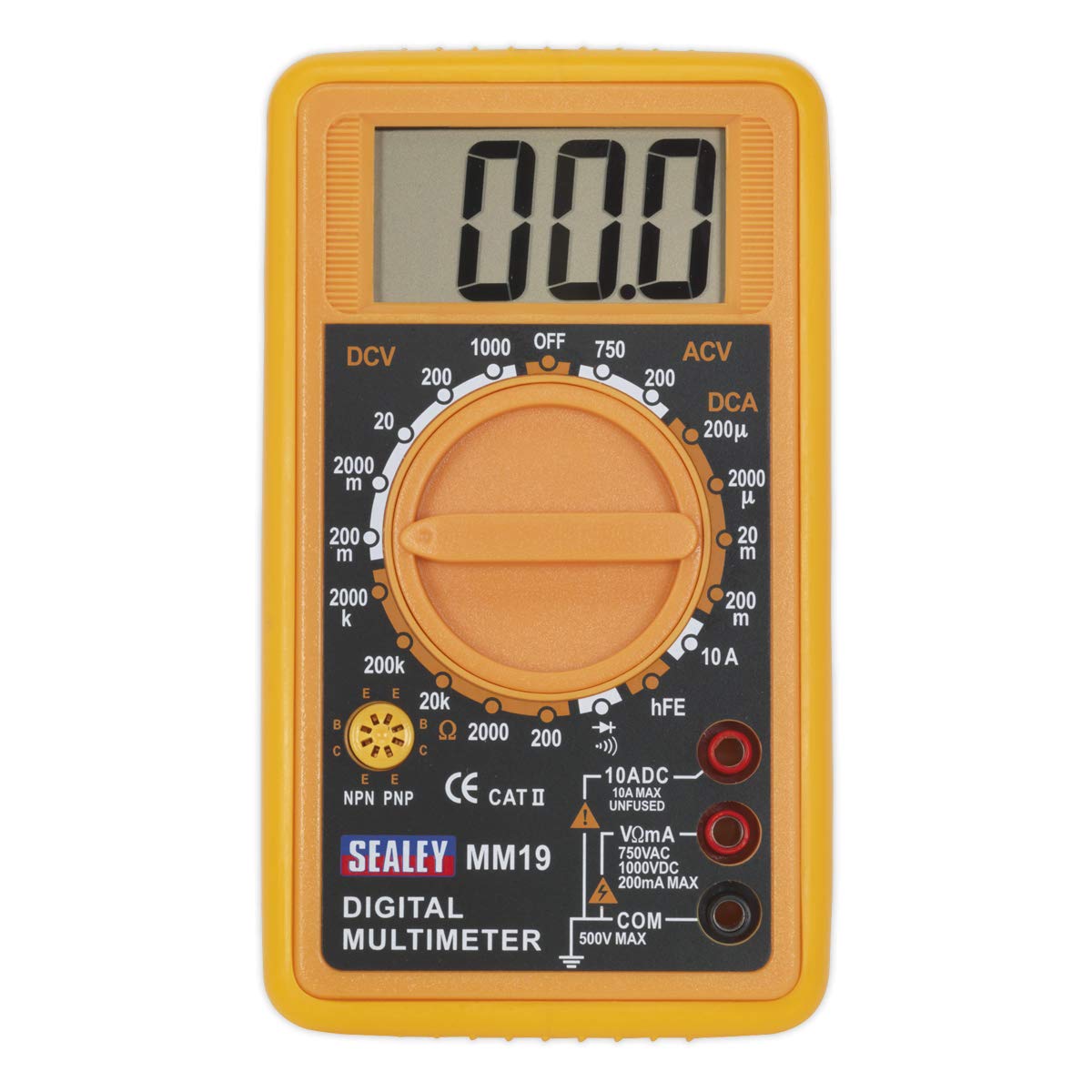
The Sealey MM19 Digital Multimeter, shown with its yellow casing, large LCD display, rotary function switch, and red and black test leads connected to the input jacks.
Ngwa:
- Ngosipụta LCD: Large (46 x 25mm) digital display for reading measurements.
- Ngbanwe Rotary: Used to select the desired measurement function and range.
- VΩmA Input Jack: Maka voltage, resistance, and current measurements up to 200mA.
- 10ADC Input Jack: For high current measurements up to 10A DC (unfused).
- Jack ntinye COM: Ntinye nkịtị (na-adịghị mma) maka nha niile.
- hFE Socket: For transistor (NPN/PNP) testing.
- Nleba ule: Red (positive) and Black (negative) leads for connecting to circuits.
4. Nhazi
4.1. Ntinye batrị
The Sealey MM19 Multimeter requires a 9V battery for operation. If the display does not illuminate or shows a low battery indicator, the battery needs to be installed or replaced.
- Hụ na agbanyụrụla multimeter ahụ.
- Chọta ebe mkpuchi batrị n'azụ unit ahụ.
- Remove the screw(s) securing the cover and carefully lift it off.
- Connect a new 9V battery to the battery clips, observing correct polarity.
- Place the battery inside the compartment and replace the cover, securing it with the screw(s).
4.2. Ijikọ ụzọ ule
The multimeter is supplied with a pair of test leads (red and black).
- Fanye ya black test lead banye na COM (Common) input jack.
- Maka ọtụtụ nha (mkpụrụ)tage, resistance, low current), insert the red test lead banye na VmA jakị ntinye.
- For high DC current measurements (up to 10A), insert the red test lead banye na 10 AD jakị ntinye.
5. Ntuziaka ọrụ
To operate the multimeter, select the desired function and range using the rotary switch.
5.1. Ịtụ DC Voltage (DCV)
- Insert the red lead into the VΩmA jack and the black lead into the COM jack.
- Set the rotary switch to the desired DCV range (e.g., 200m, 2000m, 20, 200, 1000). Start with the highest range if the voltage amaghi.
- Jikọọ ụzọ ule n'ofe akụrụngwa ma ọ bụ sekit a ga-atụ.
- Gụọ voltage uru na LCD ngosi.
5.2. Atụ AC Voltage (ACV)
- Insert the red lead into the VΩmA jack and the black lead into the COM jack.
- Set the rotary switch to the desired ACV range (e.g., 200, 750). Start with the highest range if the voltage amaghi.
- Jikọọ ụzọ ule n'ofe akụrụngwa ma ọ bụ sekit a ga-atụ.
- Gụọ voltage uru na LCD ngosi.
5.3. Measuring DC Current (DCA)
- Maka ọkụ eletrik ruo 200mA: Insert the red lead into the VΩmA jack and the black lead into the COM jack.
- Maka ọkụ eletrik ruo 10A: Insert the red lead into the 10ADC jack and the black lead into the COM jack.
- Set the rotary switch to the desired DCA range (e.g., 200μ, 2000μ, 20m, 200m, 10A). Start with the highest range if the current is unknown.
- Gbanyụọ ike na sekit. Open the circuit where the current is to be measured.
- Connect the multimeter in series with the circuit.
- Apply power to the circuit and read the current value on the LCD display.
5.4. Measuring Resistance (Ω)
- Insert the red lead into the VΩmA jack and the black lead into the COM jack.
- Set the rotary switch to the desired Resistance (Ω) range (e.g., 200, 2000, 20k, 200k, 2000k).
- Ensure the circuit under test is de-energized.
- Jikọọ ihe nlele ndị a ga-eji tụọ.
- Gụọ uru iguzogide na ngosipụta LCD.
5.5. Nnwale Ọga n'ihu Audible
- Insert the red lead into the VΩmA jack and the black lead into the COM jack.
- Set the rotary switch to the continuity symbol (speaker icon).
- Ensure the circuit under test is de-energized.
- Connect the test leads across the component or wire.
- If continuity exists (low resistance), the meter will emit an audible tone. The display will show the resistance value.
5.6. Diode/Transistor Verification Mode (hFE)
- Insert the red lead into the VΩmA jack and the black lead into the COM jack for diode testing.
- Set the rotary switch to the diode symbol.
- Connect the red lead to the anode and the black lead to the cathode of the diode. The display will show the forward voltage drop. Reverse the leads; the display should show 'OL' (open loop) for a good diode.
- For transistor hFE measurement, insert the transistor leads (Emitter, Base, Collector) into the appropriate sockets (E, B, C) in the hFE test socket, ensuring correct NPN or PNP type selection.
- Read the hFE value on the LCD display.
6. Nlekọta
6.1. Nhicha
Wipe the meter casing na adamp ákwà na ihe nhicha dị nro. Ejila ihe na-eme ka ihe dị nro ma ọ bụ ihe mgbaze dị nro. Hụ na mita ahụ kpọrọ nkụ kpamkpam tupu e jiri ya.
6.2. Ngbanwe batrị
Refer to Section 4.1 for battery installation instructions. Replace the 9V battery when the low battery indicator appears on the display to maintain measurement accuracy.
7. Nchọpụta nsogbu
- Enweghị Ngosipụta: Check battery installation and ensure the battery has sufficient charge.
- 'OL' or '1' on Display: This usually indicates an over-range condition or an open circuit. Select a higher range or check connections.
- Ọgụgụ na-ezighi ezi: Ensure the correct function and range are selected. Check test lead connections and battery condition.
- No Continuity Tone: Verify the circuit is de-energized and the leads are making good contact.
8. Nkọwapụta
| Oke | Uru |
|---|---|
| Ụdị | Sealey |
| Nọmba nlereanya | MM19 |
| Isi Iyi Ike | Akwadoro batrị (9V) |
| Ngosipụta | Digital LCD (46 x 25mm) |
| DC Voltage (DCV) | 200mV, 2000mV, 20V, 200V, 1000V |
| AC Voltage (ACV) | 200V, 750V |
| DC Ugbu a (DCA) | 200µA, 2000µA, 20mA, 200mA, 10A |
| Nguzogide (Ω) | 200Ω, 2000Ω, 20kΩ, 200kΩ, 2000kΩ |
| Na-aga n'ihu | Audible tone below approx. 30Ω |
| Nnwale Diode | Gaa n'ihu voltage drop display |
| Nnwale transistor | hFE (NPN/PNP) |
| Ogo nchekwa | CE CAT II, IEC 1010 |
| Akụkụ (L x W x H) | 1.93 x 4.21 x 6.06 sentimita asatọ |
| Ibu Ibu | 9.5 ounces (0.27 Kilogram) |
9. Akwụkwọ ikike na nkwado
For warranty information or technical support, please refer to the documentation provided with your purchase or contact Sealey customer service directly. Keep your proof of purchase for any warranty claims.


