
1. Okwu mmalite
Thank you for choosing the OUKITEL P1500E PLUS Portable Power Station. This device is a high-capacity, versatile power solution designed to provide reliable electricity for various applications, including home backup, outdoor camping, travel, and emergency situations. With a robust 1536Wh LiFePO4 battery and an 1800W continuous AC output (3600W peak), it ensures your essential devices remain powered.
This manual provides important information regarding the safe operation, setup, maintenance, and troubleshooting of your P1500E PLUS. Please read it thoroughly before using the product to ensure optimal performance and safety.

Image: OUKITEL P1500E PLUS Portable Power Station in an outdoor setting, showcasing its compact design and portability.
2. Ntuziaka nchekwa
To ensure safe operation and prolong the lifespan of your OUKITEL P1500E PLUS, please adhere to the following safety guidelines:
- Do not disassemble, repair, or modify the unit. Incorrect assembly may lead to fire, explosion, or injury.
- Keep the device away from fire, heat sources, and direct sunlight to prevent overheating.
- Do not use or store the device in bathrooms or areas exposed to water or high humidity.
- Jiri naanị eriri na ihe ndị ọzọ e ji arụ ọrụ nke mbụ ma ọ bụ nke a kwadoro.
- Avoid dropping, impacting, or subjecting the device to strong vibrations.
- Debe ebe ụmụaka na anụ ụlọ na-apụghị iru.
- The integrated LiFePO4 battery features a SuperSafe Battery Management System (BMS) that provides protection against short circuits, over-temperature, over-charge, and other potential hazards.
- Hụ na ikuku na-ekupụ ikuku nke ọma mgbe ị na-eji ya na mgbe ị na-achaji ya iji gbochie oke okpomọkụ.
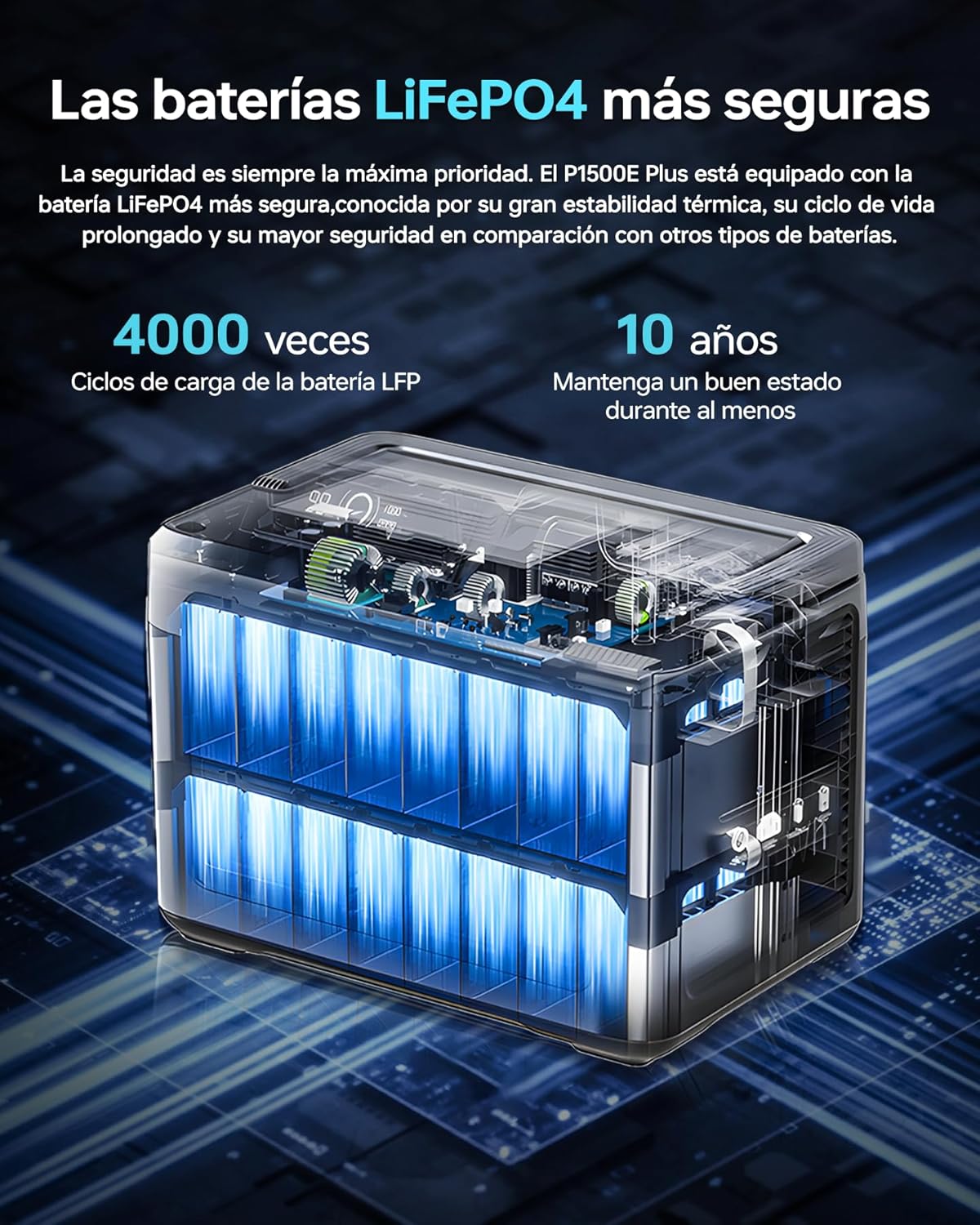
Foto: Ime view of the OUKITEL P1500E PLUS LiFePO4 battery cells, highlighting the safety and longevity of the battery technology. The text on the image indicates '4000 cycles' and '10 years' lifespan.
3. Ihe ngwugwu
Biko lelee ihe dị n'ime ngwugwu ahụ mgbe ị na-emepe igbe ahụ. Ọ bụrụ na ihe ọ bụla efuola ma ọ bụ mebie, kpọtụrụ ndị ọrụ nkwado ndị ahịa.
- 1 x OUKITEL P1500E PLUS Portable Power Station
- 2 x PV100 Foldable Solar Panels
- 1 x Igwe ọkụ AC
- 1 x MC4 to XT60 Cable
- 1 x Bluetooth Pairing Pin
- 1 x kaadị ikike
- 1 x Akwụkwọ ntuziaka onye ọrụ

Image: Diagram showing the contents of the OUKITEL P1500E PLUS package, including the power station, AC charging cable, MC4-XT60 cable, and manual.
4. Ngwaahịa gafereview
4.1. Ọdụ ụgbọ mmiri na njikwa
The OUKITEL P1500E PLUS is equipped with a variety of output and input ports to accommodate diverse charging needs:
- AC Outputs (x4): 1800W continuous, 3600W peak.
- USB-A QC3.0 (x2): Quick Charge for compatible devices.
- USB Type-C PD20W (x1): Power Delivery for smaller devices.
- USB Type-C PD100W (x1): High-speed Power Delivery for laptops and larger devices.
- DC5521 Outputs (x2): For DC-powered appliances.
- Car Charging Port (x1): Mmepụta 12V/10A.
- Ọkụ LED: Integrated for illumination.

Foto: Zuru ezu view of the OUKITEL P1500E PLUS ports and controls, labeling AC outputs, USB ports, DC outputs, and the car charging port.
4.2. Ngosipụta Interface
The clear digital display provides real-time information about the power station's status:
- 1. Discharge Remaining: Time remaining for discharge.
- 2. High Temperature Protection: Indicator for overheating.
- 3. Low Temperature Protection: Indicator for low temperature.
- 4. Fan Status: Indicates fan operation.
- 5. Power Status: Ọkwa chaja batrị.
- 6. UPS Mode: Indicates Uninterruptible Power Supply mode.
- 7. PV Charging Mode: Indicates solar charging.
- 8. Total Input Power: Current power input in watts.
- 9. Total Output Power: Current power output in watts.
- 10. Cigarette Lighter (12V) Output: Indicator for car port use.
- 11. DC (12V) Output: Indicator for DC output use.
- 12. Ọnọdụ ịgbachi nkịtị: Indicator for quiet operation.
- 13. Fast Charging Mode: Indicator for rapid charging.
- 14. Slow Charging Mode: Indicator for slower, battery-preserving charging.
- 15. Nchekwa ibu ibu: Indicator for excessive load.
- 16. USB Output: Indicator for USB-A output use.
- 17. PD Output: Indicator for USB-C Power Delivery output use.
- 18. AC Output: Indicator for AC output use.
- 19. Frequency Switching: Allows switching between 50Hz/60Hz.
- 20. WiFi / Bluetooth: Connection status for app control.

Image: Diagram illustrating the OUKITEL P1500E PLUS display interface and its indicators, with numbered labels corresponding to their functions.
5. Nhazi
5.1. Nchaji mbụ
Before first use, fully charge the OUKITEL P1500E PLUS. Connect the AC power cable to the input port and plug it into a wall outlet. The display will show the charging status. It is recommended to fully charge the unit every 3 months if not in regular use.
5.2. Connecting Solar Panels
To charge using solar power, connect the PV100 solar panels to the power station using the MC4 to XT60 cable. Ensure the solar panels are placed in direct sunlight for optimal charging efficiency. The display will indicate solar charging activity.
6. Ntuziaka ọrụ
6.1. Ịchaji Ọdụ Ike
The P1500E PLUS offers flexible charging options:
- Nchaji AC: Connect the AC cable to a wall outlet. Supports fast charging (Max 1200W) and slow charging (Max 500W). Fast charging can fully charge the unit in approximately 1 hour and 40 minutes.
- Ịchaji anyanwụ: Connect solar panels via the MC4 to XT60 cable. The unit supports up to 500W solar input.
- Ịchaji ụgbọ ala: Use a car charger (not included) to charge from your vehicle's 12V/24V outlet.

Image: OUKITEL P1500E PLUS charging via AC power from a wall outlet and simultaneously via foldable solar panels. The image indicates charging times for AC (1h 40m), Solar (3h 20m), Car (12h/6h), and combined AC+Solar (59 minutes).
6.2. Discharging (Using Outputs)
To power your devices:
- Press the main power button to turn on the power station.
- Press the respective output button (AC, DC, USB) for the port you wish to use. The indicator light for that output will illuminate.
- Connect your device to the appropriate port.
- When finished, turn off the output ports and then the main power button.
6.3. Ọrụ UPS
The P1500E PLUS features an Uninterruptible Power Supply (UPS) function with a switchover time of less than 10 milliseconds. This ensures continuous operation for sensitive devices like PCs, servers, and freezers during sudden power outages ma ọ bụ voltage drops, preventing data loss and downtime.

Image: OUKITEL P1500E PLUS providing UPS backup to a computer setup during a simulated power outage, demonstrating its ability to maintain power for critical devices. The text on the image highlights 'UPS without interruptions of 1800W <10ms'.
6.4. Njikwa ngwa
Control your P1500E PLUS remotely via the dedicated mobile application. Use the Bluetooth pairing pin to connect your device. The app allows you to:
- Monitor battery status and power consumption.
- Adjust discharge limits.
- Select charging speed (fast or slow).
- Turn outputs on/off.

Image: A user controlling the OUKITEL P1500E PLUS via a smartphone app in an outdoor setting, demonstrating the convenience of remote management. The text on the image indicates 'Smart control via application'.
7. Nlekọta
Proper maintenance ensures the longevity and performance of your power station:
- Nchekwa: Store the unit in a cool, dry place, away from direct sunlight and extreme temperatures. For long-term storage, charge the battery to 50-80% every 3 months.
- Nhicha: Jiri ákwà kpọrọ nkụ ma dị nro hichaa mpụta nke ihe ahụ. Ejila ihe nhicha ma ọ bụ ihe mgbaze.
- Nlekọta batrị: Avoid fully discharging the battery frequently. While LiFePO4 batteries are robust, maintaining a charge between 20% and 80% can extend their overall lifespan.
- Igwe ikuku: Hụ na oghere ikuku dị n'ebe a na-anaghị ekpofu uzuzu na ihe ndị na-emebi ihe agaghị ekpo oke ọkụ.
8. Nchọpụta nsogbu
If you encounter issues with your OUKITEL P1500E PLUS, refer to the following common problems and solutions:
| Nsogbu | Ihe nwere ike ime | Ngwọta |
|---|---|---|
| Unit anaghị agbanwuo | Battery is completely discharged; Power button not pressed correctly. | Charge the unit using AC power; Press and hold the power button for 3 seconds. |
| Enweghị mmepụta sitere na ọdụ ụgbọ mmiri AC/DC/USB | Output port not activated; Overload protection triggered; Device not compatible. | Press the corresponding output button; Reduce the load; Check device power requirements. |
| Ọsọ nchaji dị nwayọ | Slow charging mode activated; Low solar input; High ambient temperature. | Switch to fast charging mode via app or unit settings; Ensure solar panels are in direct sunlight; Move to a cooler environment. |
| Overheat warning on display | Excessive load; Poor ventilation; High ambient temperature. | Reduce the connected load; Ensure ventilation openings are clear; Move to a cooler environment. |
If the problem persists, please contact OUKITEL customer support.
9. Nkọwapụta
| Njirimara | Nkọwapụta |
|---|---|
| Nọmba nlereanya | P1500E PLUS |
| Ụdị | OUKITEL |
| Ụdị batrị | LiFePO4 |
| Ike | 1536Wh (480000 mAh) |
| Mmepụta AC | 1800W (Continuous), 3600W (Peak) |
| Ntinye AC | 4 |
| USB-A mmepụta | 2 x QC3.0 |
| USB-C mmepụta | 1 x PD20W, 1 x PD100W |
| Mmepụta DC | 2 x DC5521, 1 x Car Charging Port (12V/10A) |
| AC Input (Charging) | Max 1200W (Fast), Max 500W (Slow) |
| Ntinye anyanwụ | Oke 500W |
| Oge Mgbanwe UPS | <10ms |
| Akụkụ (L x W x H) | 38.6 x 22.8 x 30.5 cm (15.2 x 9.0 x 12.0 inch) |
| Ibu | Ihe dị ka 14.2 n'arọ (31.3 lbs) |
| Akwadoro ojiji | Residential, Camping, Emergency |
10. Akwụkwọ ikike na nkwado
The OUKITEL P1500E PLUS Portable Power Station comes with a 2-afọ akwụkwọ ikike site na ụbọchị ịzụrụ. Akwụkwọ ikike a na-ekpuchi ntụpọ nrụpụta na arụ ọrụ n'okpuru ojiji nkịtị.
Akwụkwọ ikike anaghị ekpuchi:
- Damage caused by misuse, abuse, or improper operation.
- Damage caused by unauthorized disassembly, repair, or modification.
- Damage caused by natural disasters or external forces.
- Nkịtị iyi na akwa.
For warranty claims, technical support, or any questions regarding the use of your OUKITEL P1500E PLUS, please contact OUKITEL customer service. Please have your purchase receipt and product model number ready when contacting support.