
Okwu mmalite
This instruction manual provides detailed guidance for the proper use and maintenance of your Voktta 6-in-1 Soil Meter. This versatile tool is designed to help you monitor six critical factors for plant health: soil moisture, pH level, temperature, fertility, light intensity, and ambient humidity. By providing accurate and timely data, the meter assists in creating optimal growing conditions for various plants in gardens, potted environments, greenhouses, and farms.
Please read this manual thoroughly before operating the device to ensure correct usage and to achieve the best results.

Image: The Voktta 6-in-1 Soil Meter being used in various settings, including potted plants, greenhouses, scientific research, flower gardens, fruit and vegetable cultivation, and orchards.
Njirimara ngwaahịa
- Ọrụ ọtụtụ 6-in-1: Measures soil fertility, moisture, pH, temperature, light intensity, and ambient humidity.
- Highly Sensitive Dual Probe Technology: Equipped with durable alloy and aluminum probes for quick and accurate readings.
- Ihuenyo LCD azụ: High-resolution display ensures clear visibility of test values in both bright and low-light conditions.
- Ngwa sara mbara: Suitable for various planting scenarios including potted plants, greenhouse cultivation, scientific research, flower gardens, vegetable gardens, and lawns.
- Nsonaazụ ọsọ ọsọ: Provides test results within approximately 3 seconds.

Image: The Voktta 6-in-1 Soil Meter displaying its six measurement functions: fertility, pH, temperature, moisture, humidity, and light detection.
Ihe karịrịview
Familiarize yourself with the different parts of your Voktta 6-in-1 Soil Meter:

Image: Detailed diagram of the Voktta 6-in-1 Soil Meter, showing its dimensions and key components. These include the receiver with light sensor, display screen, ON/OFF button, Measure button, °C/°F switch button, aluminum probe, and alloy probes. The top part of the device can be rotated 90 degrees.
- Receiver with Light Sensor: Located at the top, detects ambient light intensity.
- Ngosipụta ihuenyo: Shows all measurement readings (Fertility, Moisture, pH, Temperature, Sun Light, Humidity).
- Bọtịnụ ngbanwu/ Gbanyụọ: Na-agbanye ngwaọrụ ahụ ma ọ bụ gbanyụọ.
- Measure Button: Initiates a measurement cycle.
- bọtịnụ Celsius C/F: Toggles temperature display between Celsius and Fahrenheit.
- Aluminum Probe & Alloy Probes: The two long probes inserted into the soil for measurements.
- Isi na-agbanwe agbanwe: The top part of the device can be rotated 90 degrees for convenience.
Melite
- Wụnye batrị: Open the back cover of the device. Insert 2 x AAA batteries (not included) into the battery compartment, ensuring correct polarity. Close the back cover securely.
- Ike izizi: Pịa Gbanye/ Gbanyụọ button to power on the device. The display will light up.
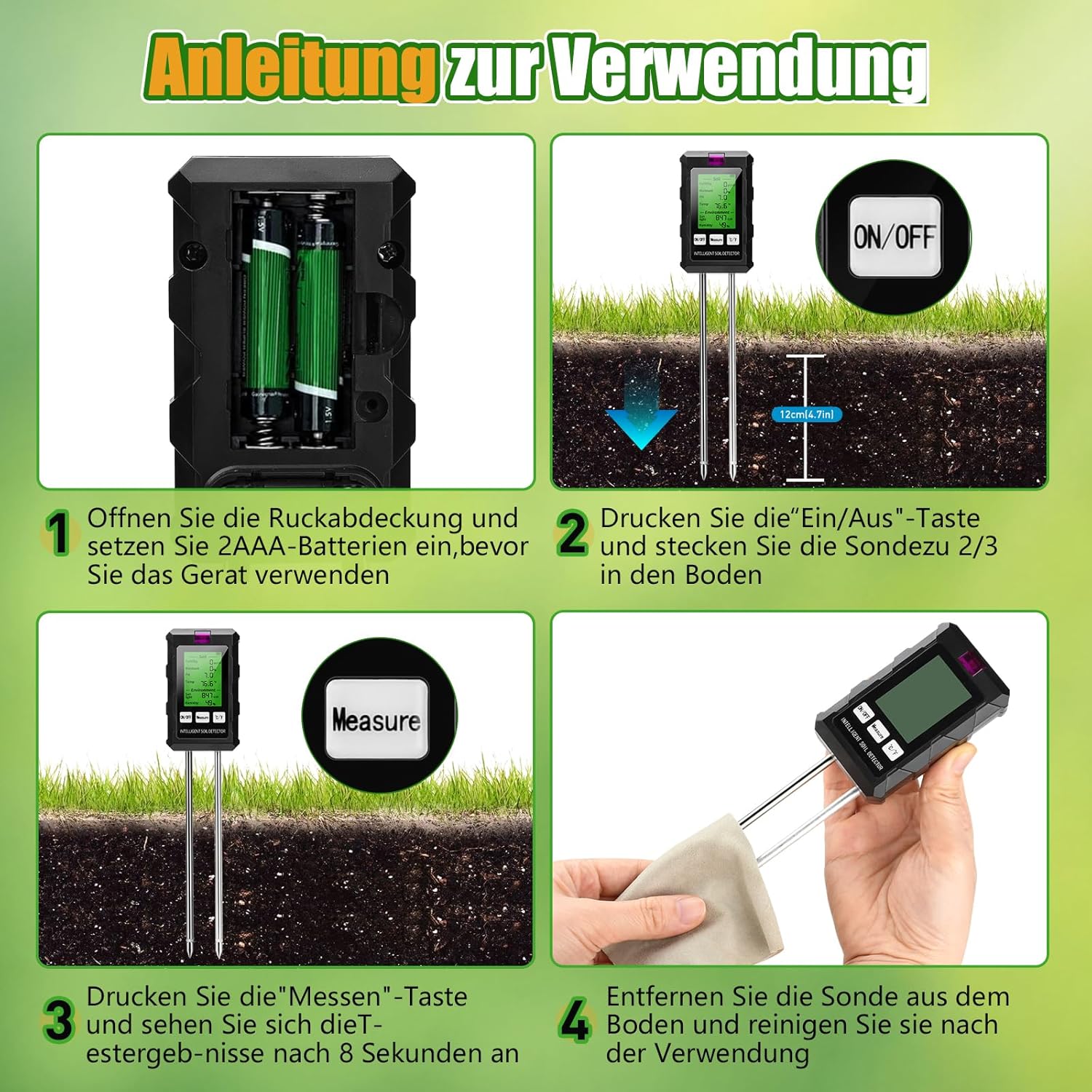
Image: Step-by-step guide for using the soil meter, illustrating battery installation, inserting the probe into soil, pressing the measure button, and cleaning the probe after use.
Ntuziaka ọrụ
- Kwadebe Ala: Ensure the soil is adequately moist. For pH and temperature measurements, it is recommended to compact the soil slightly and, if dry, water it and wait for about half an hour before testing.
- Tinye nyocha: Gently insert the two probes into the soil, approximately 2/3 of their length (about 12cm or 4.7 inches). Ensure the probes are fully in contact with the soil and not just air pockets.
- Take a Measurement: Pịa "Measure" button. The device will begin analyzing the soil.
- Read the Results: After approximately 3-8 seconds, the display will show the readings for fertility, moisture, pH, temperature, sun light, and humidity.
- Gbanwee nkeji okpomọkụ: To change the temperature unit between Celsius (°C) and Fahrenheit (°F), press the ° C/° F bọtịnụ.
- Remove and Clean: After taking your measurements, gently remove the probes from the soil. Wipe the probes clean with a soft cloth to remove any soil residue.
- Gbanyụọ: Pịa Gbanye/ Gbanyụọ button to turn off the device when not in use to conserve battery life.
Ihe ndetu dị mkpa:
- The soil must be compacted before testing pH value or temperature to ensure proper probe contact.
- If the soil is dry, water it and wait for about 30 minutes before measuring temperature.
- Do not force the probes into hard or rocky soil, as this may damage them.
- Do not leave the probes in the soil for extended periods.
Understanding Your Readings
The Voktta 6-in-1 Soil Meter provides readings for six key environmental factors. Understanding these values is crucial for maintaining healthy plant growth.
Ala ọmụmụ
Measures the nutrient content in the soil, indicated in µS/cm. A higher value generally indicates more fertile soil. The device helps you balance soil fertility for optimal plant growth.

Image: Visual representation of optimal ranges for soil fertility (0-3000 µS/cm), soil moisture (0-99%), soil pH (3.5-9.0), and soil temperature (0-50°C).
Mmiri ala
Indicates the water content in the soil as a percentage. Different plants have varying moisture requirements. Ensure the soil is neither too dry nor waterlogged.
Ala pH
Measures the acidity or alkalinity of the soil on a scale from 3.5 to 9.0. Most plants thrive in a slightly acidic to neutral pH range (6.0-7.0). Adjust soil pH as needed for specific plant types.
Okpomọkụ Ala
Displays the temperature of the soil in Celsius or Fahrenheit. Soil temperature affects root growth, nutrient uptake, and microbial activity.
Light Intensity (LUX)
Measures the amount of light available to your plants in LUX units. Different plants require different light levels for photosynthesis. Position plants appropriately based on their light needs.

Image: Visual representation of optimal ranges for light intensity (0-100000 LUX) and ambient humidity (0-99%).
iru mmiri gburugburu
Indicates the humidity level in the air surrounding the device. This is important for plants that prefer specific atmospheric moisture levels.
Nlekọta
- Nyocha dị ọcha: Always clean the probes thoroughly with a soft, dry cloth after each use to prevent residue buildup, which can affect accuracy. Do not use water directly on the main unit or abrasive materials.
- Nchekwa: Chekwaa ngwaọrụ ahụ n'ebe dị jụụ, kpọrọ nkụ na-adịghị na ìhè anyanwụ kpọmkwem na oke okpomọkụ.
- Ngbanwe batrị: Replace batteries when the low battery indicator appears on the display. Remove batteries if the device will not be used for an extended period to prevent leakage.
- Zere Mmiri mmiri: Do not immerse the main unit in water or other liquids. The probes are designed for soil contact, but the electronic housing is not waterproof.
Nchọpụta nsogbu
| Nsogbu | Ihe nwere ike ime | Ngwọta |
|---|---|---|
| No display or device won't turn on. | Batrị anwụọla ma ọ bụ etinyeghị ya nke ọma. | Check battery polarity and replace with new 2 x AAA batteries. |
| Inaccurate pH or temperature readings. | Soil is too loose, too dry, or probes are dirty. | Compact the soil around the probes. Water dry soil and wait 30 minutes. Clean probes thoroughly after each use. |
| Readings fluctuate or are inconsistent. | Poor contact between probes and soil, or air pockets. | Ensure probes are fully inserted and have good contact with moist soil. Avoid inserting into hard or rocky areas. |
| Device not detecting soil. | Soil is too dry or probes are not inserted deep enough. | Moisten the soil and ensure probes are inserted at least 2/3 of their length. |
Nkọwapụta
| Ụdị ngwaahịa: | A38IBDK0012-007 |
| Oke nha: | Illuminance, Humidity Value, pH, Temperature, Fertility |
| Akụkụ ngwaahịa: | 9.06 x 1.97 x 1.97 sentimita (23 x 5 x 5 cm) |
| Ibu ihe: | 4.2 ounce (119 grams) |
| Isi mmalite ike: | Batrị 2 x AAA (anaghị etinye ya) |
| Ngwa: | Yard garden, greenhouse planting, potted plants, scientific research, flower planting, vegetable garden, lawn. |
Ozi nchekwa
- Debe ngwaọrụ ahụ ka ụmụaka ghara iru ya.
- Do not attempt to disassemble or modify the device. This will void the warranty and may cause damage.
- Avoid exposing the device to extreme temperatures, humidity, or direct sunlight for prolonged periods.
- Tụfuo batrị eji eme ihe dịka iwu mpaghara siri dị.
- This device is intended for soil testing only. Do not use it for other purposes.