
Okwu mmalite
This manual provides detailed instructions for the installation, operation, and maintenance of your Hertz DP 1.500 D-Class Mono Bass Amplifier. Designed for optimal audio performance in a compact form factor, this amplifier delivers powerful bass output for your car audio system. Please read this manual thoroughly before installation and use to ensure proper function and safety.

Ọgụgụ 1: N'elu-n'ihu view of the Hertz DP 1.500 D-Class Mono Bass Ampna -emegharị ihe.
Atụmatụ
The Hertz DP 1.500 amplifier incorporates advanced technology to provide high-quality audio performance:
- Maximum Power in Compact Size: Advanced Class-D (ADC) technology ensures 2Ω stable power output in a small and compact design.
- Nhazi mara mma: Features an elegant status LED, solid machined terminal blocks, and a removable top panel to protect controls and connections.
- Ndakọrịta Universal: Operates with a supply voltage from 6.5 to 17.5 V and speaker-in input sensitivity from 1.6 to 40 Vrms, including an integrated Universal Speaker Simulator (USS).
- High-Noise Rejection: Pre-in and Speaker-in inputs feature balanced input circuitry for clear sound.
- Full Set of Controls: Adjustable input levels, high/low-pass crossover filters (50-4000Hz 12dB/Oct.), and bass boost allow fine-tuning of the sound.

Figure 2: Hi-Res Audio Certified for superior sound quality.
Ntọala na nwụnye
Nrụnye kwesịrị ekwesị dị oke mkpa maka ịrụ ọrụ na ogologo ndụ nke gị amplifịa. A na-atụ aro ka ọkachamara ruru eru rụọ nrụnye ahụ.
Akpachara anya maka nchekwa
- Always disconnect the vehicle's negative battery terminal before starting any electrical work.
- Ensure all wiring is correctly sized and fused according to the amplifier's specifications and local regulations.
- Ugwu ahụ amplifier in a location that allows for adequate ventilation and is protected from moisture and excessive heat.
Njikọ waya
Nke amplifier features clearly labeled terminals for power, ground, remote, and speaker outputs, as well as RCA and speaker-level inputs.

Ọgụgụ 3: N'azụ view nke amplifier with power and speaker terminals.
- Ike (BATT): Connect to the positive terminal of the vehicle's battery using appropriate gauge wire and an inline fuse.
- Ala (GND): Connect to a clean, unpainted metal point on the vehicle chassis, as close to the amplifier as possible, using the same gauge wire as the power cable.
- Ime (REM): Connect to the remote turn-on lead from your head unit.
- Speaker Output (SPEAKER OUT): Connect your subwoofer(s) to these terminals. Ensure correct polarity (+ to + and - to -).
- Input (RCA or SPK IN): Use RCA cables for line-level inputs from your head unit or speaker-level inputs (SPK IN) for direct connection to factory head units.
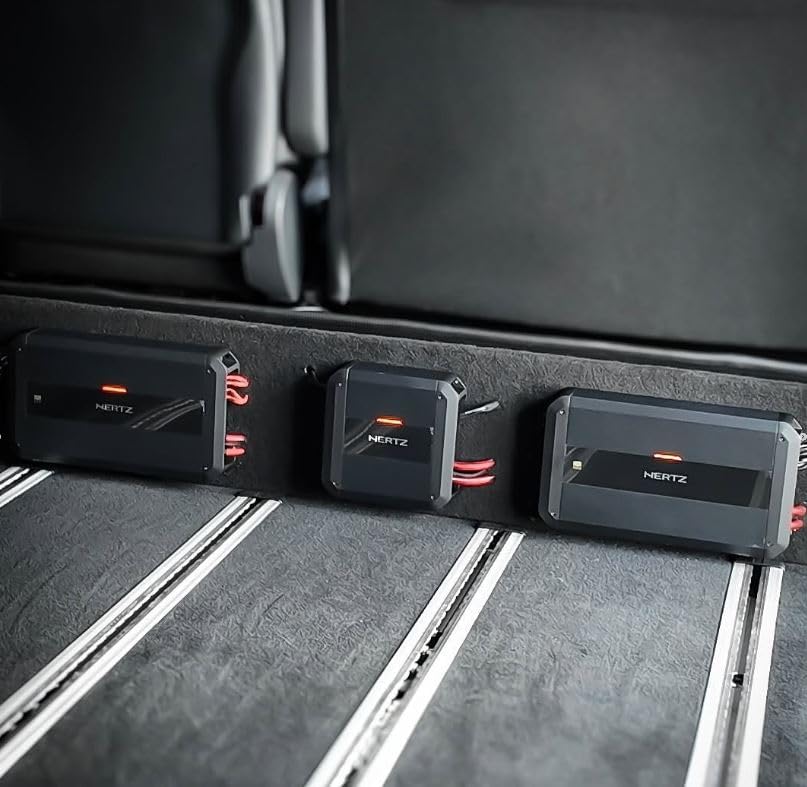
Ọgụgụ 4: Ọpụample of multiple Hertz amplifiers installed, showcasing compact design.
Ntuziaka ọrụ
The Hertz DP 1.500 amplifier offers a range of controls to fine-tune your audio experience.

Foto 5: N'ihu view nke amplifier with control panel.
- Input Level (LO/HI): Select the appropriate input level switch based on whether you are using line-level (RCA) or speaker-level inputs.
- Nweta njikwa: Adjust the gain knob to match the output voltage nke isi unit gị. Malite na uru kacha nta ma jiri nwayọ mụbaa ruo mgbe olu achọrọ ga-eru na-enweghị mgbanwe.
- LP Filter (Low Pass Filter): This control sets the upper frequency limit for the subwoofer. Adjust between 50-4000Hz (12dB/Oct.) to blend the subwoofer with your main speakers.
- Bass agbam ume: Provides an adjustable bass enhancement (0-9 dB) at 50 Hz. Use sparingly to avoid distortion.
- Phase Control (0°/180°): Adjust this switch to match the phase of the subwoofer with the main speakers for optimal bass impact.
- Njikwa Bass dịpụrụ adịpụ: An optional remote bass control (sold separately) can be connected for convenient adjustment of the subwoofer level from the driver's seat.
Nlekọta
Mmezi oge niile na-eme ka ndụ gị dị ogologo ma nwee ike ịrụ ọrụ nke ọma ampna -emegharị ihe.
- Nhicha: Debe ihe amplifier clean and free of dust and debris. Use a soft, dry cloth for cleaning. Avoid using harsh chemicals or abrasive cleaners.
- Igwe ikuku: Gbaa mbọ hụ na amplifier's cooling fins are not obstructed to prevent overheating.
- Njikọ: Periodically check all power, ground, remote, and speaker connections to ensure they are secure and free from corrosion.
- Fuuz: Nke amplifier uses 30A fuses. If a fuse blows, replace it only with a fuse of the same type and rating. Never use a higher rated fuse, as this can cause damage to the amplifier or vehicle's electrical system.
Nchọpụta nsogbu
Ọ bụrụ na ị nwere nsogbu na ndụ gị amplifier, lee usoro nchọpụta nsogbu ndị a na-ahụkarị:
- Enweghị ike: Check the main power fuse, the amplifier's fuses, and all power and ground connections. Ensure the remote turn-on wire is receiving 12V when the head unit is on.
- Enweghị ụda: Verify all input and output connections. Check the head unit's volume and settings. Ensure the input level switch (LO/HI) is correctly set. Adjust the gain control.
- Mgbagha: Reduce the gain setting. Check for proper input signal level. Ensure speaker impedance matches the amplifier's capabilities. Check for damaged speaker wires or speakers.
- Overheating (Protection Mode): Gbaa mbọ hụ na ikuku ikuku zuru oke gburugburu amplifier. Check speaker impedance to ensure it's not too low. Reduce the gain setting.
- Noise/Hum: Check for proper grounding of the amplifier and head unit. Ensure RCA cables are not routed near power wires.
If the problem persists after performing these checks, consult a qualified car audio technician.
Nkọwapụta
| Nkọwapụta | Uru |
|---|---|
| Ibu Ibu | 3.57 pound |
| Akụkụ ngwaahịa | 7.48 x 6.54 x 1.97 sentimita asatọ |
| Nọmba Nlereanya ihe | DP-1.500-FBA |
| ASIN | B0DC59R5DC |
| Ụbọchị mbụ dị | Ọgọst 13, 2024 |
Akwụkwọ ikike & Nkwado
Your Hertz DP 1.500 D-Class Mono Bass Amplifier na-abịa na a Akwụkwọ ikike nke onye nrụpụta afọ 1. For warranty claims, technical support, or any questions not covered in this manual, please contact HERTZ customer service or visit their official websaịtị.
Na-edebe ihe akaebe ịzụrụ ihe gị mgbe niile maka ebumnuche akwụkwọ ikike.