
Okwu mmalite na gafereview
This manual provides comprehensive instructions for the safe and effective operation, maintenance, and troubleshooting of your BUVAYE 5000A Jump Starter with Air Compressor, Model 1920. This versatile device is designed to quickly start low-voltage and fully-drained 12V vehicle batteries, inflate tires up to 150 PSI, and serve as a portable power bank and emergency flashlight. It is suitable for a wide range of vehicles including cars, pickups, trucks, SUVs, RVs, ATVs, motorcycles, tractors, and lawn mowers, supporting all gas engines and diesel engines up to 10.0L.

Image: The BUVAYE 5000A Jump Starter, showcasing its compact design, digital display, control buttons, and included accessories like jumper cables and inflation nozzles.
Kedu ihe dị na Igbe ahụ
Upon opening your package, please verify that all the following components are present and in good condition:
- 1 × BUVAYE 1920 Jump Starter with Air Compressor
- 1 × Heavy-Duty Smart Jumper Cables
- 1 × Detachable Air Hose (13.8'' anti-scalding)
- 4 × Multi-function Nozzles (Presta to Schrader adapter, needle adapter, short tapered nozzle, long tapered nozzle)
- 1 × USB-C eriri USB
- 1 × EVA Carrying Case
- 1 × Akwụkwọ ntuziaka onye ọrụ (akwụkwọ a)

Image: A visual representation of all items included in the BUVAYE 1920 package, clearly labeled for identification.
Nkọwapụta
| Njirimara | Nkọwapụta |
|---|---|
| Ụdị | BUVAYE |
| Nlereanya | 1920 |
| Mpụta kacha elu ugbu a | 5000 Amps |
| Nrụgide Compressor Ikuku | Ruo 150 PSI |
| Ụdị batrị | Lithium polymer (4 gụnyere) |
| Akụkụ ngwaahịa (L x W x H) | 7.68" x 2.36" x 3.14" (19.5cm x 6.0cm x 8.0cm) |
| Ibu Ibu | 2.75 pound (1.25 n'arọ) |
| Okpomọkụ na-arụ ọrụ | -4°F ruo 140°F (-20°C ruo 60°C) |
| Ụdị ọkụ ọkụ | Igwe ọkụ, SOS, Strobe |
| Nchaji ọdụ ụgbọ mmiri | Dual Type-C ports |

Image: Detailed dimensional drawing of the BUVAYE 1920 Jump Starter, indicating length, width, and height.
Akpachara anya maka nchekwa
Gụọ ịdọ aka ná ntị na ntuziaka nchekwa niile tupu i jiri ngwaahịa a. Ọ bụrụ na ị gbasoghị ịdọ aka ná ntị na ntuziaka ndị a, ọ nwere ike ibute mgbawa eletriki, ọkụ, na/ma ọ bụ mmerụ ahụ dị njọ.
- Nchekwa izugbe:
- Ewepụla ngwaọrụ ahụ na mmiri ozuzo ma ọ bụ ọnọdụ mmiri.
- Ejila ngwaọrụ ahụ rụọ ọrụ ma ọ bụrụ na emebiela ma ọ bụ gbanwee ya.
- Debe ebe ụmụaka na-apụghị iru.
- Gbaa mbọ hụ na ikuku ikuku dị mma n'oge eji.
- Akpọsakwala otu ahụ. Kpọtụrụ ndị ọrụ ruru eru ọrụ niile.
- Jump Starting Safety:
- Always connect the red (+) clamp to the positive (+) terminal of the battery and the black (-) clamp to the negative (-) terminal or a suitable ground point on the vehicle chassis.
- Ensure the smart jumper cables are securely connected to the jump starter before connecting to the vehicle battery.
- Emetụla uhie na oji clamps ọnụ.
- Avoid jump starting a frozen battery.
- The smart jumper cables provide multiple safety protections including reverse connection, overcurrent, overvoltage, overload, overcharge/discharge, and short circuit protection.
- Air Compressor Safety:
- Do not over-inflate tires. Always refer to the vehicle manufacturer's recommended tire pressure.
- The air compressor may become hot during prolonged use. Allow it to cool for 10 minutes if it becomes very hot before continuing inflation.
- Ensure the air hose is securely attached to the tire valve before operating the compressor.

Image: Visual representation of the 10 smart safety protections integrated into the device, ensuring safe operation.
Melite
Nchaji mbụ
Before first use, fully charge the BUVAYE Jump Starter. It is recommended to keep the battery starting power above 50% for optimal performance and efficiency.
- Connect the provided USB-C charging cable to the Type-C input port on the jump starter.
- Connect the other end of the USB-C cable to a suitable USB power adapter (not included) or a powered USB port.
- The LCD screen will display the charging status. Charge until the battery indicator shows full.
Mara: For long-term storage, charge the jump starter every two months to maintain battery health.
Ntuziaka Ọrụ: Ịwụlikwa Malite Ụgbọala
Follow these steps carefully to jump start your vehicle:
- Insert Smart Clip: Insert the blue end of the smart jumper cables into the jump starter's designated port. Ensure a firm connection.
- Jikọọ Clamps: Jikọọ uhie (+) clamp to the positive (+) terminal of the vehicle's battery. Connect the black (-) clamp to the negative (-) terminal of the vehicle's battery or a suitable unpainted metal part of the engine block/chassis.
- Verify Indicator: Check the indicator light on the smart jumper cable. If it's green, the connection is correct and safe to proceed. If it's red or flashing, check your connections and refer to the troubleshooting section.
- Mmalite igwe: Once the indicator light is green, start your car engine.
- Wepu Clamps: After the engine starts, immediately remove the black (-) clamp first, then the red (+) clamp from the vehicle battery. Disconnect the smart jumper cables from the jump starter.

Image: Step-by-step visual instructions for safely jump starting a vehicle with the BUVAYE device.

Image: The jump starter unit connected to a car battery, ready to provide a boost.
Operating Instructions: Air Compressor
The integrated air compressor can inflate tires and other inflatables up to 150 PSI.
- Jikọọ ikuku ikuku: Screw the air hose securely onto the valve stem of the tire or inflatable. Use the appropriate nozzle adapter if needed.
- Ike Na: Pịa ma jide bọtịnụ ike (↻) for 2 seconds to turn on the device. The LCD screen will illuminate.
- Select Mode & Unit:
- Long press the unit adjustment button (↻) to switch between inflation modes (car, motorcycle, bicycle, ball).
- Short press the unit adjustment button (↻) to select the desired pressure unit (PSI, Bar, Kpa, Kg/cm²).
- Tọọ nrụgide: Use the "+" and "-" buttons to set the desired target pressure. The current pressure will be displayed on the screen.
- Malite onu oriri: Pịa bọtịnụ ike (↻) to start the air compressor. It will automatically stop once the preset pressure is reached.
- Kwụpụ: Unscrew the air hose from the valve stem.

Image: Step-by-step visual instructions for using the air compressor function to inflate tires.

Image: The device actively inflating a car tire, demonstrating its air compressor capability.
Operating Instructions: Power Bank and Flashlight
Ọrụ Bank Power
The BUVAYE Jump Starter features dual Type-C ports for charging mobile devices and other electronics.
- Connect your device's charging cable to one of the Type-C output ports on the jump starter.
- Ihe mmalite mbuli elu ga-amalite ịchaji ngwaọrụ gị na akpaghị aka.
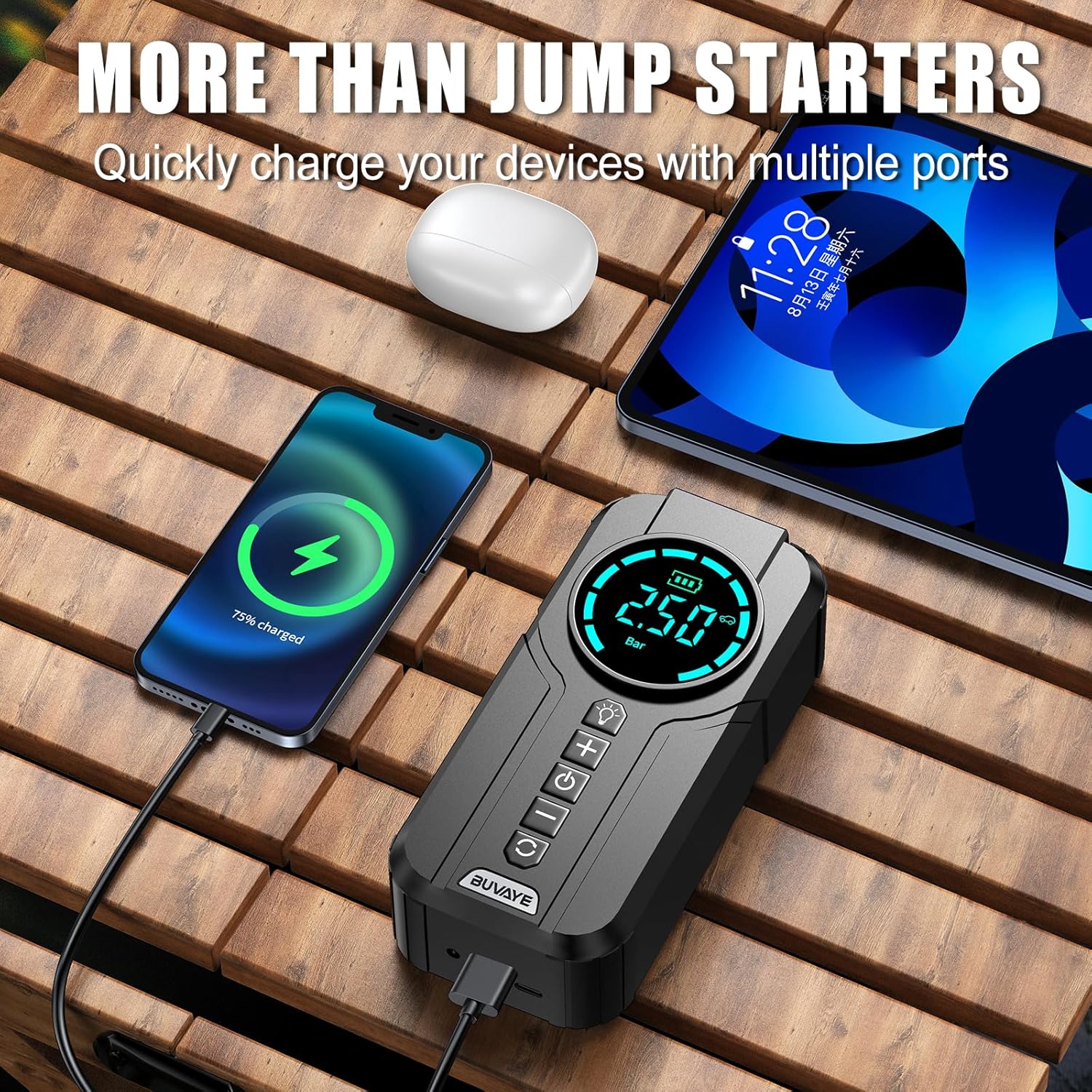
Image: The jump starter acting as a power bank, charging multiple electronic devices.
Ọrụ ọkụ ọkụ LED
The built-in LED flashlight offers three modes for various emergency situations.
- Press the flashlight button (¤) once to turn on the constant flashlight mode.
- Press the flashlight button again to switch to SOS mode (slow flashing).
- Press the flashlight button a third time to switch to Strobe mode (fast flashing).
- Pịa bọtịnụ ọkụ ọkụ nke ugboro anọ ka ịgbanyụ ọkụ.

Image: The device's LED flashlight in use, highlighting its three distinct modes for emergency lighting.

Image: The backlit display and flashlight provide visibility for night use, making operation easier in low-light conditions.
Nlekọta
Proper maintenance ensures the longevity and optimal performance of your BUVAYE Jump Starter.
- Ịchaji mgbe niile: If the device is not used for a long period, charge it every two months to prevent battery degradation.
- Nhicha: Wipe the device with a dry, soft cloth. Do not use harsh chemicals or abrasive cleaners.
- Nchekwa: Store the jump starter in its EVA carrying case in a cool, dry place, away from direct sunlight and extreme temperatures.
- Nyocha USB: Periodically inspect the smart jumper cables and air hose for any signs of damage, wear, or corrosion. Replace if necessary.
Nchọpụta nsogbu
Akụkụ a na-ekwu maka nsogbu ndị ị nwere ike izute. Maka nsogbu edepụtaghị ebe a, biko kpọtụrụ nkwado ndị ahịa.
| Nsogbu | Ihe nwere ike ime | Ngwọta |
|---|---|---|
| Vehicle does not start after jump attempt. |
|
|
| Smart jumper cable indicator light is red or flashing. |
|
|
| Air compressor does not inflate or stops prematurely. |
|
|
| Ngwaọrụ anaghị agbanwu. |
|
|
Akwụkwọ ikike na nkwado
BUVAYE offers a 1-year product quality maintenance period from the date of purchase. Additionally, we provide nkwado teknụzụ ndụ oge niile for your BUVAYE 1920 Jump Starter with Air Compressor.
For any questions, concerns, or technical assistance, please do not hesitate to contact our customer support team. Please have your model number (1920) and purchase details ready when contacting support.
Ozi mkpọtụrụ:
Email: support@buvaye.com
Websaịtị: Visit the BUVAYE Store on Amazon