
Ngwaahịa gafereview
The JSAUX 12-in-1 RGB Docking Station (Model HB1201S) is designed to expand the connectivity and enhance the gaming experience for portable gaming consoles such as the Steam Deck (OLED), ROG Ally, Legion Go, and MSI Claw. This docking station features multiple ports for video output, data transfer, network connectivity, and power delivery, along with customizable RGB lighting.

Foto: Ofeview of the JSAUX 12-in-1 RGB Docking Station, highlighting its various ports and features including Gigabit Ethernet, USB C PD (100W), USB A 3.2 (10Gbps), DisplayPort 1.4 (4K@120Hz), HDMI 2.1 (4K@120Hz), SD card slot, TF card slot, USB C 3.2 (10Gbps, no video output), IN: USB C (HOST), Retractable Stand, RGB Touch Switch, 3.5mm audio interface, USB A 2.0 (480Mbps), and RGB Light Strip.
Ihe ngwugwu
- JSAUX 12-in-1 RGB Docking Station (HB1201S)
- USB-C to USB-C Host Cable
- Akwụkwọ ntuziaka onye ọrụ

Video: A person unboxes the JSAUX RGB Docking Station, showing the purple transparent dock and the included USB-C to USB-C cable. This video demonstrates the physical contents of the product packaging.
Ntuziaka nhazi
- Njikọ ike: Connect a 100W Power Delivery (PD) charger (not included) to the USB-C PD port on the docking station.
- Host Device Connection: Use the provided USB-C to USB-C cable to connect your gaming console (Steam Deck, ROG Ally, Legion Go, etc.) to the 'IN: USB C (HOST)' port on the docking station.
- Ngosipụta njikọ:
- For single display: Connect your monitor or TV to either the HDMI (4K@120Hz) or DisplayPort (4K@120Hz) output.
- For dual display: Connect two monitors using both the HDMI and DisplayPort outputs. Note that dual-screen support maxes out at 4K@60Hz or 2K@120Hz.

Image: A Steam Deck is shown docked and connected to two external monitors, demonstrating the dual display output capability via HDMI and DisplayPort.
- Njikọ Ethernet: For a stable wired internet connection, connect an Ethernet cable to the Gigabit Ethernet port on the docking station.
- USB Peripherals: Connect your USB devices (keyboard, mouse, external drives, etc.) to the available USB A 3.2 (10Gbps), USB C 3.2 (10Gbps), or USB A 2.0 (480Mbps) ports.
- Mmepụta ọdịyo: Connect headphones or external speakers to the 3.5mm audio jack for audio output.
- Kaadị ebe nchekwa: Insert SD or TF cards into their respective slots for data access. Note: Simultaneous reading of SD and TF cards is not supported.
Ntuziaka ọrụ
Ụdị ọkụ ọkụ RGB
The docking station features six dynamic RGB lighting modes. You can cycle through these modes or turn the lighting on/off using the top-mounted touch switch. For custom lighting control, connect the USB-C upstream port to a PC and use OpenRGB software.
- Direct
- Iku ume
- Egwurugwu Egwurugwu
- Spectrum Cycle
- Race Cycle
- Nkwakọba
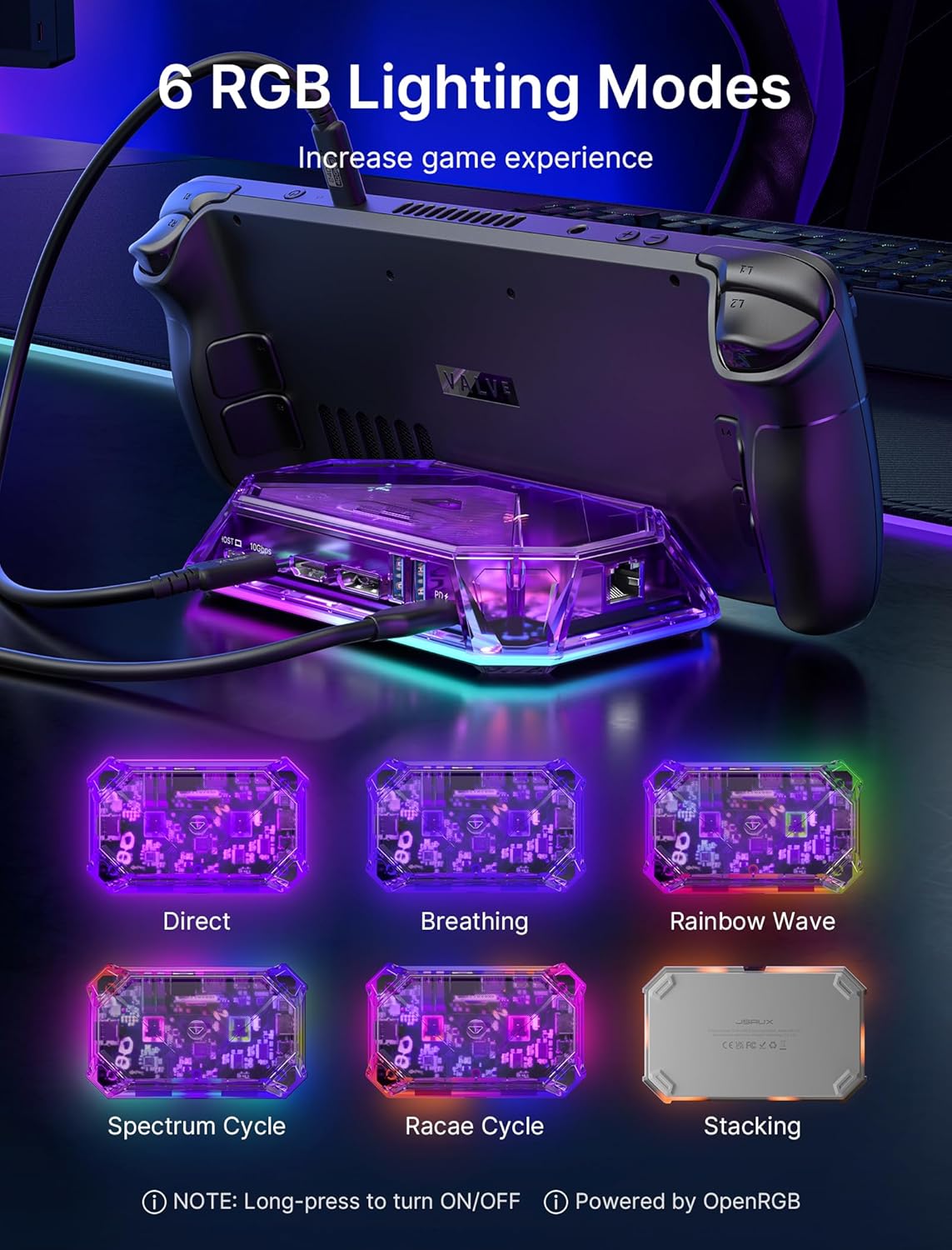
Image: The JSAUX RGB Docking Station is shown with a Steam Deck, illustrating six different RGB lighting modes: Direct, Breathing, Rainbow Wave, Spectrum Cycle, Race Cycle, and Stacking. Instructions for turning on/off and OpenRGB software are also visible.
Advanced Display Features
The HDMI and DisplayPort outputs support 4K@120Hz with advanced features for an enhanced visual experience:
- Ọnụego ume ọhụrụ na-agbanwe agbanwe (VRR): Synchronizes display refresh rate with the console's frame rate to eliminate screen tearing and stuttering.
- Ụdị nkwụsịtụ obere akpaaka (ALLM): Automatically switches the display to a low-latency mode for smoother gaming.
- Oke di elu (HDR): Provides a wider range of colors and contrast for more vibrant and realistic images.

Image: A person is shown playing a video game on a large curved monitor, with the JSAUX docking station connected to a handheld console. The image highlights features like VRR (Variable Refresh Rate), ALLM (Auto Low Latency Mode), HDR (High Dynamic Range), and QFT (Quick Frame Transport) for an immersive experience.
Nnyefe na Nchaji Data
The docking station offers high-speed data transfer and efficient power delivery:
- Nyefee data: USB A 3.2 and USB C 3.2 ports support data transfer speeds up to 10Gbps.
- Nnyefe ike: The USB C PD 3.0 port supports up to 100W fast charging for your connected console or other compatible devices.

Image: The JSAUX docking station is shown with multiple USB cables connected, emphasizing the 10Gbps data transfer speed of its USB 3.2 ports.
Nlekọta
To ensure the longevity and optimal performance of your JSAUX 12-in-1 RGB Docking Station, follow these maintenance guidelines:
- Nhicha: Use a soft, dry cloth to clean the exterior of the docking station. Avoid using liquid cleaners or abrasive materials.
- Nchekwa: Debe ebe a na-adọba ụgbọala n'ebe dị jụụ ma kpọọ nkụ, ebe anwụ na-anaghị anwụ kpọmkwem na oke okpomọkụ dị oke njọ.
- Mmelite femụwe: Periodically check the official JSAUX website for any available firmware updates. Keeping the firmware updated can improve compatibility and performance.
- Jiri Nlekọta Aka: Zere idobe ngwaọrụ ma ọ bụ tinye ya na mmetụta siri ike.
Nchọpụta nsogbu
Ọ bụrụ na ị hụ nsogbu na ọdụ docking gị, lee nsogbu na ngwọta ndị a na-ahụkarị:
| Nsogbu | Ihe nwere ike ime | Ngwọta |
|---|---|---|
| No video output or flickering screen | Loose cable connection, incompatible display settings, power issue. | Ensure all cables (USB-C host, HDMI/DisplayPort, power) are securely connected. Check your console's display settings and the monitor's input source. Verify the power adapter provides sufficient wattage (100W PD recommended). Try a different HDMI/DisplayPort cable. |
| Achọpụtaghị ngwaọrụ USB | Loose connection, device driver issue, power limitation. | Reconnect the USB device. Ensure your console's drivers are up to date. If using multiple high-power USB devices, ensure adequate power is supplied to the dock. |
| Ethernet connection not working | Loose cable, network configuration, driver issue. | Check the Ethernet cable connection. Verify network settings on your console. Ensure the console's network drivers are updated. |
| Nchaji na-eji nwayọ ma ọ bụ anaghị arụ ọrụ | Insufficient power adapter, faulty cable. | Use a 100W Power Delivery (PD) charger. Ensure the USB-C PD cable is functioning correctly. |
| RGB ọkụ anaghị arụ ọrụ | Lighting off, software issue. | Press the top-mounted touch switch to cycle through modes or turn on/off. If using OpenRGB, ensure the software is correctly configured and the dock is connected to a PC. |
| VRR/ALLM/HDR not working | Display incompatibility, console settings. | Ensure your connected display (monitor/TV) supports VRR, ALLM, and HDR. Verify these features are enabled in your console's display settings. |
Nkọwapụta
| Njirimara | Nkọwa |
|---|---|
| Nlereanya | HB1201S |
| Akụkụ | 3.62"L x 5.9"W x 1.11"H (9.19 x 14.99 x 2.82 cm) |
| Ibu | 15.2 ounces (0.43 n'arọ) |
| ọdụ ụgbọ mmiri | Ngụkọta 12 |
| Mmepụta vidiyo | 1x HDMI 2.1 (4K@120Hz), 1x DisplayPort 1.4 (4K@120Hz) |
| ọdụ ụgbọ mmiri USB | 2x USB A 3.2 (10Gbps), 1x USB C 3.2 (10Gbps, no video output), 1x USB A 2.0 (480Mbps) |
| Nnyefe ike | 1x USB C PD 3.0 (up to 100W) |
| Ethernet | 1x Gigabit Ethernet (1Gbps) |
| Audio | 1 x 3.5mm Jack Audio |
| Ndị na-agụ kaadị | 1x SD Card Slot (480Mbps), 1x TF Card Slot (480Mbps) |
| Ngwa dakọtara | Valve Steam Deck, Steam Deck OLED, ASUS ROG Ally, Lenovo Legion Go, MSI Claw, OneXPlayer, AYANEO Slide, etc. |
| Atụmatụ pụrụ iche | VRR, ALLM, HDR, 6 RGB Lighting Modes, OpenRGB Software Support |
Akwụkwọ ikike na nkwado
JSAUX products are designed for reliability and performance. For warranty information, technical support, or to inquire about replacement parts, please visit the official JSAUX websaịtị ma ọ bụ kpọtụrụ ndị ahịa ha ozugbo.
Ndị ọchịchị Websaịtị: www.jsaux.com
Biko dowe akwụkwọ ikike ịzụrụ ihe ọ bụla.