
1. Ozi nchekwa
Read and understand all safety warnings and instructions before operating this sandblasting cabinet. Failure to follow these instructions may result in electric shock, fire, and/or serious injury.
- Ngwa nchekwa nkeonwe (PPE): Always wear appropriate PPE, including safety glasses, gloves, and a respirator, to protect against abrasive media and dust.
- Igwe ikuku: Ensure adequate ventilation in the work area to prevent the accumulation of dust and fumes.
- Nrụgide ikuku: Do not exceed the recommended air pressure of 120 PSI. Always depressurize the system before performing maintenance or changing nozzles.
- Abrasive Media: Use only recommended abrasive media. Improper media can damage the cabinet or the workpiece.
- Nchekwa Eletriki: Ensure the power supply for the dust collector and LED lighting is properly grounded and meets local electrical codes.
- Nkwụsi ike: Ensure the cabinet is placed on a stable, level surface to prevent tipping.
2. Ngwaahịa gafereview
The VEVOR 90 Gallon Sandblasting Cabinet (Model SBC220BF) is designed for efficient surface treatment and cleaning tasks. It features a large capacity, integrated dust collection, and bright internal lighting for optimal visibility.
Akụkụ ndị bụ isi:
- Efficient Surface Treatment: 90-gallon capacity, holds up to 203.4 lbs of abrasive material. Includes a 1.6 HP dust collector and material recovery system. Operates efficiently with 5 CFM at 40-120 PSI.
- Clear Vision, Optimal Efficiency: Features a large acrylic window and bright LED lighting for high visibility. Includes 4 lens protection devices.
- Ihe owuwu na-adịgide adịgide: Made from high-strength cold-rolled steel with a powder-coated surface for enhanced corrosion and rust resistance.
- Oghere ọrụ dị ọcha: Pre-installed sealing strip, sealing material, and air filter effectively prevent dust leakage.
- Ngwa dịgasị iche iche: Comes with a high-quality sandblasting gun and 4 ceramic nozzles (4.5mm, 5mm, 6mm, 7mm) for various abrasive media like glass beads, silicon sand, and aluminum oxide. Ideal for polishing, cleaning, rust removal, paint removal, and oxidation layer removal.

Image: The VEVOR 90 Gallon Sandblasting Cabinet, showcasing its large capacity, working pressure, and sand loading capacity.

Image: Interior of the sandblasting cabinet, highlighting the spacious operational area, integrated gloves, and a built-in parts tray for organizing small items.
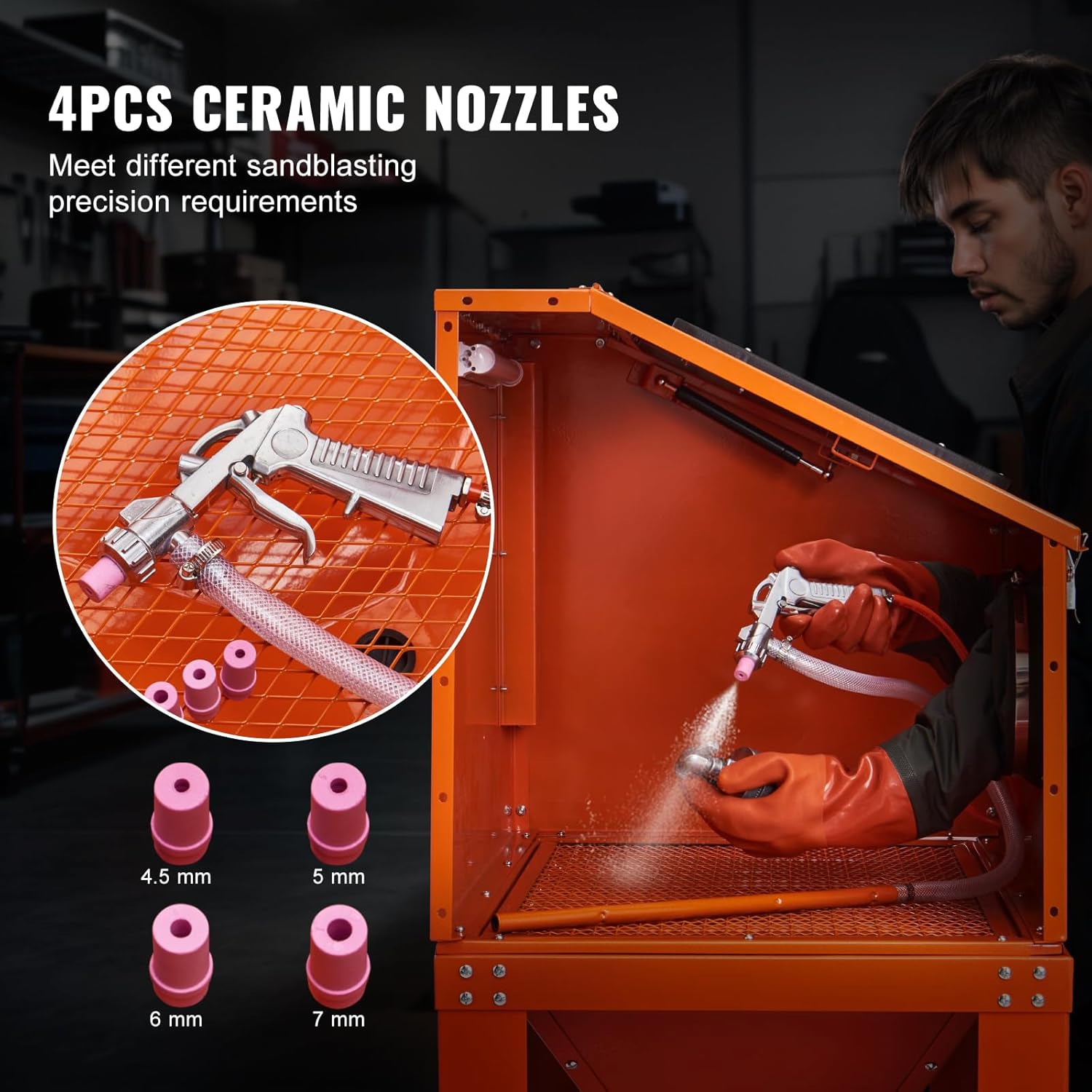
Image: The high-quality sandblasting gun with four ceramic nozzles of different sizes (4.5mm, 5mm, 6mm, 7mm) for precise control and varied applications.

Image: Illustration of the cabinet's heavy-duty cold-rolled steel structure, emphasizing its anti-corrosion, rust-resistant, and non-deformation qualities, along with a powder-coated finish.

Foto: Visual examples of the sandblasting cabinet's efficient surface treatment capabilities, including external paint surface removal, rust and oxidation layer removal, mechanical mold processing, and soldering scar and points removal.
Vidiyo: ogo 360 view of the VEVOR sandblasting cabinet, demonstrating its overall design and features.
3. Nhazi
Careful assembly and proper setup are crucial for safe and efficient operation.
- Mwepu na nyocha: Carefully unpack all components. Inspect for any damage during shipping.
- Mgbakọ: Assemble the cabinet according to the provided diagrams. While assembly is generally straightforward, some users have noted that the instructions can be vague. It is recommended to lay out all parts and refer to the diagrams carefully. Ensure all panels are properly aligned and secured.
- Akara: Apply the provided sealant to all panel joints and seams to prevent dust leakage during operation. This step is critical for maintaining a clean workspace and optimal performance.
- Connect Air Source: Connect your air compressor to the cabinet's air inlet. Ensure your compressor can provide the required 40-120 PSI and at least 5 CFM for efficient operation.
- Install Sand Suction Hose and Sandblasting Gun: Attach the sand suction hose and the sandblasting gun. Ensure all connections are secure.
- Load Abrasive Media: Open the top lid and pour the desired abrasive media (e.g., glass beads, silicon sand, aluminum oxide) into the cabinet. The cabinet can hold up to 203.4 lbs of media.
- Install Lens Protectors: Place the lens protection devices over the viewing window to prevent scratching and ensure clear visibility.
4. Ntuziaka ọrụ
Follow these steps for safe and effective sandblasting:
- Kwadebe mpempe ọrụ: Place the item to be sandblasted inside the cabinet.
- Mechie ma chekwaa: Close the cabinet lid and ensure it is securely latched.
- Activate Dust Collector and Lighting: Turn on the dust collector and the internal LED lighting for clear visibility.
- Begin Sandblasting: Insert your hands into the integrated gloves. Hold the sandblasting gun and direct the nozzle towards the workpiece. Press the trigger to begin blasting.
- Nọgide na-ahụ anya: The bright LED lighting helps maintain clear vision during operation. Replace lens protectors as needed if they become obscured.
- Gbanwee Nozzle: Select the appropriate ceramic nozzle (4.5mm, 5mm, 6mm, or 7mm) based on the desired precision and abrasive media type.
- Monitor Air Pressure: Ensure the air pressure remains within the recommended range of 40-120 PSI for consistent performance.
- Mechaa ọrụ: Once blasting is complete, release the trigger, turn off the dust collector and lighting, and allow any remaining dust to settle before opening the cabinet.
5. Nlekọta
Regular maintenance ensures the longevity and optimal performance of your sandblasting cabinet.
- Onye nchịkọta uzuzu: Regularly empty the dust collector and clean its filter to maintain efficient dust removal and prevent reduced visibility.
- Ndochi nozzle: Inspect ceramic nozzles periodically for wear. Replace worn nozzles to ensure consistent blasting performance.
- Sealing Inspection: Check all seals and joints for wear or damage. Reapply sealant as necessary to prevent dust leakage.
- Lens Protectors: Dochie nke viewing window's lens protectors when they become scratched or opaque to maintain clear visibility.
- ihicha ụlọ ọrụ: Periodically clean the interior of the cabinet to remove accumulated dust and spent abrasive media.
6. Nchọpụta nsogbu
Nke a bụ ụfọdụ okwu nkịtị na ngwọta ha nwere ike ime:
- Low Blasting Pressure: Check air compressor settings, ensure sufficient CFM, inspect air lines for leaks, and verify the nozzle is not clogged or excessively worn.
- Ahụghị Anya nke Ọma: Ensure LED lighting is functional. Replace scratched or dirty lens protectors. Clean the dust collector filter.
- Ntapụ uzuzu: Re-check all panel seals and apply additional sealant where needed. Ensure the cabinet door is properly latched.
- Abrasive Media Not Feeding: Check the sand suction hose for blockages or if it has come loose from the bottom. Ensure the media is dry and free of clumps. Some users report the suction tube tending to float; ensure it is properly weighted or secured at the bottom.
- Gloves Don't Fit: If the provided gloves are not suitable, consider modifying the glove ports to accommodate personal protective gloves that fit correctly.
- Bent or Deformed Panels: If panels arrive bent, carefully straighten them with appropriate tools before assembly to ensure proper fit and sealing.
- Inadequate Internal Lighting/Aspiration: While the cabinet includes LED lighting and a dust collector, for very fine work or heavy dust generation, some users may find additional lighting or an external aspirator beneficial.
7. Nkọwapụta
| Nkọwapụta | Uru |
|---|---|
| Nọmba Nlereanya ihe | SBC220BF |
| Cabinet Capacity | galọn 90 (340 l) |
| Sand Loading Capacity (60 Grit) | 203.4 lbs / 92.24 n'arọ |
| Nrụgide arụ ọrụ | 40-120 nkeji |
| Isi ihe | Ígwè a na-akpọ "Cold-Roll" |
| Nha ịbụ | 111.9 lbs / 50.75 n'arọ |
| Akụkụ ngwaahịa | 35.7 x 23.1 x 54.7 sentimita asatọ / 908 x 586 x 1390 mm |
| Ụdị Ike | AC |
| Ngwa gụnyere | Sandblasting Cabinet, Dust Collector, Sandblasting Gun, 4 Ceramic Nozzles, 4 Cabinet Inner Lens Protectors, Pair of Gloves, 50g Sealant, Mounting Hardware Set, User Manual |
8. Akwụkwọ ikike na nkwado
For warranty information, technical support, or to purchase replacement parts, please refer to the official VEVOR websaịtị ma ọ bụ kpọtụrụ ndị ahịa VEVOR ozugbo. Debe akwụkwọ nnata ịzụrụ maka akwụkwọ ikike.