
Okwu mmalite
This manual provides detailed instructions for the installation, operation, and maintenance of the IXITAB STC-3008, STC-3018, and STC-3028 series of digital temperature and humidity controllers. These devices are designed for precise control in various applications, including aquariums, terrariums, incubators, and industrial temperature/humidity control systems.
Ụdị ngwaahịa
- STC-3008: Dual Digital Temperature Controller with two temperature probes.
- STC-3018: Dual Digital Temperature Controller with two temperature probes.
- STC-3028: Digital Temperature and Humidity Controller with one combined temperature and humidity sensor.
Atụmatụ igodo
- Dual display for simultaneous monitoring of two temperatures or temperature and humidity.
- Two independent relay outputs for controlling heating/cooling or humidification/dehumidification devices.
- Wide range of power supply options (AC 110V/220V, DC 12V/24V) depending on the model.
- High precision sensors for accurate readings.
- User-friendly interface for setting parameters.
Akpachara anya maka nchekwa
To ensure safe operation and prevent damage to the device, please observe the following precautions:
- Kwupu ike mgbe niile tupu ịmee wiwi ma ọ bụ mmezi ọ bụla.
- Gbaa mbọ hụ na ọkọnọ ọkụ voltage matches the requirements of your specific controller model.
- Strictly distinguish the interface of the relay, sensor, and power connections to avoid short circuits or damage.
- Gbaa mbọ hụ na njikọ waya niile nwere nchekwa yana mkpuchi nke ọma.
- Keep the sensor and power wires separate and maintain a proper distance to prevent interference.
- Ewepụla ngwaọrụ ahụ na mmiri ma ọ bụ oke mmiri.
 Foto: Top view of the STC-3018 controller showing the display, buttons, and a label with wiring instructions and safety notes. The label indicates power supply options (110-220VAC, 12V, 24V) and relay outputs (10A/220VAC). A temperature probe is connected to the device.
Ngwaahịa gafereview
Ngwa
- Main Controller Unit (with digital displays and control buttons)
- Temperature Sensor (for STC-3008/3018 models)
- Temperature and Humidity Sensor (for STC-3028 model)
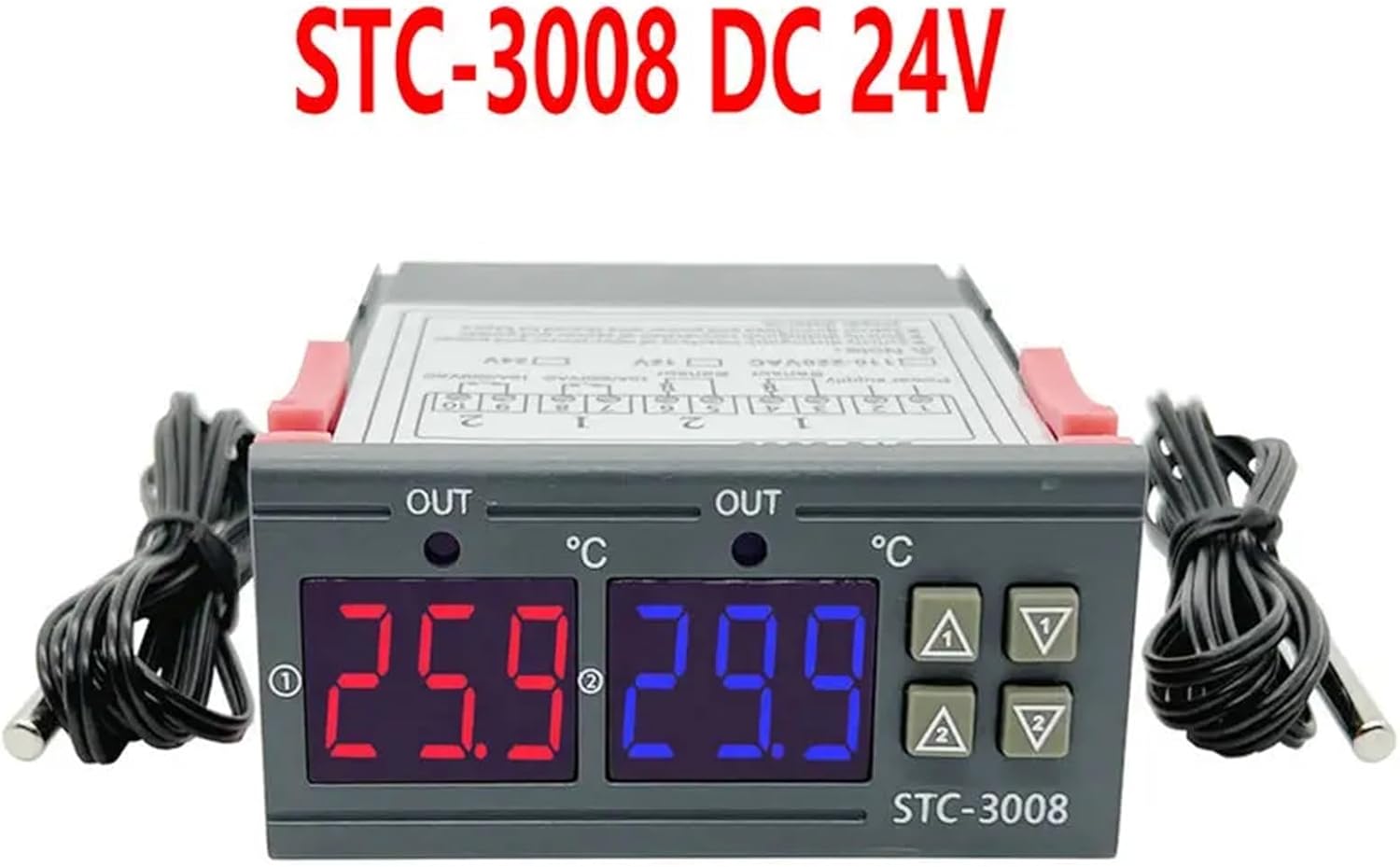 Foto: N'ihu view of the STC-3008 DC 24V model, featuring two digital displays (red and blue) showing temperature readings, and two connected temperature probes. The model name "STC-3008" is visible on the front panel.
 Image: A collage showing three different models: STC-3018 (top left), STC-3008 (top right and bottom left), and STC-3028 (bottom right). Each model is shown with its respective sensor, highlighting the visual differences and sensor types (temperature probe for 3008/3018, combined temperature/humidity sensor for 3028).
 Foto: A nso nso view of the STC-3028 model, showcasing its dual digital display for temperature and humidity, along with the connected combined temperature and humidity sensor.
Nkọwapụta
| Oke | Uru |
|---|---|
| Nlereanya | STC-3008, STC-3018, STC-3028 |
| Ịnye ọkụ | AC 110V/220V, DC 12V/24V (model dependent) |
| Oke nha nha okpomọkụ | -50°C ruo 110°C (-58°F ruo 230°F) |
| Humidity Measurement Range (STC-3028) | 0% RH ruo 99% RH |
| Output Relay Capacity | 10A/220VAC |
| Ụdị ihe mmetụta | NTC sensor (temperature), integrated sensor (humidity for STC-3028) |
| Akụkụ | Approx. 1.18 x 0.79 x 0.39 inches (main unit) |
| Ibu Ibu | Ihe ruru. 1.76 ounces |
| Mba onye si | China |
Nwụnye na Wiring
Ihe dị mkpa: Ensure power is disconnected before performing any wiring to prevent electric shock or damage to the device.
Eserese waya
 Image: Detailed wiring diagram for the STC-3018 model. It illustrates connections for power supply (110V/AC220V, 12V, 24V), two sensor inputs, and two relay outputs (10A/220VAC). Examples of connected loads like a refrigerator, fan, and water heater are shown.
Usoro waya
- Ịnye ọkụ: Connect the appropriate power supply (AC 110V/220V or DC 12V/24V) to terminals 1 and 2. Verify that the voltage matches your specific controller model.
- Ihe mmetụta: Connect the temperature sensors to terminals 3 and 4, and 5 and 6 (for STC-3008/3018). For the STC-3028, connect the combined temperature/humidity sensor to its designated terminals.
- Mgbasa ozi mmepụta Connect your heating/cooling or humidification/dehumidification devices to terminals 7 and 8 (Relay 1) and 9 and 10 (Relay 2). These are dry contacts, meaning they act as switches, and your load will require its own power source.
- Ịkwanye: The controller is designed for panel mounting. Insert the unit into a suitable cutout and secure it using the integrated clips on the sides.
Ntuziaka ọrụ
Ọrụ bọtịnụ
- Tọọ bọtịnụ: Used to enter parameter setting mode and confirm selections.
- Up (▲) Button: Increases values, navigates through menu options.
- Down (▼) Button: Decreases values, navigates through menu options.
- Rst Button: Obere pịa ka view current settings; long press (3 seconds) to reset to factory default settings.
Temperature/Humidity Setting
 Image: A visual guide demonstrating the temperature and humidity setting process on the STC-3028 model. It shows how to set starting and stopping values for both temperature (heating/cooling) and humidity (humidification/dehumidification) using the control buttons.
- Setting Starting Temperature/Humidity: Pịa ogologo Elu (▲) button for 3 seconds. The starting value on the display will flash. Use the Elu (▲) or Ala (▼) buttons to adjust to your desired starting value. Press the Tọọ bọtịnụ iji kwado wee pụọ.
- Setting Stopping Temperature/Humidity: Pịa ogologo Ala (▼) button for 3 seconds. The stopping value on the display will flash. Use the Elu (▲) or Ala (▼) buttons to adjust to your desired stopping value. Press the Tọọ bọtịnụ iji kwado wee pụọ.
- Tọgharia na Ntọala Ụlọ ọrụ: Pịa ogologo Rst button for 3 seconds until the display shows "888" or similar indication of reset.
The controller will automatically activate or deactivate the connected relays based on the set starting and stopping values to maintain the desired temperature or humidity range. For temperature control, if the starting temperature is lower than the stopping temperature, it operates in heating mode. If the starting temperature is higher than the stopping temperature, it operates in cooling mode. Similar logic applies to humidity control for humidification/dehumidification.
Nlekọta
Proper maintenance ensures the longevity and accuracy of your controller:
- Debe ngwaọrụ ahụ ọcha ma ghara ịta uzuzu na ihe ruru unyi. Jiri ákwà dị nro ma kpọọ nkụ hichaa ya.
- Gbaa mbọ hụ na ikuku ikuku zuru oke gburugburu unit ahụ iji gbochie ikpo oke ọkụ.
- Periodically inspect all wiring connections to ensure they remain secure and free from corrosion.
- Avoid exposing the unit or sensors to extreme temperatures, high humidity, or corrosive environments outside their specified operating ranges.
- Do not attempt to disassemble the unit beyond what is described in this manual.
Nchọpụta nsogbu
If you encounter issues with your controller, refer to the table below for common problems and solutions:
| Nsogbu | Ihe nwere ike ime | Ngwọta |
|---|---|---|
| Ngosipụta anaghị arụ ọrụ | No power, incorrect wiring, faulty unit. | Check power supply connections. Verify wiring against the diagram. If problem persists, contact support. |
| Relay anaghị agbanwe agbanwe | Incorrect temperature/humidity settings, faulty relay, load issue. | Review your set starting and stopping values. Check the wiring to the load device. Test the load device independently. |
| Ọgụgụ na-ezighi ezi | Sensor damaged, sensor not properly placed, environmental interference. | Inspect sensor for physical damage. Ensure sensor is in the correct environment and not obstructed. Avoid placing sensor near heat sources or drafts. |
| "LLL" or "HHH" on display | Sensor open circuit (LLL) or short circuit (HHH). | Check sensor connection for looseness or damage. Replace sensor if it appears faulty. |
| Display shows "--- " | Sensor not connected or faulty. | Ensure sensor is securely connected. Replace sensor if necessary. |
Akwụkwọ ikike na nkwado
For warranty information or technical support regarding your IXITAB STC-3008, STC-3018, or STC-3028 controller, please refer to the documentation provided with your product at the time of purchase or contact IXITAB customer service through the platform where you purchased the item.
When contacting support, please be prepared to provide your product model number (STC-3008, STC-3018, or STC-3028) and details of your purchase.