
Okwu mmalite
Thank you for choosing the Verilux Wireless Mouse M103. This manual provides detailed instructions for setting up, operating, and maintaining your new mouse. Please read this manual carefully before use to ensure optimal performance and longevity of your device.
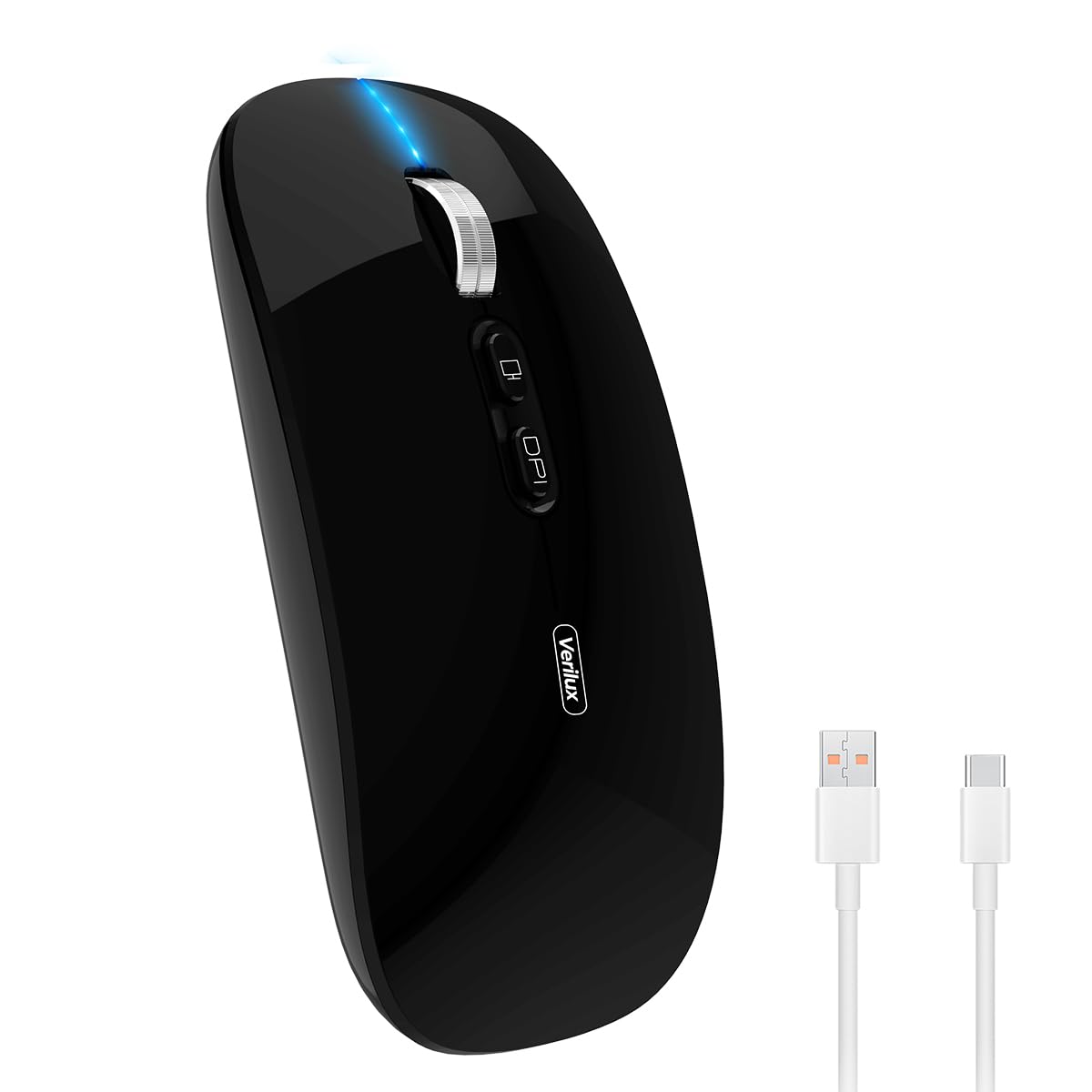
Image: Verilux Wireless Mouse M103 in black.
Ngwaahịa gafereview
The Verilux M103 is a versatile wireless mouse offering dual-mode connectivity (2.4G USB and Bluetooth 5.1), a rechargeable battery, and an ergonomic, silent design. It is compatible with a wide range of devices and operating systems.

Image: The Verilux M103 mouse demonstrating its dual Bluetooth connectivity with a laptop and tablet.
Akụkụ ndị bụ isi:
- Njikọta Ụdị Abụọ: Seamlessly switch between 2.4G USB and Bluetooth 5.1.
- Batrị enwere ike ịchaji: Built-in 500mAh battery with 4-level power indicator.
- Ergonomic & Silent Design: Comfortable grip with silent clicks for a quiet working environment.
- Ndakọrịta Universal: Supports Android, Windows, MacOS, iOS 12 and above, PC, laptops, and tablets.
- DPI nwere ike imeghari: Customize mouse sensitivity for precise control.
Melite
1. 2.4G Mode Setup:
- Chọta ebe nnata USB echekwara n'ime oghere dị n'okpuru òké ahụ.
- Plug the USB receiver into an available USB port on your device (laptop, PC).
- Turn on the mouse using the On/Off switch located on the bottom.
- Òké kwesịrị jikọọ na ngwaọrụ gị ozugbo.
Video: Demonstrates unboxing, identifying the USB receiver, and connecting the mouse via 2.4G USB to a laptop.
2. Bluetooth Mode Setup:
The mouse supports two Bluetooth channels: Bluetooth 3.0 and Bluetooth 5.1.
- Turn on the mouse using the On/Off switch on the bottom.
- Switch the mode selector on the bottom of the mouse to either BT3.0 (center blue light) or BT5.1 (right blue light).
- Activate Bluetooth on your device (laptop, PC, iPad, phone).
- Chọọ maka available Bluetooth devices and select 'BT5.1 Mouse' to connect.
- If the indicator light blinks and the connection is unsuccessful, restart both your device and the mouse, then try again.
Ntuziaka ọrụ
Mouse Buttons:
- Pịa aka ekpe: Standard selection.
- Pịa aka nri: Context menu.
- Scroll Wheel (Middle Button/Roller): Scroll up/down, click for middle-click functions.
- Bọtịnụ DPI: Na-agbanwe mmetụta òké (DPI).
- One-Click Desktop Button: Quickly minimizes all open windows to show the desktop.

Image: Close-up of the Verilux M103 mouse, highlighting the scroll wheel, DPI button, and one-click desktop button.
Ndozi DPI:
Press the DPI button (located behind the scroll wheel) to cycle through different sensitivity levels (e.g., 800, 1200, 1600 DPI). Choose the setting that best suits your preference and task.
Nchaji na batrị
The Verilux M103 mouse features a built-in 500mAh rechargeable battery. It is equipped with 4-level power indicator lights to show the remaining battery life.
Ntuziaka ịkwụ ụgwọ:
- Connect the mouse to a power source using the provided USB-C charging cable. The charging port is located at the front of the mouse.
- A flashing light on the mouse indicates normal charging.
- Charge the mouse using a 5V 1A, 5V 2A, or an adapter with no more than 10W of power. It can also be charged by connecting it to a computer's USB port.
- The mouse can be used while charging.
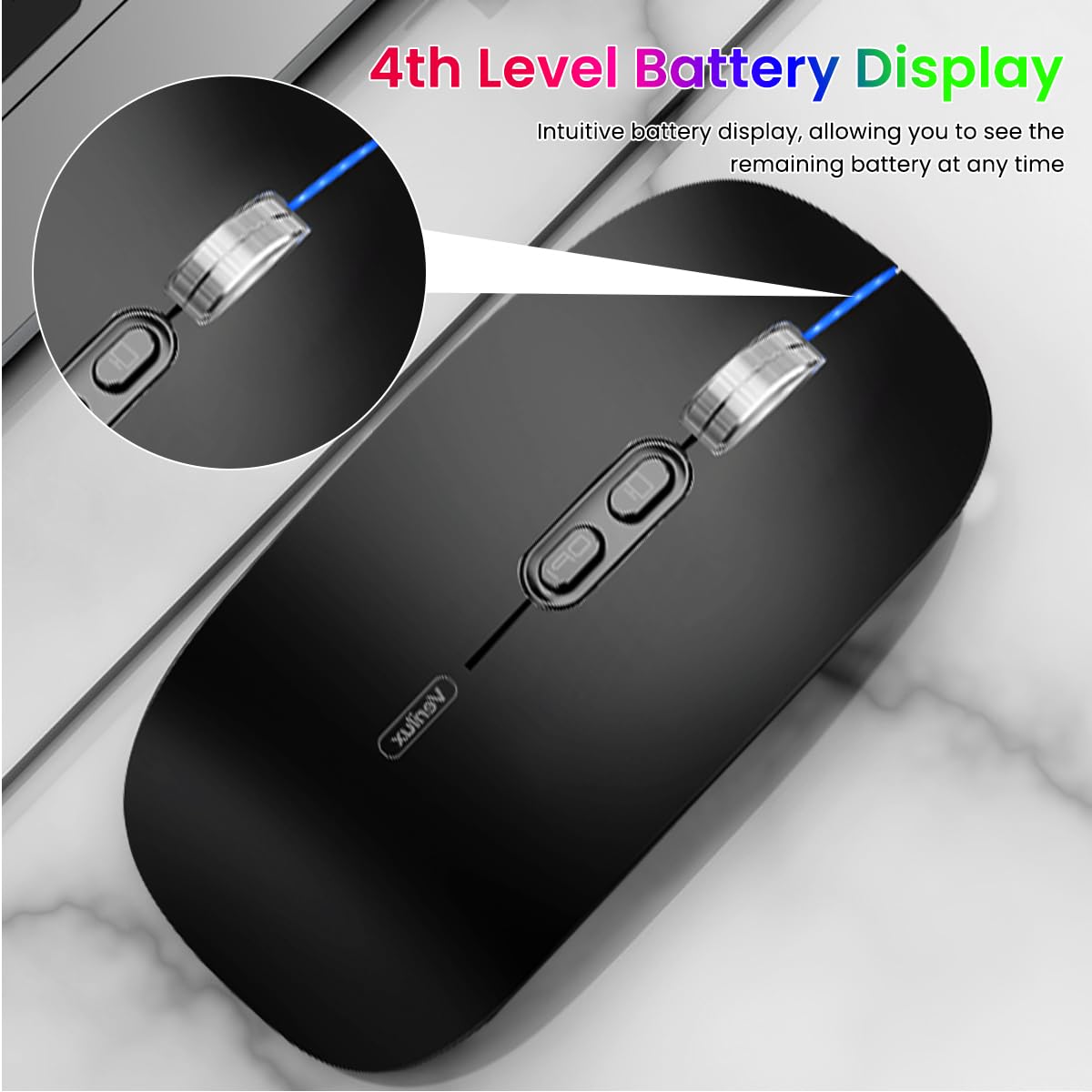
Image: The Verilux M103 mouse displaying its 4-level battery indicator lights.

Image: The Verilux M103 mouse connected to a laptop for charging via its USB-C port.
Ndakọrịta
The Verilux M103 Wireless Mouse offers broad compatibility with various devices and operating systems:
- Sistemu eji arụ ọrụ: Android, Windows (7, XP, 8, 10), MacOS, iOS 12 and above, Linux.
- Ngwaọrụ: Laptops, Personal Computers, Tablets, iPads, MacBooks.

Image: The Verilux M103 mouse shown with a laptop, desktop monitor, iPad, and smartphone, illustrating its wide compatibility.
Nlekọta
To ensure the longevity and optimal performance of your Verilux Wireless Mouse M103, follow these maintenance guidelines:
- Nhicha: Jiri akwa dị nro dị nro hichaa òké. Maka unyi isi ike, ntakịrị dampen akwa na mmiri ma ọ bụ a nwayọọ ihicha ngwọta. Zere kemịkalụ siri ike ma ọ bụ ihe na-emebi emebi.
- Nchekwa: When not in use, especially during travel, store the USB receiver in its designated compartment at the bottom of the mouse to prevent loss.
- Nlekọta batrị: Avoid fully discharging the battery frequently. Charge the mouse when the power indicator shows low battery. Do not expose the mouse to extreme temperatures.
- Ọnọdụ gburugburu: Keep the mouse away from excessive dust, moisture, and direct sunlight.
Nchọpụta nsogbu
If you encounter issues with your Verilux Wireless Mouse M103, please refer to the following common solutions:
| Nsogbu | Ngwọta |
|---|---|
| Mouse not connecting (2.4G Mode) |
|
| Mouse not connecting (Bluetooth Mode) |
|
| Mouse cursor lagging or erratic movement |
|
| Òké anaghị akwụ ụgwọ |
|
Nkọwapụta
| Njirimara | Nkọwa |
|---|---|
| Ụdị | Verilux |
| Nọmba nlereanya | M103 (AZEM4-0K5FZ5C) |
| Teknụzụ Njikọta | Bluetooth (3.0 & 5.1), 2.4G Wireless |
| Teknụzụ nchọpụta ngagharị | Ngwa anya |
| Ntọala DPI | Ruo 1600 DPI (nwere ike idozi) |
| Batrị | 500mAh nwere ike ịchaji |
| Isi Iyi Ike | Batrị kwadoro (USB-C Nchaji) |
| Bọtịnụ | 4 (Left, Right, Scroll Wheel/Middle, DPI, One-Click Desktop) |
| Ntuzi aka | Ambidextrous |
| Ibu Ibu | 119 grams |
| Akụkụ ihe (L x W) | 12L x 7W centimita |
| Agba | Black (Standard Black variant) |
Akwụkwọ ikike na nkwado
For warranty information and customer support, please refer to the documentation included with your product packaging or visit the official Verilux websaịtị ahụ. I nwekwara ike ịkpọtụrụ onye na-ere ahịa ozugbo maka enyemaka.
Onye nrụpụta: Verilux, Yiwu Kaiming Industrial Co., Ltd.
Onye mbubata/ebu: Verilux
Maka ozi ndị ọzọ, ị nwere ike ịga na Verilux Store on Amazon.