
Pro-Ject Debut III Phono HG OM5e
Pro-Ject Debut III Phono SB Turntable User Manual
Model: Debut III Phono HG OM5e
Okwu mmalite
Welcome to the user manual for your new Pro-Ject Debut III Phono SB Audiophile Turntable. This manual provides essential information for setting up, operating, and maintaining your turntable to ensure optimal performance and longevity. Please read these instructions carefully before first use.

Figure 1: Pro-Ject Debut III Phono SB Turntable (Walnut)
The Pro-Ject Debut III Phono SB is an audiophile-grade turntable featuring an 8.6" aluminum tonearm, electronic speed selection, and a pre-mounted Ortofon OM5e phono cartridge. It includes a built-in phono preamp maka njikọta ọnụ.
Ihe ngwugwu
Before beginning setup, please ensure all components listed below are present in your package:
- Pro-Ject Debut III Phono SB Turntable
- Ihe mkpuchi uzuzu
- Enwere m mmetụta
- Ịnye ọkụ
- RCA Cable (semi-balanced shielded audio cable, 1.23m)
- Standard Flat Belt (for 33/45 RPM)
- Katrij itinye n'ọnọdụ Protractor
- Round Belt (for 78 RPM)
- Ibu mgbochi Skating
- Adapter for 7" Singles
- Ortofon OM5e Phono Cartridge (pre-mounted)
Ntuziaka nhazi
Follow these steps carefully to set up your turntable.
1. Ntinye
Place the turntable on a stable, level surface away from direct sunlight, heat sources, and strong vibrations. Ensure adequate ventilation around the unit.
2. Platter and Belt Installation
- Carefully place the heavy steel platter onto the turntable spindle.
- Locate the drive motor pulley. Gently stretch the standard flat belt (for 33/45 RPM) around the motor pulley and the inner rim of the platter. For 78 RPM playback, use the round belt.

Figure 2: Turntable Platter
Ensure the drive belt is correctly seated around the motor pulley and the platter's inner rim for stable rotation.
3. Tonearm and Cartridge Setup
Your Ortofon OM5e cartridge is pre-mounted and pre-adjusted. However, you will need to set the tracking force and anti-skating.
- Tọọ Ike Nchọgharị: Rotate the counterweight at the rear of the tonearm until the tonearm floats freely and is balanced horizontally. Lock the tonearm in its rest. Rotate the tracking force dial (the numbered ring on the counterweight) to '0'. Then, rotate the entire counterweight (including the dial) counter-clockwise until the desired tracking force is set. For the Ortofon OM5e, the recommended tracking force is typically 1.75g.
- Ntọala Mgbochi Ịgba Skate: Attach the anti-skating weight to the small thread loop on the tonearm support. The thread should pass through the second groove for the Ortofon OM5e cartridge.

Figure 3: Tonearm with Anti-Skating Weight
Proper adjustment of tracking force and anti-skating is crucial for optimal sound quality and record preservation.
4. Ijikọ na Ampna -emegharị ihe
The Debut III Phono SB features a built-in phono preamp, offering two output options:
- Line si: Use this if your amplifier na-eme ọ bụghị have a dedicated phono input. Connect the supplied RCA cable from the turntable's "Line Out" jacks to any standard line-level input on your ampihe ọkụ (dịka, AUX, CD, Tuner).
- Pụta ekwentị: Use this if your ampna -emegharị ihe eme have a dedicated phono input. Connect the supplied RCA cable from the turntable's "Phono Out" jacks to your amplifier's "Phono" input.
Always connect the ground wire from the turntable to the ground terminal on your ampihe na-eme ka ihe dị nro belata.

Figure 4: RCA Outputs and Ground Terminal
Choose the appropriate output based on your ampike lifier.
5. Njikọ ike
Connect the power supply to the DC input jack on the turntable and then plug it into a suitable wall outlet.
Ntuziaka ọrụ
1. Ịgbanye / gbanyụọ
The power switch is located on the underside of the turntable plinth. Flip the switch to the 'ON' position to power on the unit.

Figure 5: Power Switch Location
The discreetly placed power switch maintains the clean aesthetic of the turntable.
2. Nhọrọ ọsọ ọsọ
The Debut III Phono SB features electronic speed selection for 33, 45, and 78 RPM.
- To switch between 33 and 45 RPM, press the speed control button located on the underside of the plinth. The platter will adjust to the selected speed.
- For 78 RPM playback, you must manually change the drive belt to the larger diameter step on the motor pulley and use the round belt provided. Then, select 45 RPM using the electronic speed control.
3. Ịkpọ ndekọ
- Place a record on the platter. If playing a 7" single, use the provided adapter.
- Select the correct playback speed (33, 45, or 78 RPM).
- Jiri nwayọ bulie ogwe aka ahụ elu site na iji ihe na-eme ka ọ dị nro.
- Position the tonearm over the desired starting groove of the record.
- Slowly lower the cueing lever to gently drop the stylus onto the record.
- At the end of the record, lift the tonearm using the cueing lever and return it to the tonearm rest. Secure it with the tonearm clip.
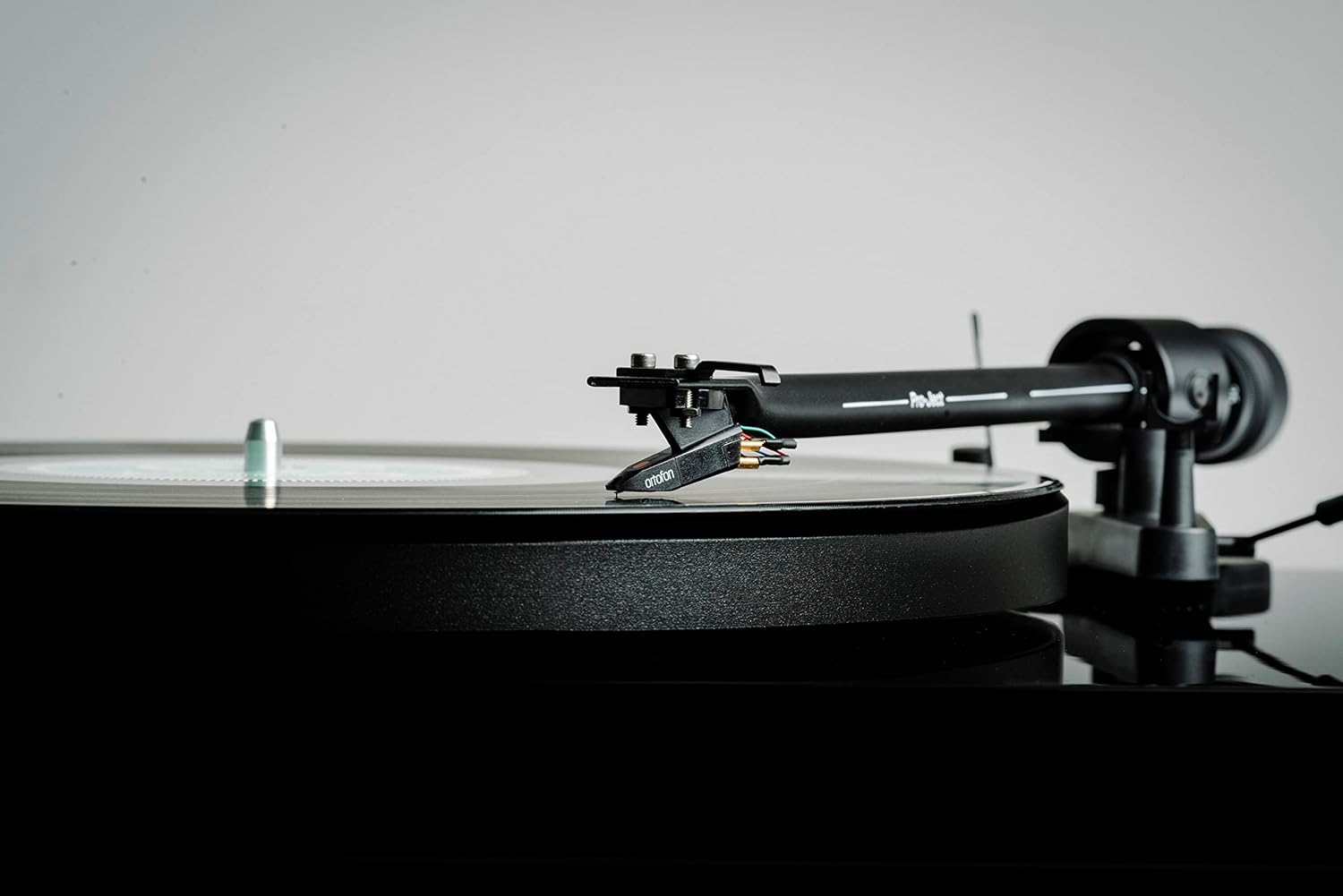
Figure 6: Cartridge on Record
Handle the tonearm and cartridge with care to prevent damage to the stylus or records.
Nlekọta
Regular maintenance will help preserve the performance and appearance of your turntable.
- Cleaning the Plinth and Dustcover: Use a soft, lint-free cloth to wipe down the plinth and dustcover. For stubborn marks, a slightly damp A pụrụ iji ákwà mee ihe, wee jiri nke kpọrọ nkụ mee ihe. Zere ihe nhicha ma ọ bụ ihe mgbaze.
- Cleaning the Stylus: Use a dedicated stylus cleaning brush or fluid. Always brush from back to front (away from the cantilever). Clean the stylus regularly to prevent debris buildup, which can degrade sound quality and damage records.
- Ndochi eriri: The drive belt may stretch over time. If you notice inconsistent speed or reduced torque, consider replacing the belt.
- Cartridge Care: Avoid touching the stylus with your fingers. If the cartridge needs replacement, consult a qualified technician or refer to the cartridge manufacturer's instructions.

Figure 7: Turntable with Dustcover
Keep the dustcover closed when not in use to protect the turntable from dust and debris.
Nchọpụta nsogbu
If you encounter issues with your turntable, refer to the following common problems and solutions.
| Nsogbu | Ihe nwere ike ime | Ngwọta |
|---|---|---|
| No power / No rotation | Power cable not connected; Power switch off; Faulty power supply. | Check power connections; Ensure power switch is ON; Test with another power outlet. |
| Enweghị ụda ma ọ bụ olu dị ala | Ntinye na-ezighi ezi ahọpụtara na amplifier; RCA cables not connected properly; Phono/Line Out switch incorrect; Stylus dirty or damaged. | Select correct input (e.g., AUX, CD, Phono); Reconnect RCA cables firmly; Ensure Phono/Line Out switch matches amplifier input; Clean or replace stylus. |
| ụda humming | Ground wire not connected; Nearby electrical interference; Loose connections. | Connect ground wire to amplifier; Move turntable away from other electronics; Check all cable connections. |
| Ụda agbagọ | Incorrect tracking force; Dirty stylus; Damaged stylus; Worn record. | Adjust tracking force; Clean stylus; Replace stylus; Try a different record. |
| Ọsọ na-ekwekọghị ekwekọ | Drive belt stretched or dirty; Platter not seated correctly; Motor issue. | Clean or replace drive belt; Re-seat platter; Contact support if issue persists. |
Nkọwapụta
Key technical specifications for the Pro-Ject Debut III Phono SB Turntable:
- Ụdị: Debut III Phono HG OM5e
- Drive Principle: Eriri mbanye
- Ọsọ ọsọ: 33, 45, 78 RPM (electronic speed selection for 33/45)
- Platter: 1.7kg heavy steel platter
- Ụda olu: 8.6" Aluminum Tonearm
- Katrij: Ortofon OM5e (pre-mounted)
- Phono Preamp: Built-in (switchable Phono/Line Out)
- Ụdị moto: moto DC
- Akụkụ ngwaahịa (L x W x H): 16.34 x 12.6 x 4.65 sentimita (41.5 x 32 x 11.8 cm)
- Ibu ihe: 12.1 pound (5.5 n'arọ)
- Ihe: Engineered Wood (Plinth)
- Agba: Ukpa
Akwụkwọ ikike na nkwado
Maka ozi gbasara akwụkwọ ikike na nkwado teknụzụ, biko gaa na Pro-Ject Audio Systems gọọmentị websaịtị ma ọ bụ kpọtụrụ onye na-ere gị ikike. Debe ihe akaebe nke ịzụrụ ihe maka akwụkwọ ikike.
Onye nrụpụta: Usoro Pro-Ject Audio
Ask a question about this manual
Ask about setup, troubleshooting, compatibility, parts, safety, or missing instructions. Manuals+ will review the question and use this page’s manual context to help answer it.