
Okwu mmalite
This manual provides essential instructions for the safe and efficient operation of your Powertech UPS Line Interactive PT-950C. Please read this manual thoroughly before installation and use, and retain it for future reference. The Uninterruptible Power Supply (UPS) is designed to protect your electronic equipment from power outages, surges, and sags, ensuring continuous operation and data integrity.
Ntuziaka nchekwa dị mkpa
- Emeghela UPS casing. There are no user-serviceable parts inside. Refer servicing to qualified service personnel.
- Do not install the UPS in direct sunlight, near heat sources, or in environments with excessive dust, moisture, or flammable liquids.
- Ensure adequate ventilation around the UPS. Do not block ventilation openings.
- Connect the UPS to a grounded AC power outlet only.
- Do not connect appliances that could overload the UPS, such as laser printers, heaters, or vacuum cleaners.
- In case of fire, use a dry chemical extinguisher. Water can be dangerous near electrical equipment.
- Disconnect the UPS from the AC power outlet before cleaning. Use a dry cloth.
Ngwaahịa gafereview na akụrụngwa
The Powertech PT-950C UPS features a compact design with multiple Schuko outlets for connecting your devices. Below is an illustration of the unit's main features.
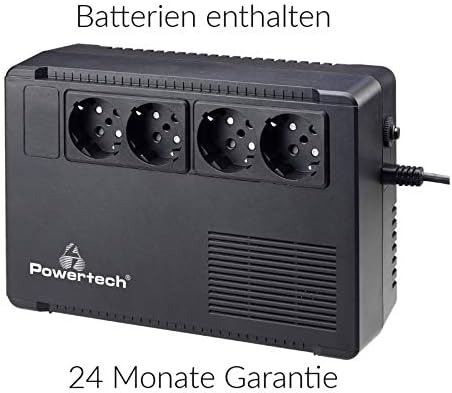
Foto 1: N'ihu view of the Powertech PT-950C UPS, showing four Schuko-type power outlets. The Powertech logo is visible on the lower left, and ventilation grilles are on the right side. A power cord is connected to the right side of the unit.
Isi ihe:
- Schuko Outlets (4x): Provide battery backup and surge protection for connected equipment.
- Bọtịnụ ike: Controls the UPS power on/off status.
- AC Input Cord: Connects the UPS to the wall power outlet.
- Ihe ngosi LED: (Typically located on the front panel, exact position may vary) Display operational status such as AC mode, battery mode, and fault conditions.
Ntuziaka nhazi
- Iwepu: Jiri nlezianya wepụ UPS ahụ na ngwugwu ya. Lelee ma ọ bụrụ na e mebisịrị ihe ọ bụla e ji ebuga ya.
- Nkwanye: Place the UPS on a flat, stable surface in a well-ventilated area, away from direct sunlight, heat, dust, and moisture. Ensure there is sufficient space around the unit for airflow.
- Nchaji mbụ: Connect the UPS to a standard grounded AC wall outlet using its integrated power cord. Allow the unit to charge for at least 8 hours before connecting any equipment to ensure optimal battery performance. The UPS will charge whether it is turned on or off.
- Ngwa njikọ: After the initial charge, connect your computer, monitor, and other critical electronic devices to the Schuko outlets on the UPS. Ensure the total power consumption of connected devices does not exceed the UPS's capacity (570W).
- Ike Na: Press the power button on the UPS to turn it on. The indicator light should illuminate, confirming operation.
Na-arụ ọrụ UPS
- Agbanye/ Gbanyụọ: Press and hold the power button for approximately 2-3 seconds to turn the UPS on or off.
- Ụdị AC: When connected to a stable AC power source, the UPS operates in AC mode, providing power to connected devices and charging its internal battery. An indicator light (e.g., green LED) typically confirms this status.
- Ụdị batrị: N'oge a iketage ma ọ bụ vol dị mkpatage fluctuation, the UPS automatically switches to battery mode, providing power from its internal battery. An audible alarm may sound, and an indicator light (e.g., flashing green or amber LED) will signal this mode.
- Ịdọ aka ná ntị batrị dị ala: If the battery level becomes critically low during battery mode, the UPS will emit a more frequent alarm, indicating that connected devices should be safely shut down.
- Ịdọ aka ná ntị bufee ibu: If the connected load exceeds the UPS's capacity, an alarm will sound, and a fault indicator may illuminate. Disconnect non-essential equipment immediately to prevent damage.
Nlekọta
- Nlekọta batrị: To maximize battery life, ensure the UPS is always connected to an AC power source. If the UPS is stored for an extended period, recharge it every three months for at least 8 hours.
- Nhicha: Disconnect the UPS from the wall outlet and all connected devices before cleaning. Use a soft, dry cloth to wipe the exterior. Do not use liquid or aerosol cleaners.
- Ngbanwe batrị: The internal battery is not user-replaceable. Contact qualified service personnel for battery replacement. Improper replacement can lead to hazards.
Nchọpụta nsogbu
| Nsogbu | Ihe nwere ike ime | Ngwọta |
|---|---|---|
| UPS anaghị agba ọkụ. | No AC input power; Low battery; UPS fault. | Check AC power connection; Allow UPS to charge for 8 hours; Contact support if fault persists. |
| UPS beeps continuously in AC mode. | Ibu ibu ọnọdụ. | Disconnect non-essential equipment until the alarm stops. Ensure total load is within 570W. |
| Short backup time. | Battery not fully charged; Battery nearing end of life; Overload. | Ensure initial 8-hour charge; Reduce connected load; Consider battery replacement by service personnel. |
| UPS does not provide power to connected devices. | UPS is off; Battery discharged; Fault condition. | Turn on UPS; Allow battery to charge; Check for fault indicators and contact support. |
Nkọwapụta
- Ụdị: PT-950C
- Ike: 950VA / 570W ike
- Ụdị: Line Interactive
- Ntinye Voltage: 220-240 VAC
- Mmepụta Voltage (Battery Mode): 220-240 VAC (simulated sine wave)
- Ụlọ ahịa: 4 x Schuko (Battery Backup & Surge Protected)
- Oge mbufe: 2-6 ms
- Ụdị batrị: Sealed Lead-Acid, Maintenance-Free (Batteries included)
- Oge nchaji: 6-8 awa ruo 90% ikike
- Nchedo: Overload, Discharge, Overcharge, Short Circuit
Akwụkwọ ikike na nkwado
The Powertech UPS Line Interactive PT-950C comes with a Akwụkwọ ikike nke ọnwa 24 site na ụbọchị ịzụrụ, na-ekpuchi ntụpọ nrụpụta. Biko dowe ihe akaebe nke ịzụrụ ihe maka akwụkwọ ikike.
For technical support, troubleshooting assistance beyond this manual, or warranty service, please contact your retailer or the Powertech customer service department. Refer to the product packaging or Powertech's official websaịtị maka ozi kọntaktị.