
1. Okwu mmalite
Thank you for choosing the Walfront LCD Digital Programmable Weekly Timer Switch. This device is designed for automatic control of various electrical appliances based on user-defined schedules. Please read this manual carefully before installation and operation to ensure proper use and to prevent damage.
2. Ozi nchekwa
Ịdọ aka ná ntị: Electrical installation should only be performed by qualified personnel. Disconnect power before installation or maintenance to prevent electric shock.
- Gbaa mbọ hụ na ntinye voltage matches the timer's specifications (24V for this model).
- Do not exceed the maximum load capacity of 16A 250VAC (resistive load).
- Debe ngwaọrụ ahụ ka ọ ghara iru mmiri na oke iru mmiri.
- Do not attempt to disassemble or repair the unit yourself. Contact support if issues arise.
3. Ngwaahịa gafereview
The Walfront LCD Digital Programmable Weekly Timer Switch is a high-precision device built with durable, moisture-resistant, and corrosion-protected materials. It features a clear LCD display and supports up to 16 ON/OFF programs daily and weekly.
3.1 Atụmatụ
- High-quality construction for long lifespan.
- Automatic ON/OFF control for various electrical devices.
- Built-in 1.2V/40mA rechargeable battery for memory retention.
- Industrial-grade chip for high precision and strong anti-interference.
- Up to 16 ON and 16 OFF programming settings per day/week.
- LCD display showing real-time, hour, minute, and ON/AUTO/OFF status.
- DIN rail mounting design.
3.2 Akụkụ

Foto nke 1: N'ihu view of the Walfront LCD Digital Programmable Weekly Timer Switch. Shows the LCD display and control buttons.

Foto nke 2: Azu view of the timer switch, illustrating the wiring terminals and basic electrical specifications printed on the unit.
4. Ntọala & nwụnye
This timer is designed for DIN rail mounting. Ensure the DIN rail is securely installed before attaching the timer.
4.1 eserese waya

Foto nke 3: Wiring diagrams showing direct connection (left) and connection with an AC contactor (right). The direct connection illustrates neutral and live wire inputs and load output. The AC contactor diagram shows 220V power input and output to the load device.
Direct Wiring: Connect the neutral and live wires to the designated input terminals (L and N). Connect the load to the output terminals (typically 3 and 4 for normally open, or 3 and 5 for normally closed, as indicated on the device). Refer to the diagram on the device for exact terminal numbering.
Wiring with AC Contactor: For higher loads, connect the timer to control an AC contactor. The timer's output will switch the coil of the contactor, which in turn controls the main power to the load. This setup is shown on the right side of Image 3.
4.2 Initial Power-Up and Battery Charging
Upon first use, connect the timer to power. The internal 1.2V/40mA rechargeable battery will begin charging. If the display is blank or shows incorrect time, allow it to charge for a few minutes. Press the "Tọgharịa" button (often labeled with a small 'R' or 'C' and requires a pointed object) to clear all settings and start fresh.
5. Ntuziaka ọrụ
5.1 Ịtọ oge ugbu a
- Pịa "CLOCK" button (often labeled with a clock icon) and hold it.
- Mgbe ijide "CLOCK", pịa "D+" bọtịnụ ka ịtọ ụbọchị dị ugbu a nke izu.
- Mgbe ijide "CLOCK", pịa "H+" bọtịnụ ka ịtọọ elekere ugbu a.
- Mgbe ijide "CLOCK", pịa "M+" bọtịnụ ka ịtọ nkeji ugbu a.
- Hapụ ya "CLOCK" bọtịnụ. Oge edobela ugbu a.
5.2 Setting 12/24 Hour Mode
By default, the timer operates in 24-hour mode. To switch between 12-hour (AM/PM) and 24-hour modes, press and hold the "CLOCK" button for approximately 5 seconds. The display will show "AM" for 12-hour mode or switch back to 24-hour format.
5.3 Programming ON/OFF Schedules
The timer supports up to 16 ON and 16 OFF programs. Each program consists of an ON time and an OFF time.
- Pịa "PROG" bọtịnụ otu ugboro. Ngosipụta ahụ ga-egosi "1 ON".
- Pịa "D+" to select the day(s) for this ON program (e.g., Mon-Fri, Sat-Sun, or specific days).
- Pịa "H+" iji tọọ awa ON achọrọ.
- Pịa "M+" iji tọọ nkeji ON achọrọ.
- Pịa "PROG" ọzọ. Ngosipụta ahụ ga-egosi "1 Gbanyụọ".
- Repeat steps 2-4 to set the OFF time for the first program.
- Gaa n'ihu ịpị "PROG" to cycle through "2 ON", "2 OFF", up to "16 ON", "16 OFF", setting each as needed.
- Mgbe ịtọchara mmemme niile achọrọ, pịa "CLOCK" button to exit programming mode and return to real-time display.
Mara: If you need to cancel a program, press the "PROG" button to select the program, then press the "MANUAL" button until "----" appears on the display for that program's time slot.
5.4 Manual Override (ON/AUTO/OFF)
Pịa "MANUAL" bọtịnụ ka ị na-agagharị site na ụdị ọrụ:
- NA: The output is continuously ON, ignoring all programs.
- UTgbọala: The timer operates according to the programmed ON/OFF schedules.
- Gbanyụọ: The output is continuously OFF, ignoring all programs.
Gbaa mbọ hụ na ihe nhazi oge dị na ya "AUTO" mode for programmed operation.
5.5 Ọrụ mkpọchi igodo
To prevent accidental changes to settings, the timer features a key lock function.

Foto nke 4: The timer display showing the key lock symbol, indicating that the buttons are locked.
- To lock the keys: Press and hold the "C/R" (Cancel/Reset) button for approximately 4 seconds until a lock symbol appears on the LCD.
- To unlock the keys: Press and hold the "C/R" button again for approximately 4 seconds until the lock symbol disappears.
6. Nkọwapụta
| Oke | Uru |
|---|---|
| Ntinye Voltage | AC/DC 24V (This model) |
| Contact Rated Voltage | AC 180V~264V (50/60Hz) |
| Ibu Ibu | 16A 250VAC (Resistive Load) |
| Mgbanyụ/ Gbanyụọ Ọrụ | 16 ON / 16 OFF (Manual/Auto) |
| Ngosipụta | LCD |
| Oriri ike | 4.5VA (Max) |
| Njehie | ≤2 seconds/day (at 25℃) |
| Ụzọ mgbanye | DIN Rail (sold separately) |
| Ogologo oge | Nkeji 1 ruo awa 168 |
| Oge kacha nta | Nkeji 1 |
| Okpomọkụ na-arụ ọrụ | -10 ℃ ruo 55 ℃ |
| Iru mmiri na-arụ ọrụ | 35-85% RH |
| Akụkụ (L x W x H) | 86 x 36 x 65mm |
| Batrị dị n'ime | 1.2V/40mA rechargeable, >15 days backup |
| Ọnụọgụ nke sekit | Changeover switch (SPDT) |
| Ndụ ije ozi | Mechanical: 107, Electrical: 105 |
| Ibu | 125g |
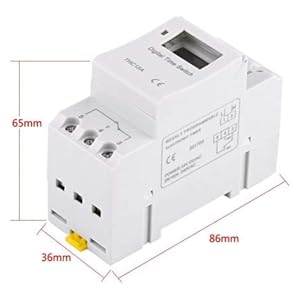
Foto nke 5: Diagram illustrating the dimensions of the timer switch: 86mm length, 36mm width, and 65mm height.
7. Nlekọta
- Debe ihe na-egosi oge dị ọcha ma ghara ịta uzuzu. Jiri ákwà kpọrọ nkụ ma dị nro hichaa ya.
- Ejila ihe nchacha abrasive ma ọ bụ ihe mgbaze.
- Periodically check wiring connections to ensure they are secure.
- The internal battery is designed for long life and typically does not require replacement. If the timer loses settings frequently after power outages, the battery may need servicing by a qualified technician.
8. Nchọpụta nsogbu
| Nsogbu | Ihe nwere ike ime | Ngwọta |
|---|---|---|
| Ngosipụta bụ oghere. | No power supply or internal battery discharged. | Check power connections. Allow the timer to charge for a few minutes after connecting to power. |
| Timer does not switch ON/OFF as programmed. | Timer is not in "AUTO" mode, programs are incorrect, or key lock is active. | Press "MANUAL" until "AUTO" is displayed. Review and correct programs. Unlock keys if necessary. |
| Bọtịnụ anaghị anabata ya. | Ọrụ mkpọchi igodo na-arụ ọrụ. | Press and hold "C/R" for 4 seconds to unlock the keys. |
| Oge ezighi ezi. | Minor drift (within specifications) or internal battery issue. | Reset and re-set the time. If inaccuracy persists or settings are lost frequently, contact support. |
9. Akwụkwọ ikike na nkwado
Walfront strives to provide high-quality products. If you encounter any issues with your product, please contact us for prompt assistance. We offer return and refund services for product defects.
For support, please refer to the contact information provided with your purchase or visit the Walfront store on Amazon: Walfront Amazon Store.