
1. Okwu mmalite
This manual provides detailed instructions for the setup, operation, and maintenance of your ELECROW 7 Inch 1024x600 IPS Capacitive Touchscreen Monitor. This display is designed for broad compatibility with devices such as Raspberry Pi (5/4/3B+/3B/2B+), BB Black, Banana Pi, Jetson Nano, and Windows 11/10/8/7 systems.
Akụkụ ndị bụ isi:
- Ihe onyonyo HD: 7-inch IPS screen with 1024x600 resolution and 170° wide viewing angle for consistent colors and clear viewing.
- Mmetụ Ike: Supports up to 5-point touch functionality without requiring driver installation for most compatible systems.
- Nkwụnye ma kpọọ: Simple connectivity via HD (HDMI) and Micro USB ports for immediate use.
- Ngwa dịgasị iche iche: Suitable for use as a Raspberry Pi display, mini PC monitor, gaming console screen, or a computer temperature monitor.
2. Kedu ihe dị na Igbe ahụ
Biko hụ na ihe niile dị na ya dị tupu ịmalite itinye ya.
- 7 Inch Capacitive Display x 1
- HD Cable x 1
- eriri USB x 1
- Micro HD Adapter x 1
- Copper Screws Pack (4pcs) x 1
- DVD x 1 (Contains drivers and documentation)
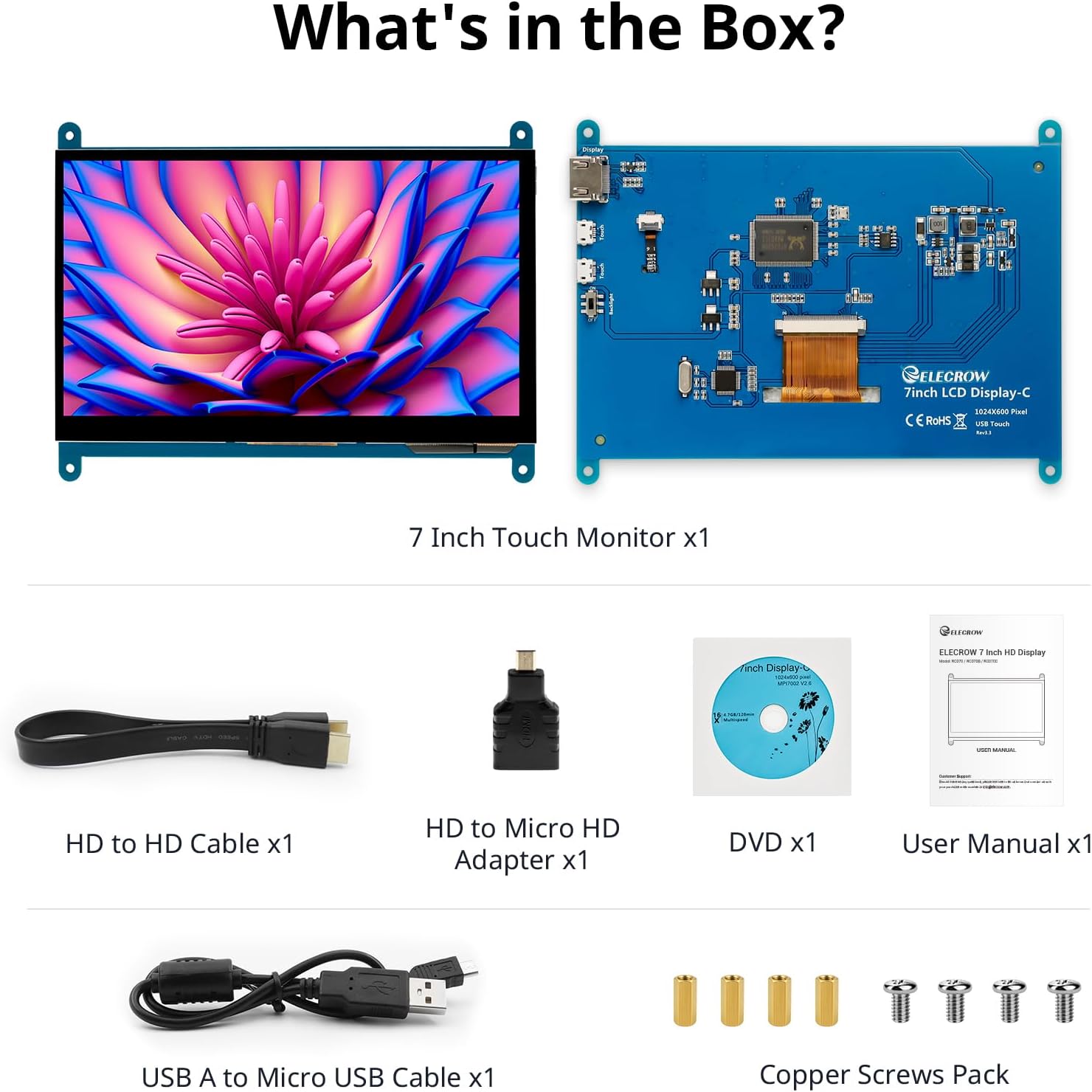
Foto: Ihe niile dị na ngwugwu ngwaahịa ahụ.
3. Ntọala na Njikọ
Follow these steps to connect your ELECROW 7 Inch Touchscreen Monitor to your device.
3.1 Ngwaike karịrịview

Foto: N'azụ view of the monitor highlighting the Standard HD Port, Micro USB Port for touch and power, and Backlight switch.
- Standard HD Port: For video data transfer.
- Micro USB Port: For touch functionality and power supply.
- Mgbanwe ọkụ azụ: To turn the display backlight on or off.
3.2 Connecting to Raspberry Pi
To connect the monitor to a Raspberry Pi, you will need both the HD cable for video and the USB cable for touch and power.
- Connect one end of the HD cable to the Standard HD Port on the monitor and the other end to the HDMI port on your Raspberry Pi. Use the Micro HD adapter if necessary for your Raspberry Pi model.
- Connect the Micro USB cable to the Micro USB Port on the monitor. Connect the other end of the USB cable to a USB port on your Raspberry Pi for power and touch data.
- Ensure the backlight switch on the monitor is in the 'On' position.
- Power on your Raspberry Pi. The display should automatically detect and show the output.
For touch functionality with Raspberry Pi, power can be supplied via the Raspberry Pi's USB port. If using an external power source for the Raspberry Pi, ensure it is sufficient. For optimal performance, especially with older Raspberry Pi models, an external power supply for the monitor might be beneficial if the Pi cannot provide enough current.
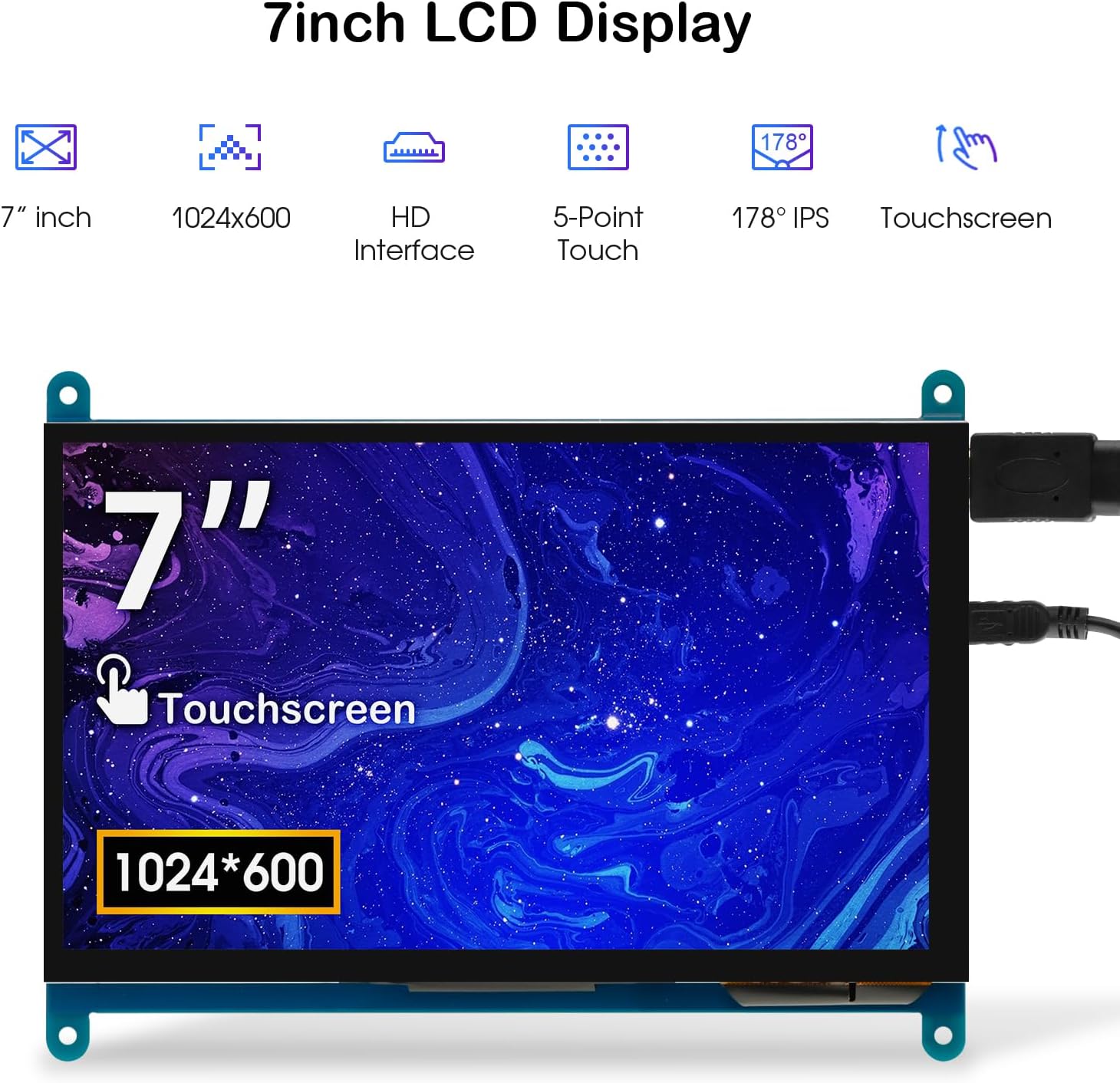
Image: The 7-inch touchscreen connected to a Raspberry Pi board, displaying a graphical user interface.
3.3 Connecting to Windows PC/Laptop
For Windows systems, the monitor functions as a plug-and-play display and touchscreen.
- Connect the HD cable from the monitor's Standard HD Port to an HDMI port on your PC or laptop.
- Connect the Micro USB cable from the monitor's Micro USB Port to a USB-A port on your PC or laptop. This provides power and enables touch functionality.
- Ensure the backlight switch is 'On'.
- Your Windows system should automatically detect the display and touchscreen. No additional drivers are typically required for Windows 7/8/10/11 for basic display and 5-point touch.

Image: The 7-inch touchscreen connected to a laptop, demonstrating seamless connectivity with various operating systems including Windows.
4. Ntuziaka ọrụ
4.1 Mmetụ Aka
The monitor supports 5-point capacitive touch, allowing for various gestures.
- Kpatụ: Single touch for selection or activation.
- Pịa: Sustained touch for context menus or drag operations.
- Mbugharị/Ọpụpụ: Pinch gestures with two fingers.
- Mouse Click: A single tap typically registers as a left-click.
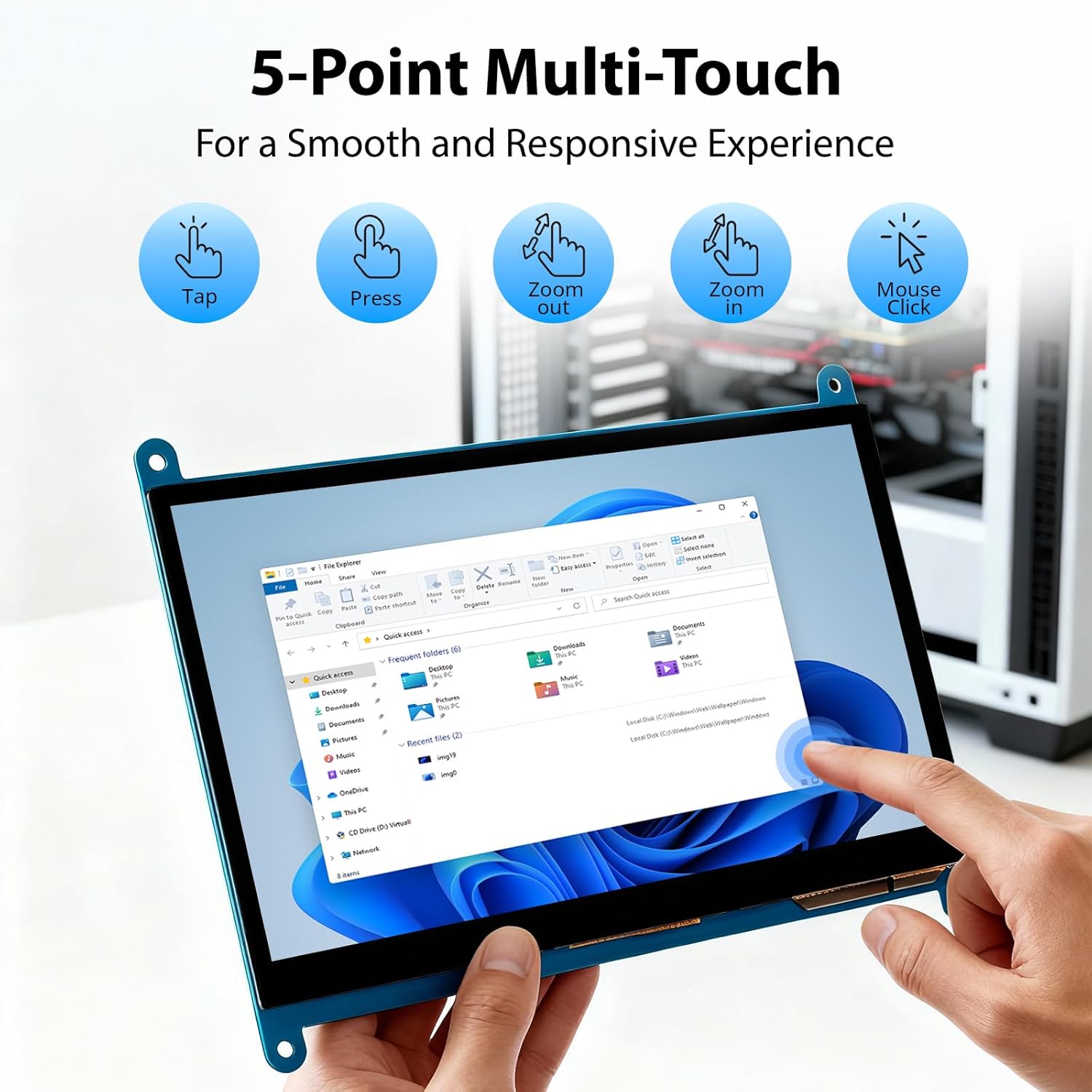
Image: Visual guide to the 5-point multi-touch capabilities of the screen, showing common gestures.
Ụdị ngosi 4.2
When connected to a computer, the monitor can operate in several display modes:
- Ụdị oyiri: The monitor mirrors the content of your primary display.
- Gbatịkwuo ọnọdụ: The monitor acts as an extension of your primary display, providing additional screen space.
- Second Screen Mode: The monitor functions as the sole display, with the primary display turned off.
These modes can typically be configured through your operating system's display settings.

Image: Illustrations demonstrating the three display modes: Duplicate, Extend, and Second Screen, showing how the monitor can be used with a laptop.
Njikwa ọkụ azụ 4.3
The monitor features a physical switch to control the backlight. This allows you to turn the display illumination on or off without disconnecting power. Note that there is no granular brightness control; it is an on/off function only.
Video: This video demonstrates the backlight control switch on the ELECROW 7 Inch Touchscreen, showing how to turn the display illumination on and off.
5. Nlekọta
Ndozi nke ọma na-eme ka ogologo ndụ na arụmọrụ kacha mma nke nyocha gị.
- Na-ehicha ihuenyo: Jiri akwa dị nro na-enweghị ntụpọ dampened with water or a screen-cleaning solution. Avoid harsh chemicals or abrasive materials that could damage the screen surface.
- General Nlekọta: Keep the monitor in a clean, dry environment. Avoid exposing it to extreme temperatures, direct sunlight, or high humidity.
- Ijikwa: Handle the monitor by its edges. Avoid applying excessive pressure to the screen.
6. Nchọpụta nsogbu
Ọ bụrụ na ị hụ nsogbu na ihe nlele gị, lee nsogbu na ngwọta ndị a na-ahụkarị.
| Nsogbu | Ihe nwere ike ime | Ngwọta |
|---|---|---|
| Enweghị ngosi/ihuenyo ojii |
|
|
| Ihuenyo mmetụ anaghị aza |
|
|
| Display resolution incorrect |
|
|
| Enweghị njikwa nchapụta | The monitor only has an on/off switch for the backlight, not adjustable brightness. | This is expected behavior. The monitor does not support adjustable brightness. |
7. Nkọwapụta
Detailed technical specifications for the ELECROW 7 Inch Touchscreen Monitor.
| Njirimara | Nkọwa |
|---|---|
| Ụdị | ELECROW |
| Aha Nlereanya | RC070 |
| Nha ihuenyo | 7 sentimita asatọ |
| Ngosipụta kachasị | 1024 x600 |
| Mkpebi obodo | 1024x600 |
| Ụdị ngosi | LCD |
| Ngosipụta teknụzụ | IPS |
| Akụkụ akụkụ | 1.71:1 |
| Ọnụego ume ọhụrụ | 60 Hz |
| Oge nzaghachi | 8 nkeji |
| Ọnụọgụ ọdịiche | 800:1 |
| Icha ọkụ | 300 lm |
| Viewna n'akuku | 170 ogo |
| Nkọwa ihu ihu ihuenyo | kenkowaputa |
| Teknụzụ Njikọta | HDMI |
| Njikọta ngwaike | HDMI, USB |
| Ọnụọgụ niile nke ọdụ ụgbọ mmiri HDMI | 1 |
| Mgbakọta ọdụ ụgbọ mmiri USB | 2 (Micro USB for power/touch, USB-A for power/touch) |
| Oriri ike | 12.5 Watt |
| Voltage | 5 volts |
| Akụkụ ihe (D x W x H) | 0.3"D x 6.1"W x 4.8"H |
| Ibu Ibu | 7.36 ounces |
| Ngwa dakọtara | Raspberry Pi, BB Black, Banana Pi, Jetson Nano, Computers, Laptops, Gaming Consoles |
8. Akwụkwọ ikike na nkwado
Your ELECROW 7 Inch Touchscreen Monitor comes with a manufacturer's warranty.
- Ụdị akwụkwọ ikike: Akwụkwọ ikike nke Onye nrụpụta afọ 1
- Nkọwa akwụkwọ ikike: Onye nrụpụta afọ 1
For technical support or warranty claims, please contact ELECROW customer service through their official websaịtị ma ọ bụ ikpo okwu ebe a zụrụ ngwaahịa ahụ.